


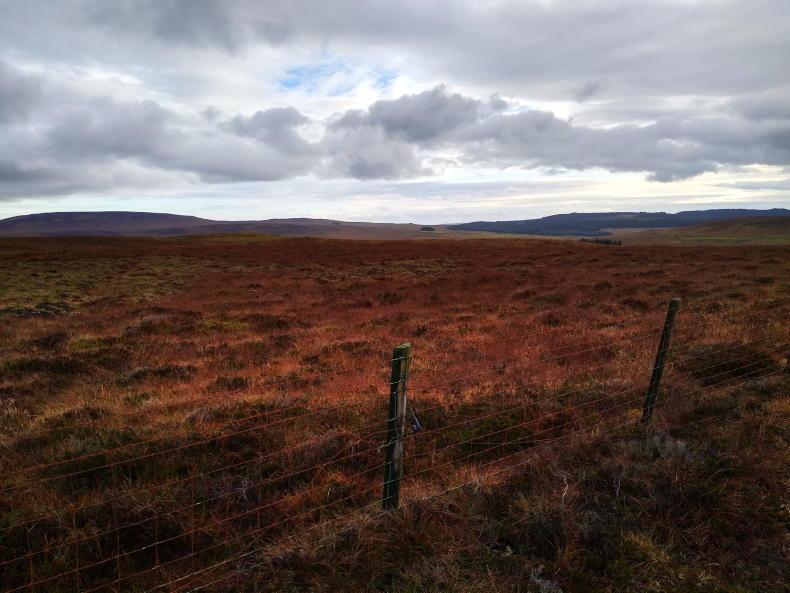
The level of carbon emitted by upland peatlands could be grossly overestimated, based on initial findings from research carried out on the CAFRE hill farm by Ulster University.
The research, led by Professor Phil Jordan and presented by Dr Sanjeev Dasari at Tuesday’s CAFRE and Teagasc joint Uplands Symposium, shows that drained peatland on the hill farm sequestered an average of 2.53t CO2 eq/ha/year.
This is in sharp contrast to data from the UK Peatland Inventory, which lists drained modified bog – grass/heather peatlands – as emitters of approximately 3.32t CO2 eq/ha/yr.
The carbon sequestration figures recorded on the CAFRE hill farm Creeve Moor site are also much higher than the inventory emission figure of 0.36 CO2 eq/ha/yr for modified rewetted bog and is also better than the 1.09t CO2 eq/ha/yr sequestration recorded for intact peatland in Glencar, Co Kerry, as detailed in Table 1.
The driver of the unexpected sequestration figure is the amount of CO2 directly sequestered. There is still carbon emitted from dissolved carbon (DOC) in waters and from carbon lost via soil erosion (POC) along with significant quantities of methane being emitted.
Sanjeev told the large attendance of researchers, farmers and industry stakeholders that the findings have created numerous questions, which have led to the research team putting in additional measurements to disprove their findings.
However, thus far the data has held robust, with load algorithms and additional testing delivering the same results.
Other questions include how representative the data is likely to be to other peatlands, whether or not the figures can be used as a proxy for wider metrology and what does the data mean for net zero restoration techniques and targets.
Industry significance
The findings have potentially big consequences for Northern Ireland agriculture. Sanjeev outlined that 20% of Northern Ireland comprises of peatland, of which 86% is classified as being in a degraded state.
Upland peat areas make up approximately 30% of the total peatland areas.
There are big targets on the table to restore 150,000ha of degraded peatland for 2050 net zero targets with restoration measures also set to include ‘other service improvements’.
As such, all eyes will remain on the findings, with calls at the event for the research to receive the required support to deliver robust findings that can influence policy.




SHARING OPTIONS