Irish apple production is going through a renaissance – and with the right methodology, our apples could be the envy of the world.
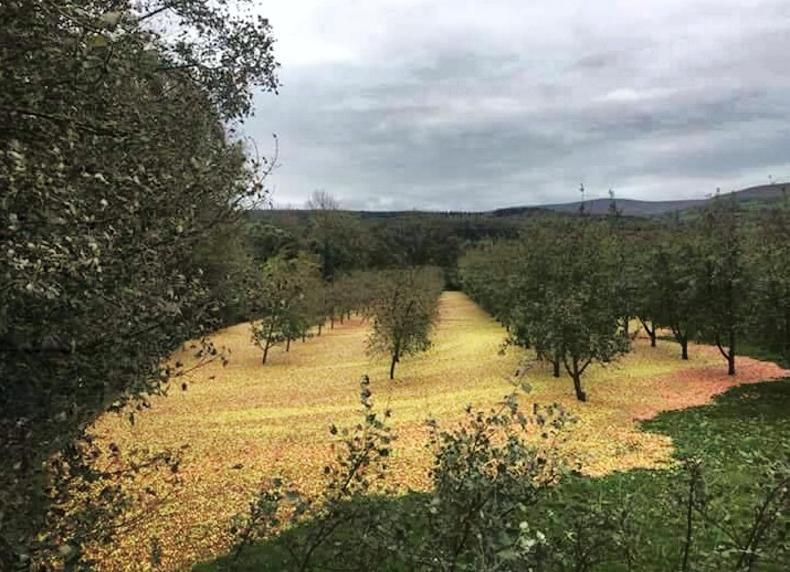
If you have an apple tree or two growing in your yard, did you enjoy a bumper crop this year? By all accounts, it has been an excellent harvest season.
Despite this, and as we head into the winter months – a time when apples were, traditionally, among the only fresh fruit available to us (thanks to cold storage) – there will still be a severe lack of Irish apples on our supermarket shelves.
According to Dr Alberto Ramos Luz, who is fruit research officer at Teagasc Oak Park in Co Carlow, we currently import over 90% of the apples we
consume. He and his research team are hopeful they can change this figure in the future.
Three years ago, they planted their 1ha research orchard and are currently growing, harvesting and testing over 50 different apple varieties.
Growing apples
“We want to see how these varieties grow in Ireland, but we also want to understand what the Irish consumer wants in an apple,” he explains. “We are looking at the overall quality of the fruit: its size, sugar content, acidity, colour and flesh firmness.”
Originally from Brazil, Alberto has been working with apples since 2006. Brazil is one of the world’s largest apple producers. His parents moved to the country’s main apple growing region in the south to work in the industry, and he has been involved ever since.
“In Brazil [the apple sector] is a big deal,” he says. “There are [approximately] 34,000ha of apple orchards. However, they only grow two or three different varieties [Fuji, Gala and a bit of Pink Lady]. When I first came to Ireland, I was exposed to much more diversity – it’s still a learning process for me every year.
“[In Brazil], I was working to improve efficiency and fruit quality, but we never worked with different apples because the consumer wanted Galas and Fujis. What we are trying to do here is grow different types of apples to see which ones Irish consumers will accept.
“We don’t have much baseline information around consumer attitudes; we just know that 60-70% of the apples consumed here are Pink Ladies. But is that because the consumer likes Pink Ladies, or because they are consistent?”
Alberto believes Ireland could be a leader in premium apple production. He and his team are experimenting in growing early to mid-ripening varieties of apple, which could extend the harvest season from August to the end of October. They are also looking at disease-resistant varieties and those which are ideal for longer storage times, to further extend availability. Ultimately, they want to create a resilient apple-growing sector and create a “best practise” scenario for Irish growers.
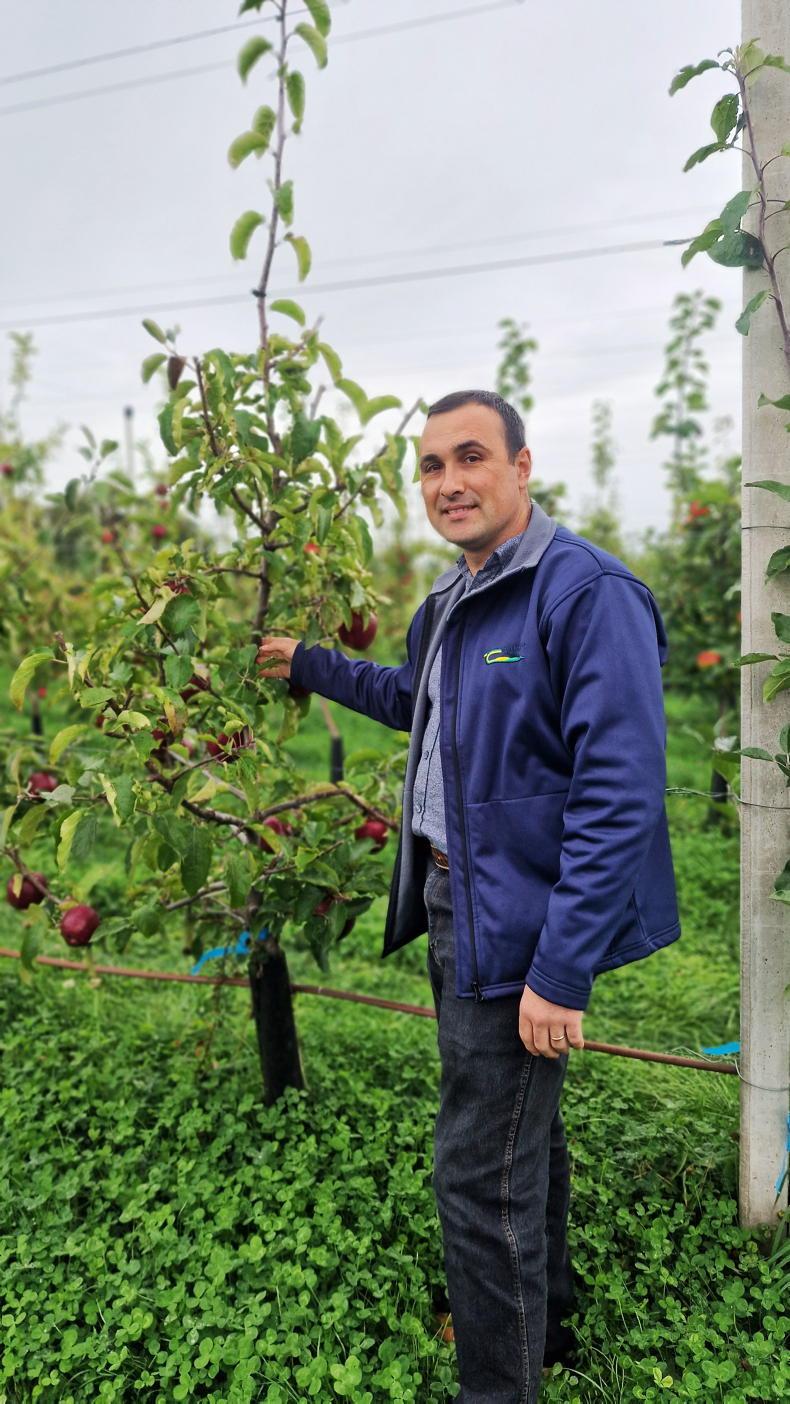
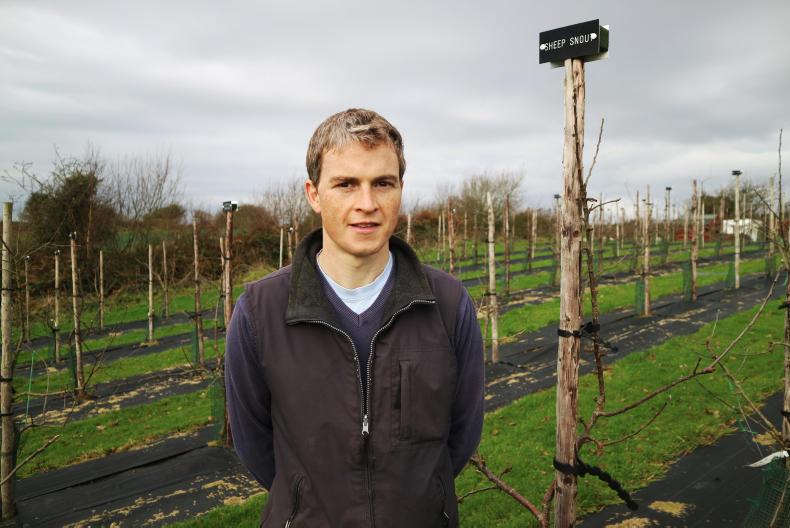
Dr Alberto Ramos Luz is originally from Brazil, one of the largest apple producing countries in the world. \ Janine Kennedy
Taste test
Irish Country Living recently visited Teagasc Oak Park to see the orchard first-hand. Alberto had four apples ready and waiting to be tasted as we entered the lab.
One was the aforementioned Pink Lady variety, which is grown in locations throughout the world (including Italy, Chile, South Africa and New Zealand).
The other three were grown on-site and harvested the day before: Ladina (a dessert apple developed in Switzerland in the early 2000s), Jonagold Robijn (a naturally occurring clone of the Jonagold apple developed in the Netherlands in 2003) and Freya (a disease-resistant variety developed at Wageningen University in the Netherlands). These apples were at peak freshness, though the varieties wouldn’t be as easily recognised as the Pink Lady.
The apple team at Oak Park only work with eating apples and are specifically looking for apples which could rival imported eating varieties. Of the three Irish-grown varieties we tried, all were juicy with a firm, crunchy texture, and all were delicious, with the Jonagold Robijn and its complex flavour profile being a particular favourite.
Prior to tasting these apples, we – like many consumers – mistakenly thought that no Irish apple could rival a Pink Lady or Gala for overall eating experience. We were wrong. Alberto says it has long been assumed that Irish apples could never beat warmer climate rivals for sweetness, flavour or yield.
With ongoing support from Teagasc, the Department of Agriculture, Food and the Marine and Bord Bia, their work is changing the hearts and minds of many would-be sceptics.
“If the product isn’t good, people aren’t going to buy it,” he says. “It took a while to get the right investment in Irish apples, and we had challenges along the way; partly because many still don’t believe it’s possible to grow great quality apples here.”
Teagasc largely exists to help Irish farmers apply best practise to their farming enterprises, and to conduct research to ensure said practises are suited to Irish conditions. There are very few places in the world that are like Ireland, in size or climate. When it comes to apple horticulture – there are modern methods being used elsewhere in the world, but how would they work in Ireland?
We could apply the same methodology but end up with different results, or varying degrees of success. Adjustments likely have to be made. In the field, this is what Alberto and his team are working to accomplish.
“A lot of growers go abroad to get advice, and it doesn’t always work,” Alberto says. “In Ireland, we have between 40 and 50 apple growers, though really, we have around 15 who are growing on a large scale. Most grow Bramleys, some have cider apples and others have eating apples like Elstars, Galas and Sisireds.
“The market is there; people want to be able to buy Irish apples, and the quality of our existing eating apples is quite good, but many Irish apples are being grown in older systems and yields are not as high as we could achieve.”
In terms of quality, apples are classed in three different ways: extra, class one and class two. Extra and class one are the largest earners. Alberto wants Irish growers to adopt modern growing methods to increase yield, quality and overall profitability.
However, in order to modernise, there will need to be significant investments made to on-farm infrastructure, the creation of processing and grading facilities and marketing campaigns to get Irish consumers on board.
“There are different ways to grow to achieve 80-90% of class one and extra apples,” he says. “We can also increase the yield to make harvests more profitable and then consumers would also have access to higher quality product. We are looking at how much a tree can yield without compromising quality or flavour.
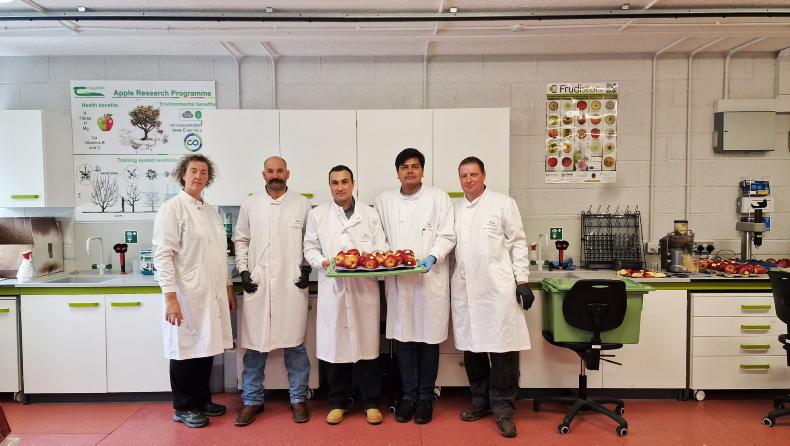
The Irish Apple research team at the lab in Teagasc Oak Park, from left to right; Rachel Keirse, Jean do Prado, Alberto Ramos Luz, Ahmad Hassan and Philip McLoughlin.
“We are not reinventing the wheel, but we are testing everything possible to adapt for the Irish context – even down to things like planting density and how far each row sits from one another. The aim is to get a good balance. You might achieve good growth, but low productivity in terms of fruit.
“This is long-term research; it will take another five years. But, with climate change, I think Ireland is only going to become a better place to grow apples.
“We don’t have extremes in temperature, where if you look to apple-growing regions in Spain or Italy, they are facing really hot summers and their winters are getting warmer. The trees need the cold in the winter to get a good bud burst in the spring and start the season off well,” he says.
Irish consumers
Aside from their research on-site, Alberto and his team will be looking to engage with Irish consumers over the coming year. Alberto’s colleague, Jean do Prado, was recently at the National Ploughing Championships where he spoke with attendees about the work they are doing in Oak Park.
He is currently working on sensory profiling the apples, in collaboration with colleagues in Teagasc Ashtown and the Atlantic Technological University.
Next year they will conduct sample testing with consumers to see which apples we Irish really like best, and Irish Country Living will follow the story.
In Short
Research at Teagasc Oak Park is looking at developing the Irish apple sector for eating apples.
Their research is not just in growing premium grade eating apples for retail; they are also looking into Irish consumer attitudes to apples.
We currently import over 90% of the apples we eat.
In Ireland, 60-70% of apples consumed are the Pink Lady variety, which are grown in countries like Italy, Chile and South Africa.
Developing the Irish apple sector will require significant investment among all stakeholders, including Irish growers.
Irish apple production is going through a renaissance – and with the right methodology, our apples could be the envy of the world.
If you have an apple tree or two growing in your yard, did you enjoy a bumper crop this year? By all accounts, it has been an excellent harvest season.
Despite this, and as we head into the winter months – a time when apples were, traditionally, among the only fresh fruit available to us (thanks to cold storage) – there will still be a severe lack of Irish apples on our supermarket shelves.
According to Dr Alberto Ramos Luz, who is fruit research officer at Teagasc Oak Park in Co Carlow, we currently import over 90% of the apples we
consume. He and his research team are hopeful they can change this figure in the future.
Three years ago, they planted their 1ha research orchard and are currently growing, harvesting and testing over 50 different apple varieties.
Growing apples
“We want to see how these varieties grow in Ireland, but we also want to understand what the Irish consumer wants in an apple,” he explains. “We are looking at the overall quality of the fruit: its size, sugar content, acidity, colour and flesh firmness.”
Originally from Brazil, Alberto has been working with apples since 2006. Brazil is one of the world’s largest apple producers. His parents moved to the country’s main apple growing region in the south to work in the industry, and he has been involved ever since.
“In Brazil [the apple sector] is a big deal,” he says. “There are [approximately] 34,000ha of apple orchards. However, they only grow two or three different varieties [Fuji, Gala and a bit of Pink Lady]. When I first came to Ireland, I was exposed to much more diversity – it’s still a learning process for me every year.
“[In Brazil], I was working to improve efficiency and fruit quality, but we never worked with different apples because the consumer wanted Galas and Fujis. What we are trying to do here is grow different types of apples to see which ones Irish consumers will accept.
“We don’t have much baseline information around consumer attitudes; we just know that 60-70% of the apples consumed here are Pink Ladies. But is that because the consumer likes Pink Ladies, or because they are consistent?”
Alberto believes Ireland could be a leader in premium apple production. He and his team are experimenting in growing early to mid-ripening varieties of apple, which could extend the harvest season from August to the end of October. They are also looking at disease-resistant varieties and those which are ideal for longer storage times, to further extend availability. Ultimately, they want to create a resilient apple-growing sector and create a “best practise” scenario for Irish growers.
Dr Alberto Ramos Luz is originally from Brazil, one of the largest apple producing countries in the world. \ Janine Kennedy
Taste test
Irish Country Living recently visited Teagasc Oak Park to see the orchard first-hand. Alberto had four apples ready and waiting to be tasted as we entered the lab.
One was the aforementioned Pink Lady variety, which is grown in locations throughout the world (including Italy, Chile, South Africa and New Zealand).
The other three were grown on-site and harvested the day before: Ladina (a dessert apple developed in Switzerland in the early 2000s), Jonagold Robijn (a naturally occurring clone of the Jonagold apple developed in the Netherlands in 2003) and Freya (a disease-resistant variety developed at Wageningen University in the Netherlands). These apples were at peak freshness, though the varieties wouldn’t be as easily recognised as the Pink Lady.
The apple team at Oak Park only work with eating apples and are specifically looking for apples which could rival imported eating varieties. Of the three Irish-grown varieties we tried, all were juicy with a firm, crunchy texture, and all were delicious, with the Jonagold Robijn and its complex flavour profile being a particular favourite.
Prior to tasting these apples, we – like many consumers – mistakenly thought that no Irish apple could rival a Pink Lady or Gala for overall eating experience. We were wrong. Alberto says it has long been assumed that Irish apples could never beat warmer climate rivals for sweetness, flavour or yield.
With ongoing support from Teagasc, the Department of Agriculture, Food and the Marine and Bord Bia, their work is changing the hearts and minds of many would-be sceptics.
“If the product isn’t good, people aren’t going to buy it,” he says. “It took a while to get the right investment in Irish apples, and we had challenges along the way; partly because many still don’t believe it’s possible to grow great quality apples here.”
Teagasc largely exists to help Irish farmers apply best practise to their farming enterprises, and to conduct research to ensure said practises are suited to Irish conditions. There are very few places in the world that are like Ireland, in size or climate. When it comes to apple horticulture – there are modern methods being used elsewhere in the world, but how would they work in Ireland?
We could apply the same methodology but end up with different results, or varying degrees of success. Adjustments likely have to be made. In the field, this is what Alberto and his team are working to accomplish.
“A lot of growers go abroad to get advice, and it doesn’t always work,” Alberto says. “In Ireland, we have between 40 and 50 apple growers, though really, we have around 15 who are growing on a large scale. Most grow Bramleys, some have cider apples and others have eating apples like Elstars, Galas and Sisireds.
“The market is there; people want to be able to buy Irish apples, and the quality of our existing eating apples is quite good, but many Irish apples are being grown in older systems and yields are not as high as we could achieve.”
In terms of quality, apples are classed in three different ways: extra, class one and class two. Extra and class one are the largest earners. Alberto wants Irish growers to adopt modern growing methods to increase yield, quality and overall profitability.
However, in order to modernise, there will need to be significant investments made to on-farm infrastructure, the creation of processing and grading facilities and marketing campaigns to get Irish consumers on board.
“There are different ways to grow to achieve 80-90% of class one and extra apples,” he says. “We can also increase the yield to make harvests more profitable and then consumers would also have access to higher quality product. We are looking at how much a tree can yield without compromising quality or flavour.
The Irish Apple research team at the lab in Teagasc Oak Park, from left to right; Rachel Keirse, Jean do Prado, Alberto Ramos Luz, Ahmad Hassan and Philip McLoughlin.
“We are not reinventing the wheel, but we are testing everything possible to adapt for the Irish context – even down to things like planting density and how far each row sits from one another. The aim is to get a good balance. You might achieve good growth, but low productivity in terms of fruit.
“This is long-term research; it will take another five years. But, with climate change, I think Ireland is only going to become a better place to grow apples.
“We don’t have extremes in temperature, where if you look to apple-growing regions in Spain or Italy, they are facing really hot summers and their winters are getting warmer. The trees need the cold in the winter to get a good bud burst in the spring and start the season off well,” he says.
Irish consumers
Aside from their research on-site, Alberto and his team will be looking to engage with Irish consumers over the coming year. Alberto’s colleague, Jean do Prado, was recently at the National Ploughing Championships where he spoke with attendees about the work they are doing in Oak Park.
He is currently working on sensory profiling the apples, in collaboration with colleagues in Teagasc Ashtown and the Atlantic Technological University.
Next year they will conduct sample testing with consumers to see which apples we Irish really like best, and Irish Country Living will follow the story.
In Short
Research at Teagasc Oak Park is looking at developing the Irish apple sector for eating apples.
Their research is not just in growing premium grade eating apples for retail; they are also looking into Irish consumer attitudes to apples.
We currently import over 90% of the apples we eat.
In Ireland, 60-70% of apples consumed are the Pink Lady variety, which are grown in countries like Italy, Chile and South Africa.
Developing the Irish apple sector will require significant investment among all stakeholders, including Irish growers.







SHARING OPTIONS