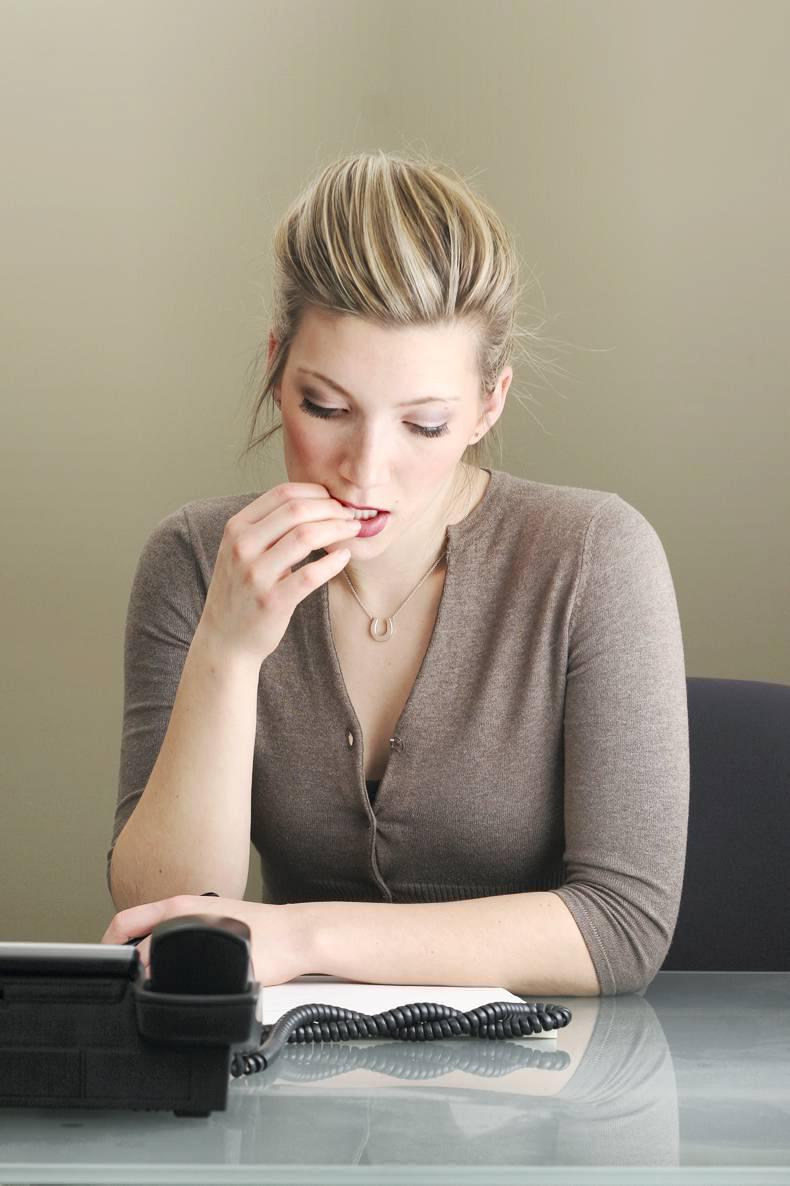
Despite not wanting to do it, you continue to shred your fingernails or bite them back to the quick.
Nail biting (or onychophagia) is up there with thumb-sucking, nose-picking, pen-chewing, hair-twisting and picking at skin as habits that some people indulge in when the pressure is on or when they are simply bored.
Statistics show that 30% of children aged between seven and 10 bite their nails and one third of college students also do it. Most people stop by the age of thirty, however.
So what’s the attraction?
“There are lots of different reasons why people bite their nails. Stress is one reason, boredom is another,” says pharmacist Bernard Duggan of the Irish Pharmacists Union.
“It can also be a symptom of a psychological condition in some people, like obsessive compulsive disorder.
“It can be a coping mechanism too, a way of relieving anxiety and can become a habit over time. It becomes their default response for dealing with stress or anxiety.”
WHY SHOULD
YOU STOP?
If you bite your nails regularly you can make the area around your nails bleed and become sore, says Bernard.
“They can bleed and become infected and you’ll need antibiotics then. And every time you bite your nails you are transferring bacteria and viruses from your nails and fingers to your face and mouth, and that can lead to issues there as well. It can also harm your teeth as nail can be quite brittle and hard.
“The practise of nail biting also looks unsightly, which may lead to anxiety and stress if people comment on it, so it can be important to break the habit from a social perspective as well.”
TIPS TO STOP BITING YOUR NAILS
Here are his tips for giving up:
• Prevent access to nails – cover the nails with adhesive bandages or wear gloves. These act as physical barriers where you can’t get at the nails, therefore, you can’t bite them and this gives them a chance to grow back. • Keep nails short – that way there is less to bite, so cut them two or three times a week.• Limit what you bite – some people may decide to cover all nails on one hand, for instance, as it might be too much initially to stop biting nails on both hands.• Acquire stress management skills – if you are using nail biting as a coping mechanism, you might need to look into the reasons for that as well. Why exactly are you biting your nails? Alternative techniques of managing stress, like deep breathing or using a stress ball, may need to be considered so that you don’t bite your nails. Another tip is to put an elastic band around your wrist and every time you go to bite your nails snap it and the physical pain of that will stop you doing it. A GP referral might be needed too, to advise on the correct course of treatment for anxiety. • Use nibble inhibitors to put you off – nail biting inhibitors are products like nail varnishes or paints that contain a foul-tasting chemical. This puts you off biting the nails and if you bite once, you are unlikely to bite again. There isn’t a huge range of products out there, but the main one is Stop ‘n’ Grow. • Talk to your community pharmacist about help – your community pharmacist is a good first port of call when you need help to stop biting your nails.Emotional link
Dr Eddie Murphy, clinical psychologist with Operation Transformation and author of Becoming Your Real Self, bites his nails on occasion.
“Yes, I do bite them and the challenge is to break the habit. I find that I do it more at some times than others. It can be an expression of stress and most nail-biters struggle with it. I use a product called Nail the Habit, a dip-and-twist product and find it helpful. My nails are short at the moment. Nail biting draws up negative emotions – you feel that people are looking at you and may be thinking less of you because of what you’re doing.”
Dr Eddie’s advice is to identify when you nail-bite.
“Many people do it if they are watching TV, sometimes through boredom. For me it’s often stress – when I have too many tasks on hand. The nail biting while bored is engaging in the habit without conscious awareness that you’re doing it.”
DR EDDIE’S TIPS
Trying to stop is about habit reversal training and what’s called behaviour chaining, he says.
“You have to disrupt the chain of behaviour. Keeping a diary of when you do it most is useful, for example. Then you can decide on what you’ll do to avoid biting your nails.
“Wearing gloves at the time that you are likely to bite might be a solution. Some people make a decision to only bite one fingernail. When I find that I’m biting my nails I use the dip product for a few days again. It makes you realise that you’re biting your nails and helps put you off doing it.”
CONSEQUENCES
Nail biting may cause your teeth to shift out of their proper position, become misshapen, wear down early or become weak.
Nail biting can interfere with proper dental occlusion, ie the manner in which your upper and lower teeth come together when you close your mouth.
OTHER TIPS
• Ask yourself, when don’t I bite my nails?• Knitting or playing a musical instrument can help keep your fingers busy and away from your mouth.• Chew gum. • Stick on artificial nails to prevent access.• Think how attractive your nails will look when they are longer – take photos of your nails as they recover to log your progress.RESEARCH
A University of Montreal study, led by Dr Kieron O’Connor, showed that nail-biters could be doing so because of perfectionist personalities.
Participants in the study who were perpetual nail-biters and put in experimental situations at the research centre aimed at making them experience stress, relaxation, frustration and boredom, claimed that they felt compelled to bite on their nails when they were rushed through a task (they wanted it to be perfect).
They also bit their nails when they were left alone in a room for six minutes or more (boredom).
A comprehensive 2011 study published in the Iranian Journal of Medical Sciences stated that nail biting is not an isolated symptom. It is a common but unresolved problem in psychiatry, psychology, medicine and dentistry.
Treatment is not easy, however. Punishment is not effective and may lead to an increase rather than a decrease in behaviour.
Some research suggests that it could be partly learned behaviour, with a child seeing a parent or sibling doing it and copying.
Like to help with asthma research?
If so, then you may want to get involved with the EU-driven Asthma Patient Forum’s new myAirCoach project. It involves members of asthma patient organisations testing out a mobile app that it is hoped will become an essential tool for improvement symptom management for those with asthma. The app monitors your asthma, takes measurements of your environment and gives you personalised advice based on your day-to-day activities and symptoms.
To participate you must be over 18, have asthma and be available for approximately four hours a month. See www.asthma.ie and www.myaircoach.eu
Hand, foot and mouth disease
in creches
Irish Country Living has had a few reports of hand, foot and mouth disease outbreaks in creches. Should parents worry? The first concern is whether or not it has anything to do with foot and mouth disease which affects animals. The answer is no, says the HSE.
“The two infections are unrelated and you cannot catch hand, foot and mouth disease from animals.”
Hand, foot and mouth disease is a common, mild illness caused by a type of virus called an enterovirus. The disease gets its name from the non-itchy rash that develops on the palms of your hands and soles of your feet. It can also cause ulcers in your mouth and make you feel generally unwell, but some people have no symptoms. It is very contagious and most common among children under 10. Adults who get it usually experience milder symptoms. Treatment is usually not needed as the body’s immune system clears the virus and symptoms go away after seven to 10 days. To avoid catching it:

• Wash hands often with soap and water for 20 seconds. • Avoid hugging.• Avoid sharing utensils with anyone infected. • Disinfect frequently touched surfaces. • Avoid touching eyes, nose and mouth with unwashed hands.
Despite not wanting to do it, you continue to shred your fingernails or bite them back to the quick.
Nail biting (or onychophagia) is up there with thumb-sucking, nose-picking, pen-chewing, hair-twisting and picking at skin as habits that some people indulge in when the pressure is on or when they are simply bored.
Statistics show that 30% of children aged between seven and 10 bite their nails and one third of college students also do it. Most people stop by the age of thirty, however.
So what’s the attraction?
“There are lots of different reasons why people bite their nails. Stress is one reason, boredom is another,” says pharmacist Bernard Duggan of the Irish Pharmacists Union.
“It can also be a symptom of a psychological condition in some people, like obsessive compulsive disorder.
“It can be a coping mechanism too, a way of relieving anxiety and can become a habit over time. It becomes their default response for dealing with stress or anxiety.”
WHY SHOULD
YOU STOP?
If you bite your nails regularly you can make the area around your nails bleed and become sore, says Bernard.
“They can bleed and become infected and you’ll need antibiotics then. And every time you bite your nails you are transferring bacteria and viruses from your nails and fingers to your face and mouth, and that can lead to issues there as well. It can also harm your teeth as nail can be quite brittle and hard.
“The practise of nail biting also looks unsightly, which may lead to anxiety and stress if people comment on it, so it can be important to break the habit from a social perspective as well.”
TIPS TO STOP BITING YOUR NAILS
Here are his tips for giving up:
• Prevent access to nails – cover the nails with adhesive bandages or wear gloves. These act as physical barriers where you can’t get at the nails, therefore, you can’t bite them and this gives them a chance to grow back. • Keep nails short – that way there is less to bite, so cut them two or three times a week.• Limit what you bite – some people may decide to cover all nails on one hand, for instance, as it might be too much initially to stop biting nails on both hands.• Acquire stress management skills – if you are using nail biting as a coping mechanism, you might need to look into the reasons for that as well. Why exactly are you biting your nails? Alternative techniques of managing stress, like deep breathing or using a stress ball, may need to be considered so that you don’t bite your nails. Another tip is to put an elastic band around your wrist and every time you go to bite your nails snap it and the physical pain of that will stop you doing it. A GP referral might be needed too, to advise on the correct course of treatment for anxiety. • Use nibble inhibitors to put you off – nail biting inhibitors are products like nail varnishes or paints that contain a foul-tasting chemical. This puts you off biting the nails and if you bite once, you are unlikely to bite again. There isn’t a huge range of products out there, but the main one is Stop ‘n’ Grow. • Talk to your community pharmacist about help – your community pharmacist is a good first port of call when you need help to stop biting your nails.Emotional link
Dr Eddie Murphy, clinical psychologist with Operation Transformation and author of Becoming Your Real Self, bites his nails on occasion.
“Yes, I do bite them and the challenge is to break the habit. I find that I do it more at some times than others. It can be an expression of stress and most nail-biters struggle with it. I use a product called Nail the Habit, a dip-and-twist product and find it helpful. My nails are short at the moment. Nail biting draws up negative emotions – you feel that people are looking at you and may be thinking less of you because of what you’re doing.”
Dr Eddie’s advice is to identify when you nail-bite.
“Many people do it if they are watching TV, sometimes through boredom. For me it’s often stress – when I have too many tasks on hand. The nail biting while bored is engaging in the habit without conscious awareness that you’re doing it.”
DR EDDIE’S TIPS
Trying to stop is about habit reversal training and what’s called behaviour chaining, he says.
“You have to disrupt the chain of behaviour. Keeping a diary of when you do it most is useful, for example. Then you can decide on what you’ll do to avoid biting your nails.
“Wearing gloves at the time that you are likely to bite might be a solution. Some people make a decision to only bite one fingernail. When I find that I’m biting my nails I use the dip product for a few days again. It makes you realise that you’re biting your nails and helps put you off doing it.”
CONSEQUENCES
Nail biting may cause your teeth to shift out of their proper position, become misshapen, wear down early or become weak.
Nail biting can interfere with proper dental occlusion, ie the manner in which your upper and lower teeth come together when you close your mouth.
OTHER TIPS
• Ask yourself, when don’t I bite my nails?• Knitting or playing a musical instrument can help keep your fingers busy and away from your mouth.• Chew gum. • Stick on artificial nails to prevent access.• Think how attractive your nails will look when they are longer – take photos of your nails as they recover to log your progress.RESEARCH
A University of Montreal study, led by Dr Kieron O’Connor, showed that nail-biters could be doing so because of perfectionist personalities.
Participants in the study who were perpetual nail-biters and put in experimental situations at the research centre aimed at making them experience stress, relaxation, frustration and boredom, claimed that they felt compelled to bite on their nails when they were rushed through a task (they wanted it to be perfect).
They also bit their nails when they were left alone in a room for six minutes or more (boredom).
A comprehensive 2011 study published in the Iranian Journal of Medical Sciences stated that nail biting is not an isolated symptom. It is a common but unresolved problem in psychiatry, psychology, medicine and dentistry.
Treatment is not easy, however. Punishment is not effective and may lead to an increase rather than a decrease in behaviour.
Some research suggests that it could be partly learned behaviour, with a child seeing a parent or sibling doing it and copying.
Like to help with asthma research?
If so, then you may want to get involved with the EU-driven Asthma Patient Forum’s new myAirCoach project. It involves members of asthma patient organisations testing out a mobile app that it is hoped will become an essential tool for improvement symptom management for those with asthma. The app monitors your asthma, takes measurements of your environment and gives you personalised advice based on your day-to-day activities and symptoms.
To participate you must be over 18, have asthma and be available for approximately four hours a month. See www.asthma.ie and www.myaircoach.eu
Hand, foot and mouth disease
in creches
Irish Country Living has had a few reports of hand, foot and mouth disease outbreaks in creches. Should parents worry? The first concern is whether or not it has anything to do with foot and mouth disease which affects animals. The answer is no, says the HSE.
“The two infections are unrelated and you cannot catch hand, foot and mouth disease from animals.”
Hand, foot and mouth disease is a common, mild illness caused by a type of virus called an enterovirus. The disease gets its name from the non-itchy rash that develops on the palms of your hands and soles of your feet. It can also cause ulcers in your mouth and make you feel generally unwell, but some people have no symptoms. It is very contagious and most common among children under 10. Adults who get it usually experience milder symptoms. Treatment is usually not needed as the body’s immune system clears the virus and symptoms go away after seven to 10 days. To avoid catching it:

• Wash hands often with soap and water for 20 seconds. • Avoid hugging.• Avoid sharing utensils with anyone infected. • Disinfect frequently touched surfaces. • Avoid touching eyes, nose and mouth with unwashed hands.
SHARING OPTIONS