Agricultural contractor Philip Hughes of Hughes Agri runs a family business based in Ballinkillen, Co Carlow. The Hughes family carries out an extensive range of services from planting through to harvesting.
Hughes is one of the few contractors in the country to operate silage wagons, round balers and a self-propelled silage outfit.
Philip said: “The silage wagon is ideal. We can send it out to jobs alone, use it alongside the harvester if we are under pressure or use it as a trailer if we are stuck.”
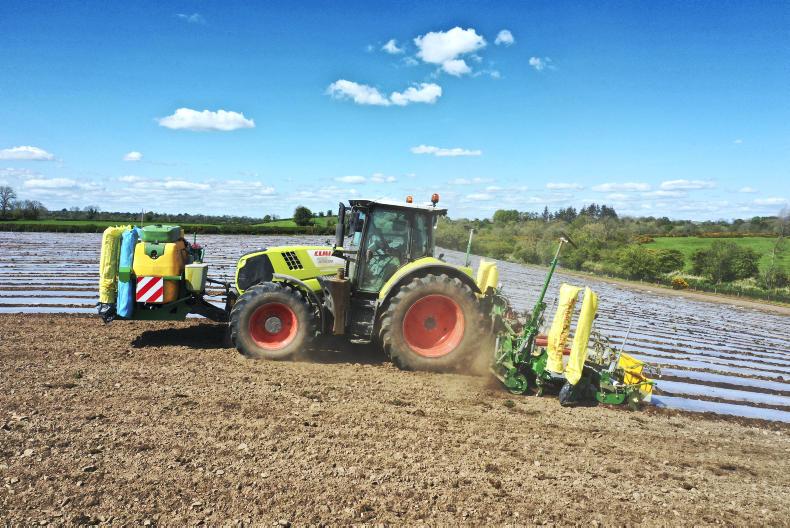
Hughes Agri plant between 500-700 acres of maize each year.
The Hughes family operates a mixed fleet of tractors consisting of Claas, John Deere and one Valtra. Philip explained how they keep at least two fresh tractors, these being the primary workhorses and within warranty. Once the warranty is up, they are replaced.
“It’s hard to keep all machines fresh but we aim to keep two new tractors, Claas 650s, and use these as the workhorses. The older John Deeres are mainly used for trailer work but everything is maintained to a high standard and in good condition.”
The drill itself rarely is an issue. It’s more often the ground conditions
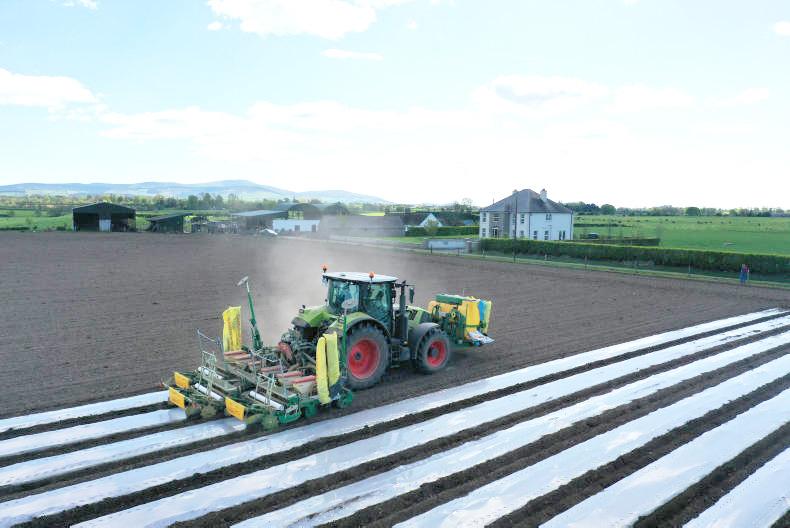
Maize accounts for a large portion of the business and they recently purchased a new Samco 7100 six-row planter. This is the second six-row machine Hughes has owned, having run a four-row machine at the start.
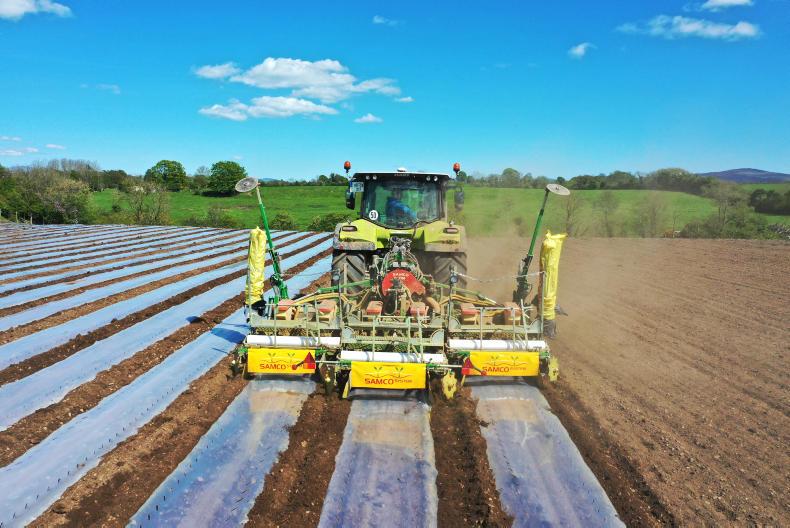
The Samco 7100 maize drill has a working width of 4.5m equivalent to six rows of maize.
Hughes Agri made the decision to upgrade the drill this year to the newer model having operated the old drill for 10 years. Philip noted that the main reason for change was down to the newer drills being more advanced, having had improvements made over the years.
“Ten years may seem old, but on average we would have planted 500 acres a year, so after 10 years the drill had only planted 5,000 acres which isn’t overly high,” said Philip.
The new 7100 drill gives the operator greater control of the machine from the cab, now having electrical control of the sprayer via its control terminal. More sensors throughout the drill monitor the planting process. These are a few of the changes to the new machine that allow it be more reliable and have an increased output when compared to the older model. A typical day would see on average 5.5 acres to 6 acres an hour planted, although ground conditions can often be the limiting factor.
“The drill itself rarely is an issue. It’s more often the ground conditions,” explained Philip. It is important to have a fine firm seedbed for planting.
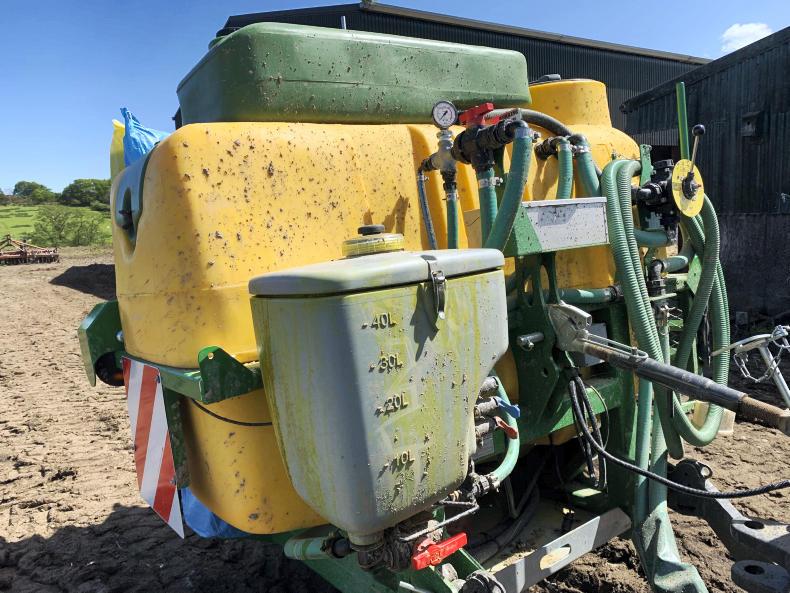
The front mounted sprayer tank has a capacity of 1200l.
When we caught up with Philip, he was planting 8200 variety seed at 40,000 seeds /acre with 100l of pre-emergence herbicide being applied per acre underneath the film. This is the first year Hughes Agri had the opportunity to use GPS and Autosteer while planting, having purchased the new Claas Arion 650 with Autosteer. This makes planting much easier, Philip noted.
Drilling started on 10 April, but more recently the lads have been planting around the clock with their new Claas Arion 650.
Two 12-hour shifts see the tractor continuously running. When the ground is suitable for planting, the opportunity cannot be missed, even if it takes means drilling around the clock to get the acres done.
“Both the tractor and drill are well kitted out with lights. We recently fitted the tractor with a light bar which was a massive improvement to visibility in the dark.”
Samco
The renowned Samco system was the brainchild of Sam Shine. The Adare, Co Limerick, man was the world’s first to develop a three-in-one machine to sow seed, spray the soil with pre-emergence herbicide and finally but most importantly lay a thin layer of degradable film over the seedbed, all in one pass.
The three-in-one planter was first invented in 1996. Since then the company has become an Irish manufacturing success story, with markets all over the globe. Samco also produces the degradable plastic as a part of the business.
The degradable films have a number of functions: pinholes allow trapped air to escape leaving the film to sit tight to the soil and retain moisture and heat within the soil to maintain an ambient environment. Finally, the pinholes weaken the film, allowing the plant to easily emerge through it. Different types of film have been developed to suit different needs and markets.
Samco now manufactures a maize storage solution called the BagPress, along with sub-soilers and other tillage equipment.
Today, two-row up to eight-row planters are available. The 7100 machine is a six-row folding model aimed at large farmers and contractor markets. The six-row machine is divided into three independent units allowing the drill to fold to a width of 3.2m.
Drilling
Starting at the front of the drill, there is a rubber roller to consolidate soil, producing a firm seed bed. Behind this rubber roller are track eradicators to prevent deeper soil compaction in the seed row. These are sprung to allow for protection from objects such as stones.
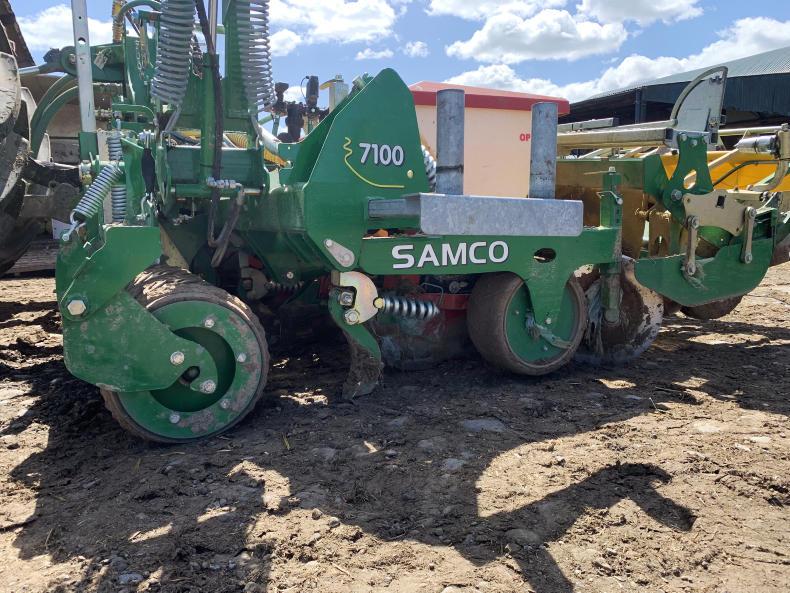
The compact 7100 drilling unit weighs in at 3,800kg.
Behind the track eradicators is the seeding unit. Six Kverneland Optima pneumatic seed units carry out the planting process. Seed is placed on the seed disc using vacuum, while two mechanical selectors can be adjusted to reduce doubling of smaller seeds on the disc and allow larger seeds to be sown without any changes to the seed unit. Each of the six seed hoppers is easily accessible using the walkways for ease of filling. Seed placement depth is adjusted manually on each drilling unit.
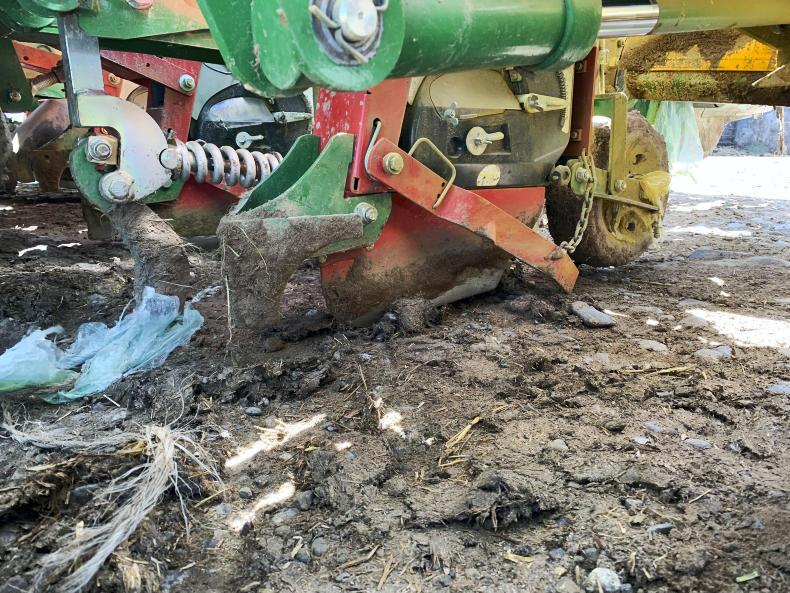
The drill is fitted with six Kverneland Optima pneumatic seed units. Seed placement depth is manually adjustable.
Philip was applying seed at a rate of 40,000 per acre. This rate information is provided on the seeder terminal along with seed rate per ha for each seeding unit, number of ha drilled per day, total number of ha planted, area per hour and the number of hours worked.
Sensors are fitted to each unit to alert the operator if a unit is empty or blocked, a must-have feature for Philip. Each film unit can be operated independently through the terminal to make use of the drill easier in angled parts of the field, while hillside adjustment is fitted as standard to provide accurate drilling on slopes.
Spraying
Once seed is placed in the ground, next it is sprayed with pre-emergence herbicide. Philip explained how this new 7100 drill is fitted with an automatic spray system controlled from the cab. This spray system takes into account the forward working speed so it can regulate and spray the correct volume per acre as programmed, (100l/acre).
Spraying is automatically triggered above speeds of 0.2km/h. Spraying automatically starts and stops when the drill is lifted at the headlands.
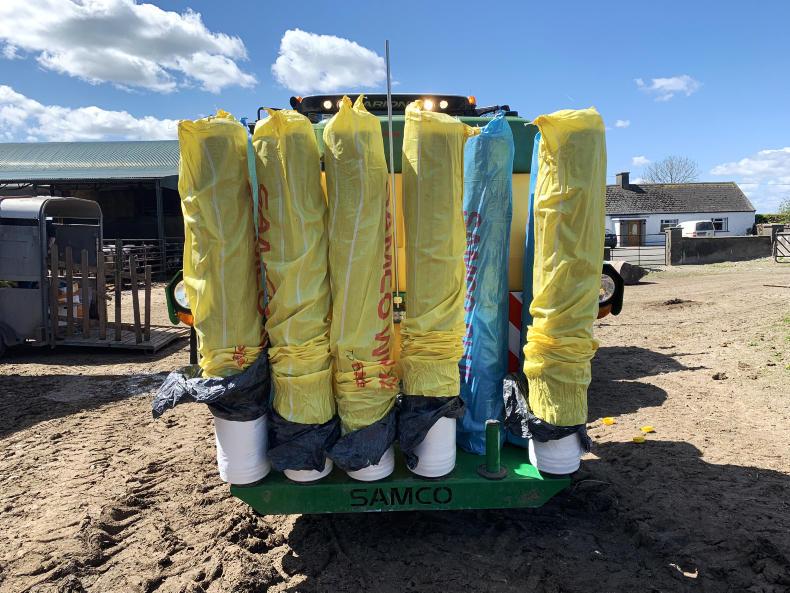
The front spray tank has a frame capable of carrying 12 rolls of film.
The Spraylight terminal in the cab has several functions to inform the operator, which Philip said is much more intuitive on the new drill when compared to his older model.
“I can easily monitor remaining tank volume from the terminal, which wasn’t available on the previous drill. I can monitor each of the nozzles to ensure they are working, litres per minute, forward speed and spray pressure.”
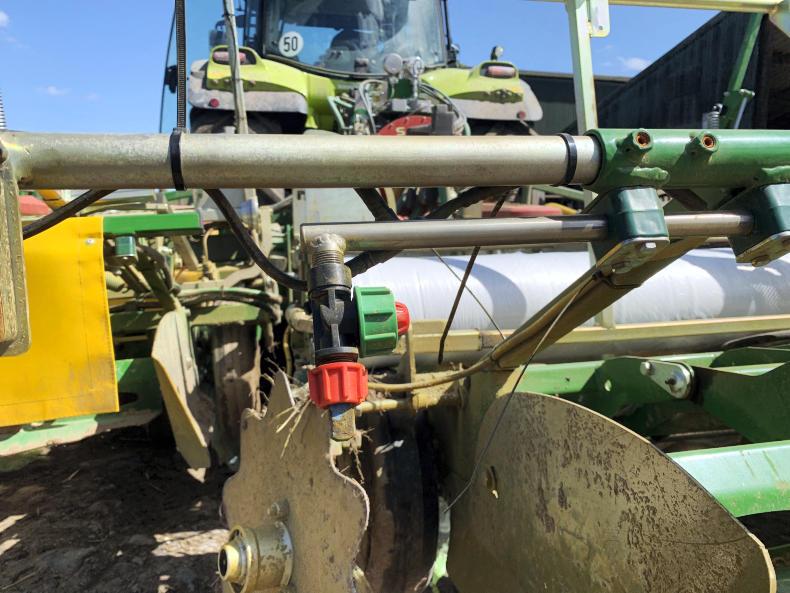
The drill sprays pre-emergence herbicide on to the seedbed before film is applied. The row of nozzles on the rear of the machine spray herbicide between rows of film after drilling.
Philip can view the sprayer’s manifold from the cab. This has six tubes, all with a rotating ball to indicate active nozzles. The ball will drop in the event of a blockage. The rear of the drill has another row of nozzles, which are directed to the outsides of each row of film. This allows the exposed soil between rows of film to be sprayed with the pre-emergence herbicide, so all ground is covered.
The front-mounted spray tank has a capacity of 1,200l, 200l rinse tank for cleaning out spray lines and a 10l tank for rinsing hands. Once full, this front tank acts as a ballast for the rear-mounted 3.8t planter, providing more grip to the front wheels.

The drill has two intuitive control terminals, one dedicated to the drill and one for controlling the sprayer.
The sprayer’s Hardi pump is PTO-driven,with pipes running underneath the tractor from the pump to the tank. All chemical mixing is carried out using the 40l induction hopper. The front tank has a bracket fitted with a road lighting kit and has the ability to carry 12 rolls of degradable film as well as bags of seed. Philip noted that while road travelling, he ensures the front tank is empty to save excessive tyre wear.
Film application
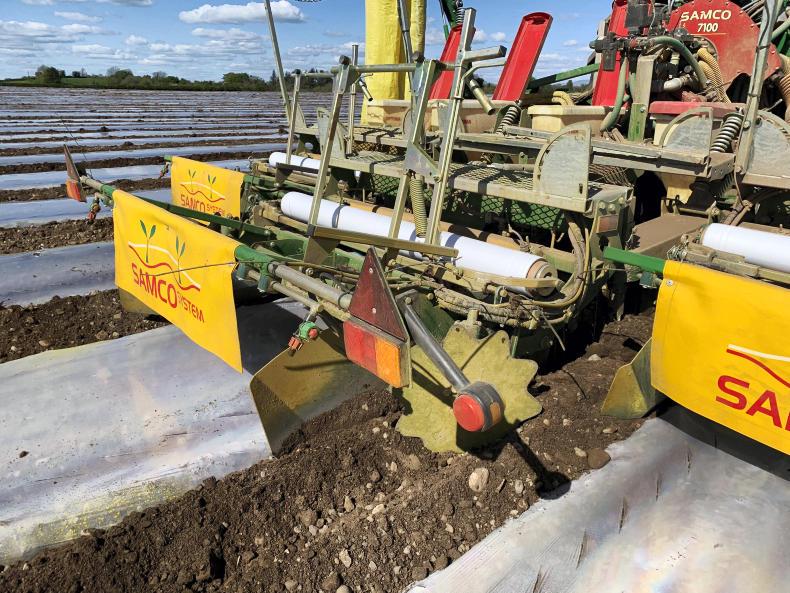
Angled discs throw soil onto each side of the film, anchoring it in place. These discs are adjustable to alter the amount of soil placed on the film.
Once the pre-emergence herbicide is spread, the 5.5 micron degradable film is applied. The three film-metering units are easily accessible. Spring-loaded roll holder units place the rolls in the correct position. Spring-tensioned wheels with rubber tracks catch each side of the film, feeding it into position, which it maintains while working. This is one aspect Samco has improved immensely over the years, Philip noted, having had very few issues of plastic becoming loose.
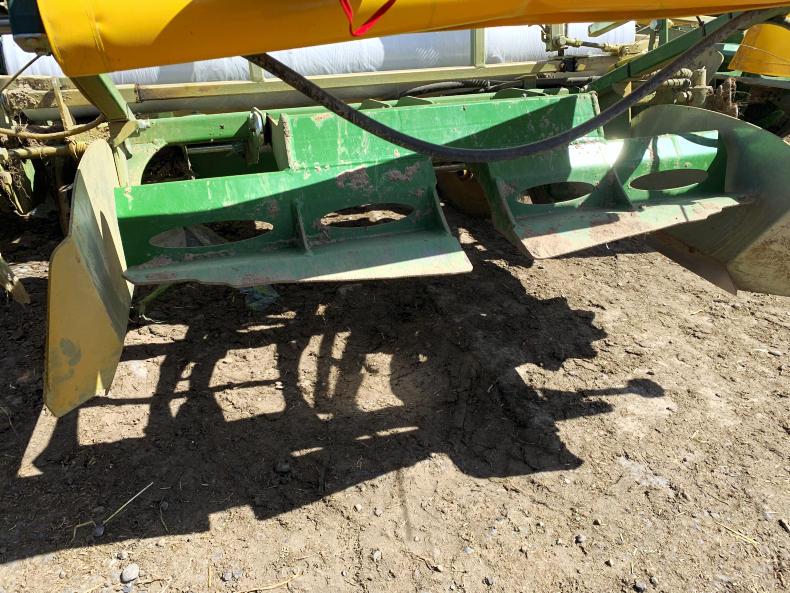
The rear of each film metering unit has a spade-like plate. This throws soil up on to the film to hold it in place.
Each side of the film metering unit has a disc. These discs are adjustable and open a channel 10cm deep in the soil. When the channel is opened the film metering unit is lowered, engaging the cut and bury plate or what’s known as the ‘spade’ covering the film at both ends of the headland to avoid wind getting under the film. Rear-mounted discs at either side cover the edge of the film, anchoring it in the soil. Philip explained that these discs are adjustable to allow more or less soil onto the film.
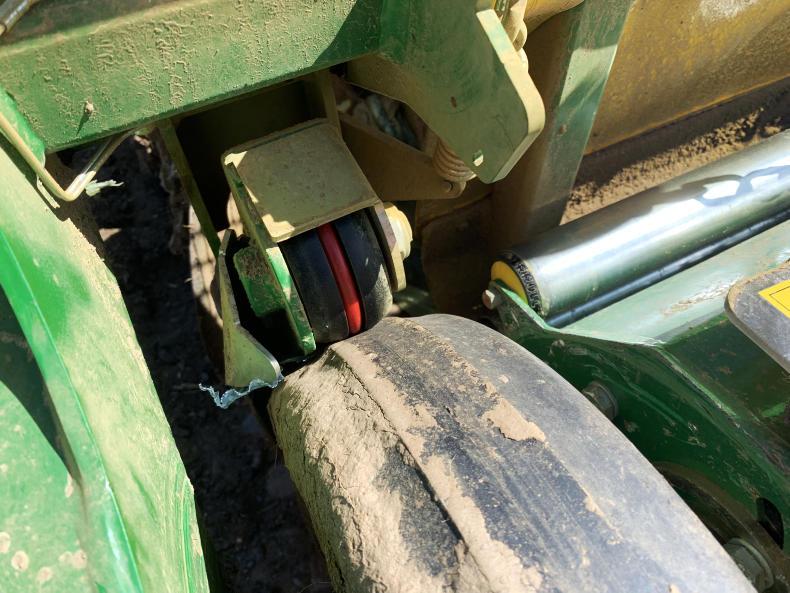
Spring tensioned wheels hold the film in place on each metering unit. Sensors alarm the operator if film looses tension or tears.
At this stage the maize is planted in an optimum warm humid environment before emerging a number of weeks later.
Working width: 4.5m Total rows: SixRow spacing: 70/80 cm Working speed: 5-7km/hHerbicide tank volume: 1,200lTransport width: 3.2mPower requirement: 150-170hpWeight: 3,800kgPrice: €73,800 incl VATa
Agricultural contractor Philip Hughes of Hughes Agri runs a family business based in Ballinkillen, Co Carlow. The Hughes family carries out an extensive range of services from planting through to harvesting.
Hughes is one of the few contractors in the country to operate silage wagons, round balers and a self-propelled silage outfit.
Philip said: “The silage wagon is ideal. We can send it out to jobs alone, use it alongside the harvester if we are under pressure or use it as a trailer if we are stuck.”
Hughes Agri plant between 500-700 acres of maize each year.
The Hughes family operates a mixed fleet of tractors consisting of Claas, John Deere and one Valtra. Philip explained how they keep at least two fresh tractors, these being the primary workhorses and within warranty. Once the warranty is up, they are replaced.
“It’s hard to keep all machines fresh but we aim to keep two new tractors, Claas 650s, and use these as the workhorses. The older John Deeres are mainly used for trailer work but everything is maintained to a high standard and in good condition.”
The drill itself rarely is an issue. It’s more often the ground conditions
Maize accounts for a large portion of the business and they recently purchased a new Samco 7100 six-row planter. This is the second six-row machine Hughes has owned, having run a four-row machine at the start.
The Samco 7100 maize drill has a working width of 4.5m equivalent to six rows of maize.
Hughes Agri made the decision to upgrade the drill this year to the newer model having operated the old drill for 10 years. Philip noted that the main reason for change was down to the newer drills being more advanced, having had improvements made over the years.
“Ten years may seem old, but on average we would have planted 500 acres a year, so after 10 years the drill had only planted 5,000 acres which isn’t overly high,” said Philip.
The new 7100 drill gives the operator greater control of the machine from the cab, now having electrical control of the sprayer via its control terminal. More sensors throughout the drill monitor the planting process. These are a few of the changes to the new machine that allow it be more reliable and have an increased output when compared to the older model. A typical day would see on average 5.5 acres to 6 acres an hour planted, although ground conditions can often be the limiting factor.
“The drill itself rarely is an issue. It’s more often the ground conditions,” explained Philip. It is important to have a fine firm seedbed for planting.
The front mounted sprayer tank has a capacity of 1200l.
When we caught up with Philip, he was planting 8200 variety seed at 40,000 seeds /acre with 100l of pre-emergence herbicide being applied per acre underneath the film. This is the first year Hughes Agri had the opportunity to use GPS and Autosteer while planting, having purchased the new Claas Arion 650 with Autosteer. This makes planting much easier, Philip noted.
Drilling started on 10 April, but more recently the lads have been planting around the clock with their new Claas Arion 650.
Two 12-hour shifts see the tractor continuously running. When the ground is suitable for planting, the opportunity cannot be missed, even if it takes means drilling around the clock to get the acres done.
“Both the tractor and drill are well kitted out with lights. We recently fitted the tractor with a light bar which was a massive improvement to visibility in the dark.”
Samco
The renowned Samco system was the brainchild of Sam Shine. The Adare, Co Limerick, man was the world’s first to develop a three-in-one machine to sow seed, spray the soil with pre-emergence herbicide and finally but most importantly lay a thin layer of degradable film over the seedbed, all in one pass.
The three-in-one planter was first invented in 1996. Since then the company has become an Irish manufacturing success story, with markets all over the globe. Samco also produces the degradable plastic as a part of the business.
The degradable films have a number of functions: pinholes allow trapped air to escape leaving the film to sit tight to the soil and retain moisture and heat within the soil to maintain an ambient environment. Finally, the pinholes weaken the film, allowing the plant to easily emerge through it. Different types of film have been developed to suit different needs and markets.
Samco now manufactures a maize storage solution called the BagPress, along with sub-soilers and other tillage equipment.
Today, two-row up to eight-row planters are available. The 7100 machine is a six-row folding model aimed at large farmers and contractor markets. The six-row machine is divided into three independent units allowing the drill to fold to a width of 3.2m.
Drilling
Starting at the front of the drill, there is a rubber roller to consolidate soil, producing a firm seed bed. Behind this rubber roller are track eradicators to prevent deeper soil compaction in the seed row. These are sprung to allow for protection from objects such as stones.
The compact 7100 drilling unit weighs in at 3,800kg.
Behind the track eradicators is the seeding unit. Six Kverneland Optima pneumatic seed units carry out the planting process. Seed is placed on the seed disc using vacuum, while two mechanical selectors can be adjusted to reduce doubling of smaller seeds on the disc and allow larger seeds to be sown without any changes to the seed unit. Each of the six seed hoppers is easily accessible using the walkways for ease of filling. Seed placement depth is adjusted manually on each drilling unit.
The drill is fitted with six Kverneland Optima pneumatic seed units. Seed placement depth is manually adjustable.
Philip was applying seed at a rate of 40,000 per acre. This rate information is provided on the seeder terminal along with seed rate per ha for each seeding unit, number of ha drilled per day, total number of ha planted, area per hour and the number of hours worked.
Sensors are fitted to each unit to alert the operator if a unit is empty or blocked, a must-have feature for Philip. Each film unit can be operated independently through the terminal to make use of the drill easier in angled parts of the field, while hillside adjustment is fitted as standard to provide accurate drilling on slopes.
Spraying
Once seed is placed in the ground, next it is sprayed with pre-emergence herbicide. Philip explained how this new 7100 drill is fitted with an automatic spray system controlled from the cab. This spray system takes into account the forward working speed so it can regulate and spray the correct volume per acre as programmed, (100l/acre).
Spraying is automatically triggered above speeds of 0.2km/h. Spraying automatically starts and stops when the drill is lifted at the headlands.
The front spray tank has a frame capable of carrying 12 rolls of film.
The Spraylight terminal in the cab has several functions to inform the operator, which Philip said is much more intuitive on the new drill when compared to his older model.
“I can easily monitor remaining tank volume from the terminal, which wasn’t available on the previous drill. I can monitor each of the nozzles to ensure they are working, litres per minute, forward speed and spray pressure.”
The drill sprays pre-emergence herbicide on to the seedbed before film is applied. The row of nozzles on the rear of the machine spray herbicide between rows of film after drilling.
Philip can view the sprayer’s manifold from the cab. This has six tubes, all with a rotating ball to indicate active nozzles. The ball will drop in the event of a blockage. The rear of the drill has another row of nozzles, which are directed to the outsides of each row of film. This allows the exposed soil between rows of film to be sprayed with the pre-emergence herbicide, so all ground is covered.
The front-mounted spray tank has a capacity of 1,200l, 200l rinse tank for cleaning out spray lines and a 10l tank for rinsing hands. Once full, this front tank acts as a ballast for the rear-mounted 3.8t planter, providing more grip to the front wheels.
The drill has two intuitive control terminals, one dedicated to the drill and one for controlling the sprayer.
The sprayer’s Hardi pump is PTO-driven,with pipes running underneath the tractor from the pump to the tank. All chemical mixing is carried out using the 40l induction hopper. The front tank has a bracket fitted with a road lighting kit and has the ability to carry 12 rolls of degradable film as well as bags of seed. Philip noted that while road travelling, he ensures the front tank is empty to save excessive tyre wear.
Film application
Angled discs throw soil onto each side of the film, anchoring it in place. These discs are adjustable to alter the amount of soil placed on the film.
Once the pre-emergence herbicide is spread, the 5.5 micron degradable film is applied. The three film-metering units are easily accessible. Spring-loaded roll holder units place the rolls in the correct position. Spring-tensioned wheels with rubber tracks catch each side of the film, feeding it into position, which it maintains while working. This is one aspect Samco has improved immensely over the years, Philip noted, having had very few issues of plastic becoming loose.
The rear of each film metering unit has a spade-like plate. This throws soil up on to the film to hold it in place.
Each side of the film metering unit has a disc. These discs are adjustable and open a channel 10cm deep in the soil. When the channel is opened the film metering unit is lowered, engaging the cut and bury plate or what’s known as the ‘spade’ covering the film at both ends of the headland to avoid wind getting under the film. Rear-mounted discs at either side cover the edge of the film, anchoring it in the soil. Philip explained that these discs are adjustable to allow more or less soil onto the film.
Spring tensioned wheels hold the film in place on each metering unit. Sensors alarm the operator if film looses tension or tears.
At this stage the maize is planted in an optimum warm humid environment before emerging a number of weeks later.
Working width: 4.5m Total rows: SixRow spacing: 70/80 cm Working speed: 5-7km/hHerbicide tank volume: 1,200lTransport width: 3.2mPower requirement: 150-170hpWeight: 3,800kgPrice: €73,800 incl VATa 





SHARING OPTIONS