



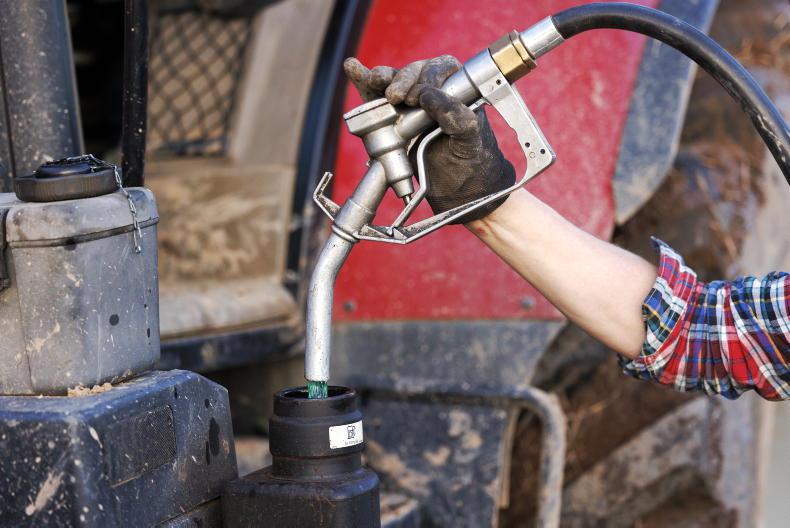
Green diesel prices have remained somewhat stable in recent weeks. As we went to press, quotes for bulk orders of green diesel or marked gas oil (MGO) ranged from €1.33/l to €1.40/l including VAT – with the majority of suppliers contacted, quoting closer to €1.35/l including VAT.
Most suppliers noted that prices rose between 1-2c/l Monday night ahead of Tuesday morning.
Despite, being back from the earlier highs of €1.64/l including VAT at the end of March and before the Government intervened with temporary excise reductions, prices are still up massively on 2025.
Looking back on fuel reports from the corresponding week last year, prices are elevated by as much as 50c/l year on year, a time when green diesel was trading at an average of 92.5c/l including VAT.
Despite prices being severely elevated year on year, a number of suppliers noted that the market has stabilised to a large degree over the past month, both in terms of demand and price.
“We are now back to a more normal supply and demand situation. When the war broke out, a lot of customers panic bought which in turn put strain on normal supply chains.
“In normal times, supply chains operate like a finely tuned engine; demand is predictable, meaning the supply required, is too. Issues arise when such sudden increases in demand happen and we have our usual predicted volumes ordered in advance,” one midlands supplier outlined.
Brent crude
Brent crude, the major oil benchmark has risen over the last month, despite some spikes and falls along the way, which remain linked to geopolitical announcements. At the time of going to print this week, Brent crude was trading around $110/barrel.
Supply remains under pressure, with Gulf production still heavily impacted by transport disruption through the Straits of Hormuz.
As a result, exports from the Atlantic Basin, particularly the US, Canada and Brazil have helped fulfil some demand.
According to the latest report issued by the International Energy Agency (IEA), global oil demand is now forecast to contract during 2026 despite earlier predictions for a growth in demand.
High prices and slower global economic activity are beginning to curb fuel consumption, according to the IEA.
Fuel Support Scheme
Farmers and agricultural/forestry contractors have until 27 May to submit applications and avail of the Fuel Income Support Scheme.
Eligible applicants will receive a rebate of up to 20c/l, with a minimum payment of €100 for the assumed litres used during the period from March to July 2026.
The assumed usage will be based on total litres purchased during 2025, divided evenly over the 12 month period.
For example, a farmer that used 10,000 litres of green diesel in 2025 will receive approximately €833.30. This is based on an assumed usage of 4,167l during March to July 2026 and a payment of 20c/l.
The finer detail of the scheme has caused backlash amongst farmers and contractors.
The reason being that the bulk of fuel tends to be used during the busy spring/ summer months as opposed to evenly across the calendar year, which is how payments are set to be calculated.
For example, a farmer burning 10,000 litres may in fact burn 60% or more of their annual total during the March to July period, not to mention that this is exacerbated for contractors where the bulk of the work is generally seasonal.



SHARING OPTIONS