



One of the areas that was a central focus of BEEF2026 was grass; from picking varieties based on PPI, making quality silage, incorporating clover to grass utilisation.
As beef farmers, it is probably one of the areas we fall down the most in, particularly on a suckler system where beef cows will do a relatively good job on rearing their calf on subpar grass. Declan Byrne of Kildaton College was on hand giving a demonstration on fencing and he coined it correctly when he said ‘’we as beef farmers are good at growing grass but not at utilising it. If cattle are in the same field for or nine days then you are not utilising your grass correctly.
Teagasc has some key advice for farmers looking to better utilise their grass though setting up a paddock system relayed below.
Pasture growth is most efficient when animals graze for a maximum three days and are then moved.
Farmers can graze when pasture quality – digestibility and energy, is at its highest (typically at 1,300-1,500kg DM/ha).
Utilising paddocks as opposed to set stocking will increase the volume of grass grown on farm while also increasing the quality of grass in front of animals through farmers having a greater level of control of what is grazed and what is baled out.
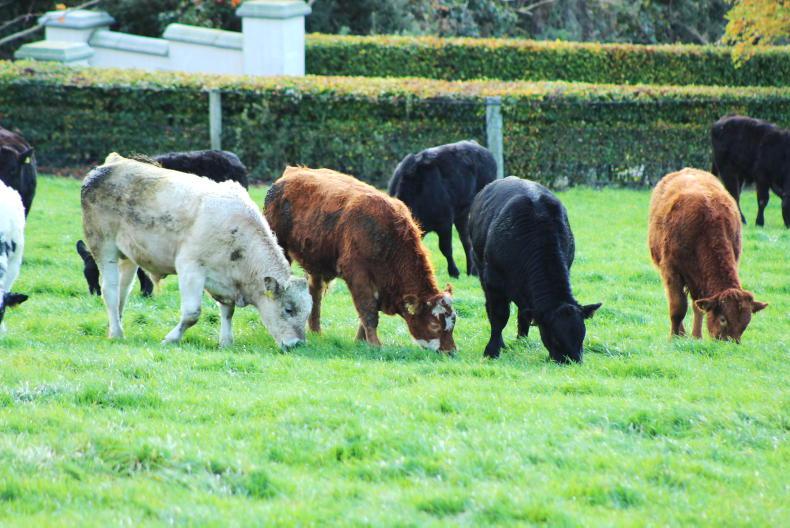
The difference in live weight gain of beef cattle grazing high-quality pasture, and poor-quality pasture, achieved with the control of paddocks, is up to 0.25 kg per day according to Teagasc research.
Over 200 days, this is an additional 50 kg live weight per animal, which at current prices ( circa €5/kg live weight for weanlings) results in earning an additional €250 per animal over the grazing season.
Paddock systems can be difficult to get right, with varying field sizes topography of the ground and varying cattle groups all providing a challenge. The general recommendation is to establish the paddocks with a temporary system of pigtails/ poly posts and reels before committing to a permanent system. The temporary infrastructure can always be utiiilsed again to further subdivide paddocks. However, to make the initial plan:
Use farm map to consider several different ways of laying out the farm and consider the positives and negatives of each one.
Decide on the number of paddocks required (recommended eight per group)
Minimising the number of grazing groups reduces the number of paddocks needed.
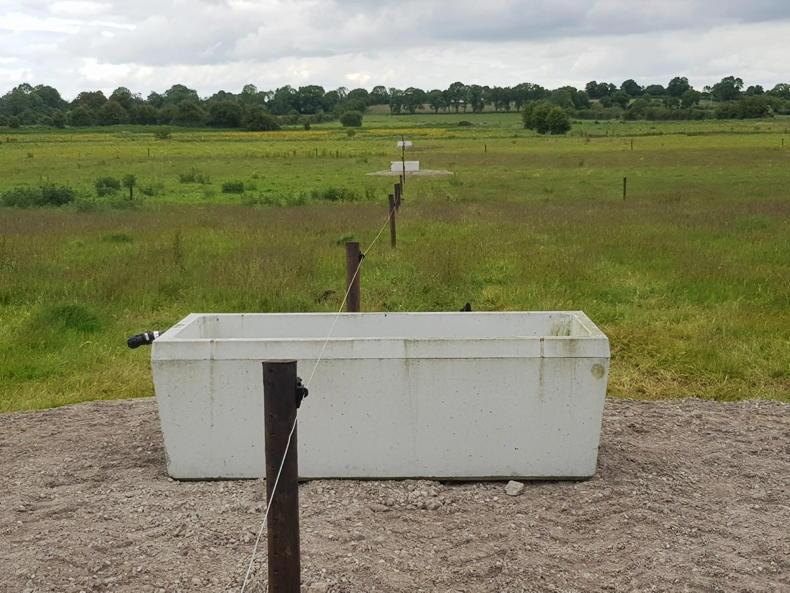
Identify the most appropriate water trough(s) position in each paddock. Where possible, share a trough between paddocks but, more importantly, position the troughs to allow further, possibly temporary, subdivision of paddocks.
Keep paddocks square if possible.
Proper subdivision of grazing land into paddocks is essential to be able to successfully manage pastures and achieve desirable rotation intervals.
The target should be to design a paddock for three days grazing followed by a 21-day recovery period during typical mid-season peak growth.
This requires establishing what size cattle group is usually run on the farm during mid-season and establishing what the total feed requirement is for the number of cattle in the group (Table 1).
Due to physical restrictions on the farm, some paddocks may have to be made smaller. For example, two 2-day paddocks from one small field.
Paddocks should ideally be connected in a way so that cattle can move between paddocks efficiently through interconnecting roadways.
It should be avoided that cattle have to cross several paddocks for handling for AI etc, with a proper roadway eliminating this.
Roadways should be designed to allow animals to be returned to housing during inclement weather in the spring and autumn as easily as possible and by one person. Where possible incorporate the following design ideas for easier management:
Water troughs should be located centrally to facilitate this.
Avoid long narrow paddocks as they result in too much walking over ground to graze the end of the paddocks creating an excessive risk of poaching in difficult grazing conditions and a build-up of poorer quality grass at the back of paddocks.
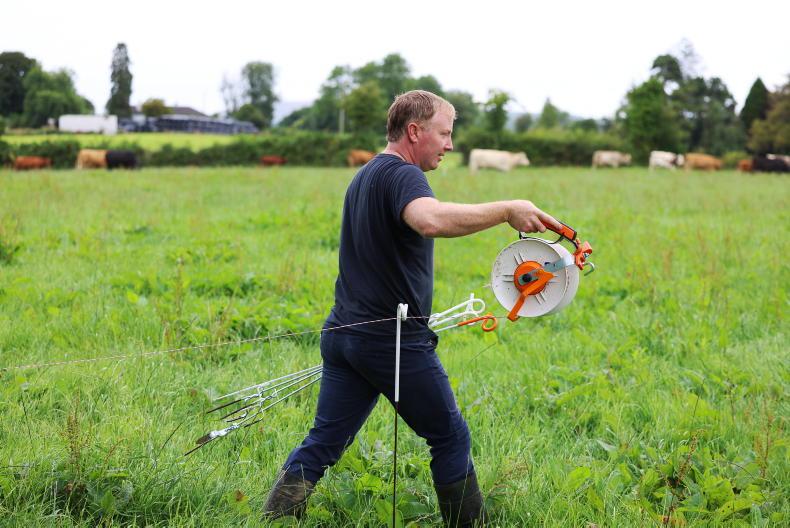
An alternative to a fixed paddock system is to adopt a flexible system whereby large fields are grazed using temporary wire divisions for all grazings.
The area available for grazing and the size of the paddock at any grazing can easily be adjusted throughout the year.
Larger paddock sizes can be allocated where grass covers are low or the cattle group size is bigger, and smaller paddock sizes can be given when grass covers are higher, or the group size is smaller.
Surplus grass is easily harvested, usually as baled silage.
For the best success a permanent electric fence around the field boundary should be in place.
From this, temporary electric fences are used to allocate pasture with a temporary electric back fence used to prevent stock going back to graze the previous area.
Again, appropriately located water troughs are critical to paddock flexibility, with paddocks able to service several paddocks or subdivisions of a paddock.
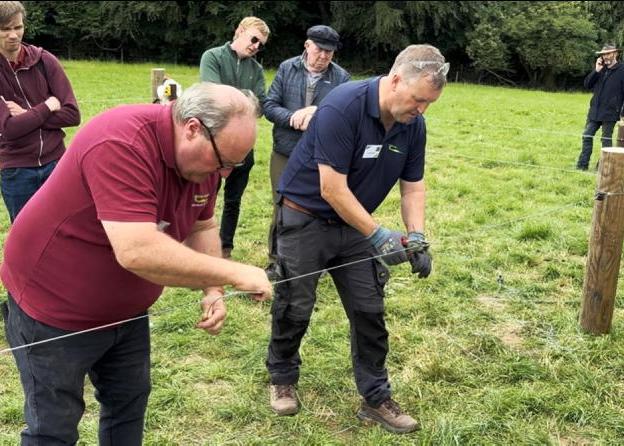
As mentioned, Declan Byrne and his colleague Stephen Kearns of Kildalton College were on hand giving a live demonstration on tying off, joining and straining high tensile wire, which saw keen interest from attendees.
Byrne recommended setting posts apart by 12m for a single strand of high tensile single strand wire, with additional posts required where turns or ground topography changes.
At this, typical costs will run to €2.10/linear metre for materials only.
“There’s no reason as to why you can’t complete this work yourself. Getting a contractor in could see a labour cost of €2/m, essentially doubling your cost,” he said.




SHARING OPTIONS