



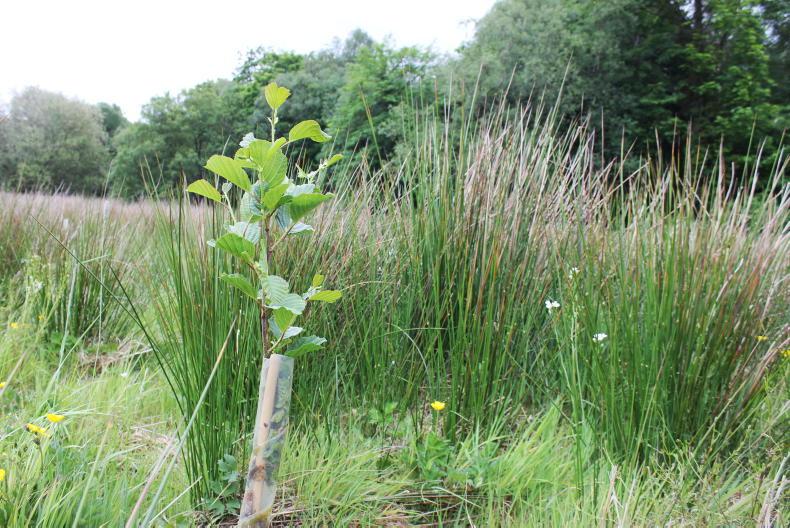
A notable issue that stands out in the recently published DAERA annual report for 2025-2026 is just how far behind the department is around tree planting targets.
Last summer, DAERA set out its business plan for 2025-2026, which included 42 commitments across eight different priorities.
Each of these is assessed within the annual report, with 33 noted as being ‘achieved’, a further eight are ‘delayed’, leaving just one marked in red as ‘not achieved’.
That outstanding commitment was to plant 600ha of new forest on both private and publicly owned land between 1 April 2025 and 31 March 2026. In the end, just 310ha was established over the period.
Net zero
Additional tree planting is seen as a crucial element of meeting future targets around the achievement of net zero greenhouse gas emissions by 2050.
The target in the first of a series of carbon action plans, covering the period 2023 to 2027 is to establish 2,585ha of new woodland, however, just 1,386ha has been planted so far.
Beyond that, the plans look incredibly ambitious, with approximately 50,000ha of new woodland to be created between now and 2050. To do that will require approximately 2,000ha of new forest planted every year, which is over six times what was achieved in the last financial year.
It is no surprise that the department has now come forward with a Tree Planting Action Plan, which includes various actions to increase awareness among landowners of the benefits of woodland and create a new generation of forestry contractors and mangers.
There is also a commitment that DAERA Forest Service will “revise current grant schemes” and introduce “a longer application window” for these schemes
Ultimately, future woodland grants will have to be very financially attractive if planting trees is to be a viable alternative to either farming the land or letting it out in conacre.
Unfortunately for DAERA, the increased focus being put on stocking rates per hectare within a revised Nutrients Action Programme only adds to the upward pressure on land prices in NI, making it even less likely that land is given over to trees.



SHARING OPTIONS