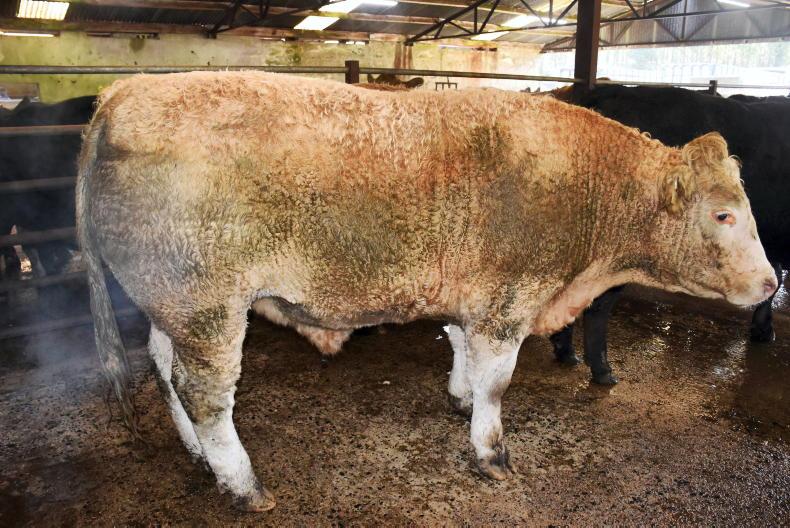
Despite arbitrary weight limits at slaughter and a Government scheme to encourage farmers to kill cattle at younger ages, it remains the case that a significant number of farmers still like to finish cattle at over 850kg and approaching three years old.
With prices of over £3,000 per head, it perhaps suggests a lot of profit is being made, but is that really the case? Should these cattle be killed at younger ages?
To explore that, we have looked at two options. Both start with an assumption that steers are bought as weanlings at autumn sales, averaging 300kg at 500p/kg. With haulage and other fees included, it is a total initial outlay of £1,525 per head.
In the first option, the cattle are stored over the winter, grazed during the summer and finished out of the house in the early spring of the following year at 24 months old.
During the store period, the animals are fed an average of 20kg of fresh silage daily costed at £35/t, along with 2kg of concentrate per head, costing £290/t. Silage and concentrate expenses come to £126 and £104.40 respectively, with an allowance of £15 included to cover veterinary treatments. Average growth is 0.7kg per day and by turnout in the spring, the steers average 426kg liveweight.
The cattle are at grass for 160 days in a well-managed grazing system, achieving daily growth rates of 0.9kg per day.
There is no concentrate fed and daily grazing costs are 70p per head.
Adding in £10 for vet treatments, costs over this period are £122 per head. The cattle average 570kg at housing.
During a 140-day finishing period, they eat 25kg of silage per day and 5kg of concentrate, finishing at 724kg liveweight. At 56% kill out it is a carcase of 405kg, valued at 630p/kg. Adding in the £75 per head Beef Carbon Reduction (BCR) scheme money, total output is £2,629.
Total costs are £2,258, leaving a margin of £371.37, or 77p per head per day.
Option 2
The main difference in the second option is that the cattle aren’t pushed quite as hard during a store phase and they are grazed for a further 90 days, before a short 90-day intensive finishing period.
During their first winter, they are fed 1kg of concentrate per head and during their second winter, receive 2kg per head.
Total costs to this point are £2,162.50 and cattle average 690kg when they are turned out at just over two years.
During this 90-day grazing, cattle are fed 2kg per head of concentrate and achieve weight gains of 0.95kg per day, before being housed at 775kg for a sharp finish.
Over this final 90-day period, they eat 7kg of concentrate and 35kg of silage per head per day.
The animals average 865kg at slaughter, which at a 56% kill-out is a final carcase of 485kg. Assuming the same beef price of 630p/kg, total output comes to £3,055.
Total costs are £2,620.65, leaving a margin per head of £434.85, which is a margin per day of 62p.
Sensitivity analysis of the figures
The figures quoted in the two scenarios are purely indicative, although in both cases, to achieve the weights at slaughter will require high levels of management throughout.
Looking at the data would suggest that higher margins (of 77p) per day can be made when slaughtering cattle at younger ages.
However, in our example, it is also important to note that if we exclude the BCR payment, daily margins achieved in both scenarios are actually very similar.
But some factories might argue they pay less per kg for cattle around 500kg deadweight than those around 400kg. For every 10p/kg reduction in finished beef price in option 2, it adjusts the daily margin downwards by 6.9p.
It is also fair to point out that not all cattle will be capable of getting to nearly 500kg carcase weight at just over 30 months. But ultimately, nothing beats buying cheap and selling dear, irrespective of the system chosen.
CAFRE calculators online
For farmers who keep beef cattle there are four different calculators available on the CAFRE website to help with decision-making and explore potential margins.
The calculators cover short-keep finishing, weanling or store to beef, bull beef production and whether to sell or keep. Go to the business support section of the website (www.cafre.ac.uk) and select agriculture.