



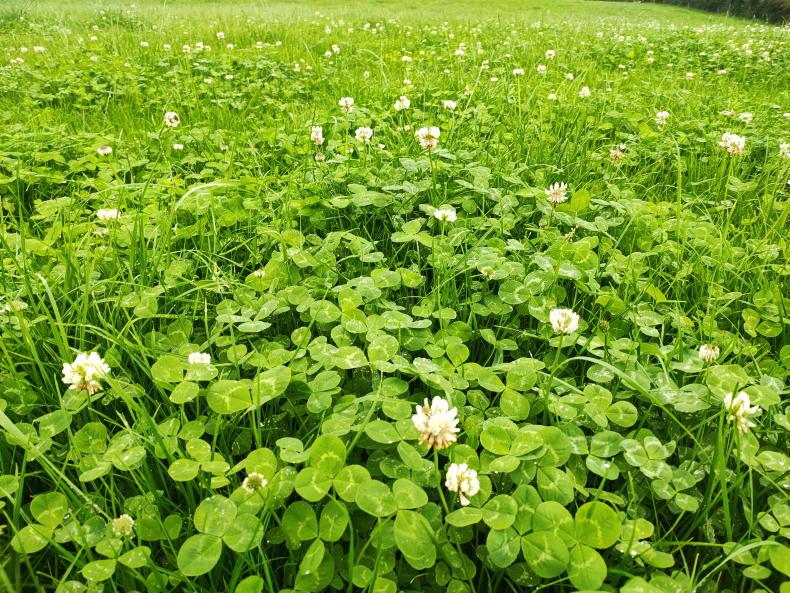
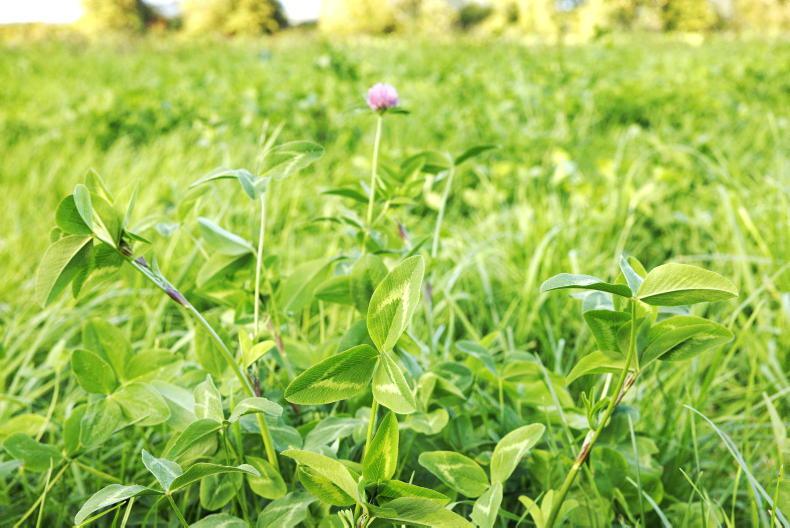
Over the last few years I have been trying to get clover back into my grassland and to get it working for me.
I have been doing this for a number of reasons. Firstly, and probably most importantly, is to save myself money. The thinking is that the clover can fix atmospheric nitrogen and therefore reduce the need for artificial fertiliser.
Then there is the perceived benefit to my carbon footprint. This is a lot harder to quantify but I am fairly confident that it will help lower emissions from the farm.
There are also potential benefits for soil biodiversity and nature (more bees and insects) when growing clover and fairly good evidence that it will result in improved animal performance both at grass and in the winter if red clover silage is fed. This red-clover silage should be higher in protein and therefore reduce the need for expensive protein in the meal fed to cattle.
All in all, there are enough benefits in having clover in the grassland to justify the time and effort in trying to get it to grow. But that effort must be successful and therein lies the problem.
Establish
I have tried to establish white clover in my grazing swards and red clover in my silage ground. Over the last few years, I have learnt a lot about both plants.
To start with I listened to a lot of advice and tried to follow it as best I could. I have had some really good success but also some failures.
There is lots of advice about pH and having it close to 6.5. You are also told about the need to reduce artificial nitrogen and keep the sward low to let light reach the clover.
For red clover you are advised to have a cut height higher than normal and to try and avoid too much traffic over the ground.
No guarantee
My own experience is slightly different. Higher pH is a help but it will not make up for other failings and having pH at 6.5 will not guarantee clover success.
In my opinion, sward height is definitely not that important. There are varieties of clover that will actually thrive in higher covers. I have fields of high covers where the clover does very well.
Artificial nitrogen will not kill clover. Reducing artificial nitrogen will encourage the clover to work.
The advice for red clover seems fairly accurate. Cutting at a higher level and less traffic seems to reduce the risk of the red clover being killed. However, for me, the jury is still out on animal performance and the reduced need for protein in supplementary feeding.
While I have learnt a lot over the last few years, I still have not got all the answers. I have some clover that has done really well and other bits that (for no particular reason) just have not performed.
When it has done well it looks superb and makes it worthwhile. But on the other hand, when it does not work (for no particular reason) it can be very frustrating.
Negatives
There are a few really big negatives that I have noticed. Clover does not like cold or wet conditions. If it is very wet or very cold the clover will die out.
It also does not like to be trampled with livestock or machinery. Either will cause massive damage to the plant. Clover is very dependant on good weather and good land – not just on good management.
However, the biggest problem with growing clover is weeds. In particular, docks love the same conditions as clover. Then there is the limited options for spraying, with most clover safe sprays not great at killing established docks.
I am not going to give up on clover, but it is definitely not as simple and straight forward as some might advise.



SHARING OPTIONS