



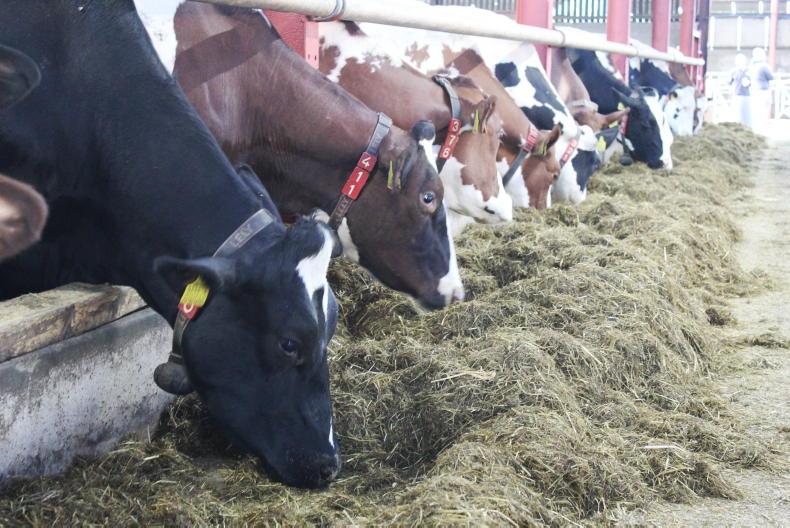
Impractical targets in the Nutrients Action Programme (NAP) consultation from May 2025 have been removed, but significant changes will still be required on more intensively stocked farms if they are to stay within future rules.
The original proposal was that 3,100 farms operating at over 150kg of manure Nitrogen (N) per hectare would have to comply with a Phosphorus (P) balance limit of 8kg/ha/year by 2029. With farmers potentially forced to reduce stock numbers, analysis by AgriSearch suggested that the annual economic cost to the NI dairy industry could have been as high as £900m.
Instead of a strict limit, the latest NAP proposals set out a number of pathways for farmers to reduce the P surplus on their farms.
Overall, best estimates suggest the P surplus across NI farming stood at 8,729t in 2024 – it is effectively a surplus of P over and above what is needed for crop growth – most of it comes from concentrate feed, with some also from artificial fertiliser. The aim is to reduce that P surplus by 30% over the 4-year NAP period from 2027 to 2030.
This reduction will be achieved through a number of measures, including increased use of slurry processing to take the solids fraction off farms to the likes of anaerobic digestion (AD), before potentially drying down resultant digestate and exporting out of NI.
P fertiliser
There will also be more pressure on farms to only use P containing fertiliser when there is a clear need.
The original May 2025 proposals suggested use should be restricted to a limited number of circumstances (such as reseeding). The latest version is not as prescriptive, but reference is made to new rules specifying “which chemical P products can be used on grassland” and there being “a limited number” of products available on the NI market. A fertiliser database to record movements and usage of product is being worked on and will be brought forward in separate legislation.
Derogation
However, for a lot of dairy farmers, it is probably a revised approach to nitrates derogation and tight rules around slurry exports, which will necessitate changes on farm.
All NI livestock farms must keep within a limit of 170kg manure N/ha, unless they apply for a derogation to operate at up to 250kg N/ha.
Farmers not in derogation often rely on exporting slurry to keep to the rules. Those in derogation have various conditions to meet, including a P balance limit of 10kg/ha. Inspection results show compliance tends to be high on these farms.
In recent years, just over 400 farms are in derogation, but analysis of data suggests this should be a lot higher – in 2024 there were 1,990 non-derogated farms operating at over 170kg manure N and in breach of current legislation.
An aim within the latest NAP proposals is to remove some of the barriers around becoming a derogated farm.
The terminology is to be replaced by a new ‘Nutrient Stewardship Programme’, within which there will be a two-tier structure. Tier 1 will be farms already compliant with the rules. Tier 2 will “work towards Tier 1 over time with advisory support”.
These farms will be permitted to join the programme even if they have a high P surplus, providing they commit to reducing it by at least 10% over four years or get to the current derogation requirement of 10kg P/ha.
All farms in the new programme will be required to submit annual nutrient / fertilisation accounts to the NI Environment Agency (NIEA).
Inspections
Those in Tier 1 will be subject to a 1% inspection rate, with 5% of Tier 2 farms inspected each year.
Farms who don’t join the programme and who are operating at over 170kg manure N/ha “will be considered high risk” and subject to a 10% inspection rate.
Slurry exports
For those farms who export slurry, significant changes are planned to the current system of annual reporting by the end of January in the following year.
The latest NAP consultation points out this system comes with a potential risk that some of the records are falsified, while there are concerns about accuracy when large volumes are notified, particularly over long distances.
What is proposed is an enhanced online system where movements are notified to DAERA at least three times per year (movements up to the end of February, June and October are notified by the exporter and verified by the importer by the end of the subsequent month).
Additionally, all exports of 15 miles or more, in a straight-line distance, must be notified within five days and verified by the importer within two weeks.
Where farms are found to have submitted false or misleading data, they will then be required to notify DAERA at least a day in advance of an export and submit “geotagged photographs” as evidence of movement on the day of transfer.
When it comes to working out the manure N limit of 170kg/ha or a P balance on a farm, the amount of both nutrients excreted by cows is important.
Under the current NAP, each dairy cow is assumed to excrete 100kg of N and 19kg of P per year. In the May 2025 proposals, a system of 10 bands was suggested, ranging from 88kg N and 13kg P (under 6,000l cows) to 128kg N and 19kg P (over 10,000l cows).
Something similar is in the latest NAP consultation. Dairy cows yielding under 5,000l will be assumed to excrete 77kg N and 11kg P each year, rising to 149kg N and 22kg P for cows yielding over 12,000l.
It will be possible to submit independently-verified farm-specific calculations for N based on actual diets, but either way, the proposals will push higher yielding herds closer to N and P limits.




SHARING OPTIONS