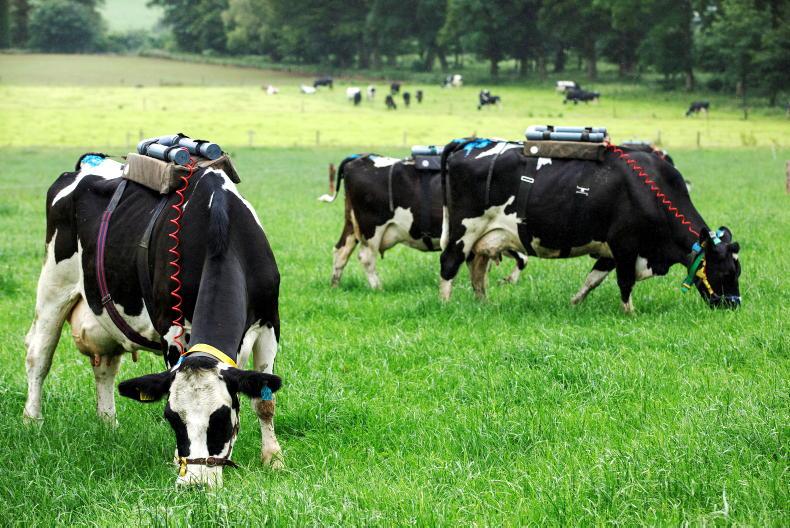
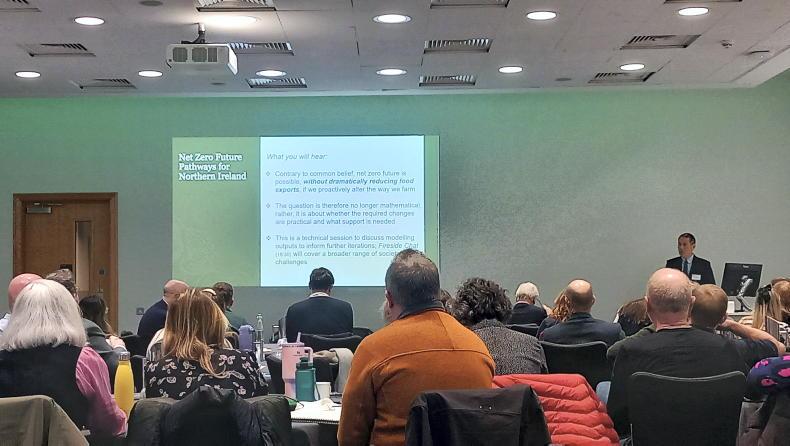
Two potential pathways for NI to reach net zero greenhouse gas emissions were set out at an event at Queen’s University Belfast (QUB) last week.
Professor Paula Harrison from the UK Centre for Ecology and Hydrology (UKCEH) said the plan was developed by representatives from academia, government, industry and environmental groups.
The two potential routes were presented as an “adaptive balanced pathway” and a more stretching “leap balanced pathway”.
However, a key take-away from the exercise seemed to be that reductions in livestock numbers on NI farms were required in both scenarios.
Under the adaptive pathway, sheep numbers need to reduce by 22%, beef cattle by 18% and dairy by 15% by 2050.
The leap pathway sees sheep numbers down 28%, beef reducing 23% and dairy down 18% over the same timeframe.
The two pathways differ from similar work done by the UK Climate Change Committee, as some of that modelling suggests current NI livestock numbers would need to halve by 2050.
However, the two new pathways set out at the Queen’s event seem to have greater reliance on the use of methane inhibiting feed additives on livestock farms.
“Across both pathways, stakeholders include feed additives to be adopted when practical, reaching 80% of the appropriate herd by 2050, with the assumption it will reduce methane by 20%,” said Dr Sarah Sinclair from the UKCEH.
Farm output
Sinclair said the reduction in livestock numbers would not correspond to the same reduction in meat and dairy output from NI farms.
This is because the pathways include an 18% to 20% increase in “livestock yields”, which is brought about by improvements in genetics, animal health and feed efficiency.
Another key change is a 27% reduction in nitrogen fertiliser use under the adaptive pathway, with a 40% drop set out in the leap pathway.
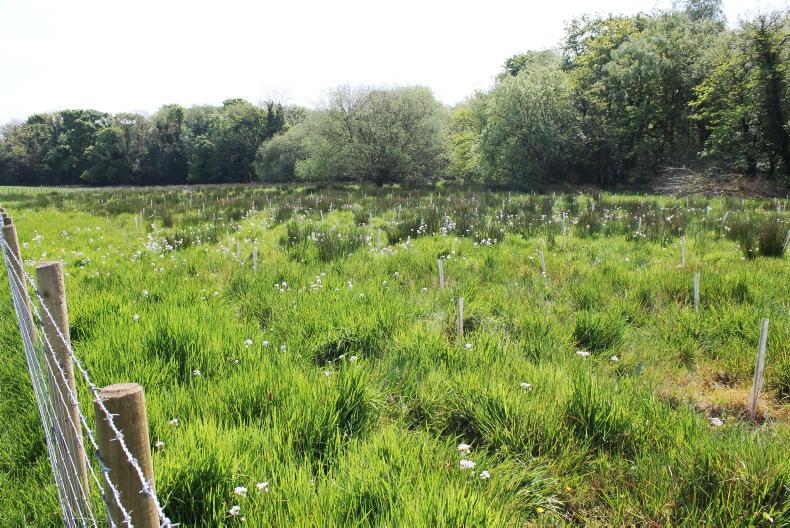
In addition, the area of NI under forest is required to increase from around 9% at present, to 14% under the adaptive pathway and 16% with the leap pathway.
Also, between 30% to 50% of intensive grassland needs to include legumes, 1.5% to 3% of farmland is planted in bioenergy energy crops, and 80% to 100% of unproductive peatland is restored by 2050.
“These results should be viewed as a starting point for discussion, rather than predictions. Their value lies in exploring and illustrating the opportunities, trade-offs and choices facing NI over the coming decades,” Sinclair said.
More research is required into how soils absorb and store carbon from the atmosphere, a leading land-use scientist has said.
Speaking at the QUB event, Professor Bridget Emmett from the UKCEH said “better data” is needed to fully understand soil carbon sequestration.
Recent studies from NI have shown that agricultural soils have considerable potential to sequester carbon and partially offset the greenhouse gas emissions associated with farming.
“A single study will not change what we think about soil carbon,” Emmett told delegates. She pointed out that different studies from across the UK have shown a wide range in the rate that soils can sequester carbon. “There are some really exciting numbers coming from NI, which will increase the upper end of these ranges. We can’t just forget the lower ranges. They are real studies, on real farms, in real fields,” she said.
Emmett said scientists needed to better understand what management practices are linked to the higher rates of soil carbon sequestration, and similarly what factors cause lower rates: “We cannot mis-sell this to our farmers by saying you will always get the top-end number,” she said.