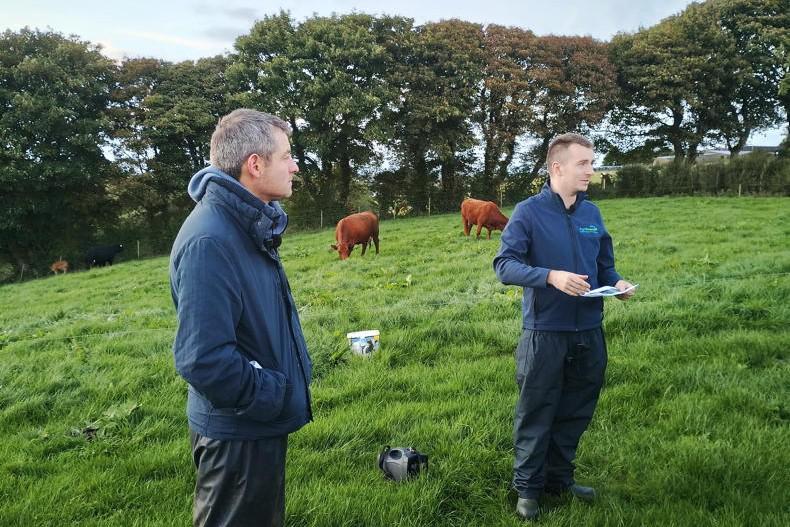
A spring-calving suckler herd might deliver more profit per cow than an autumn system, but there are a number of benefits from running both, Co Tyrone farmer Oliver McKenna told attendees at an AgriSearch event on his farm last Thursday.
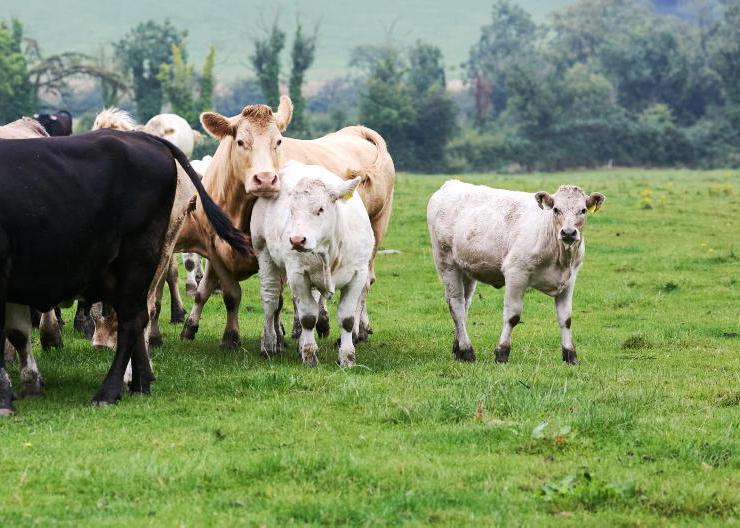
Oliver keeps 40 cows on 60 acres outside Eskra, with bulls taken through to beef and heifers not retained for breeding, either finished or sold as stores. The herd is split evenly into spring and autumn, with spring cows calving in March and April, and autumn cows in August and September. At the time of the farm walk, there were only four autumn cows left to calve.
Oliver runs a high stocking rate of 2.2 to 2.5 livestock units per ha (LU/ha) and maintained this could not be achieved if all the herd was spring calving.
“It would be difficult to graze 40 spring-calving cows on this farm. The even split makes it more flexible, it divides workload, boosts cashflow and the autumn cows suit a bull beef system,” he said.
The autumn calvers are weaned the following spring, so can be ran as dry cows behind youngstock to clean out paddocks. If conditions are poor, they can also remain inside to take the pressure off grazing.
Normally Oliver houses his autumn herd from 1 October, ahead of breeding. It means he is able to hold other stock at grass, although it does require suitable facilities to house cows with young calves.
AI bred
All cows on the McKenna farm are bred exclusively using artificial insemination (AI), with Oliver doing his own insemination work. A mix of bulls are used, with heifers bred to Red Angus and Salers. Some Stabiliser genetics has been used on Simmental cows, with Limousin, Simmental and Hereford genetics also within the herd.
“I am breeding all crosses – there is never a Limousin bull put to a Limousin cow. I want easy calving, lots of milk, good temperament and good terminal traits as well,” said Oliver.
He has used some sexed semen. While availability of sexed beef bulls has been a problem, it is gradually improving every year. On average, he uses 1.5 AI straws per cow or heifer scanned in-calf.
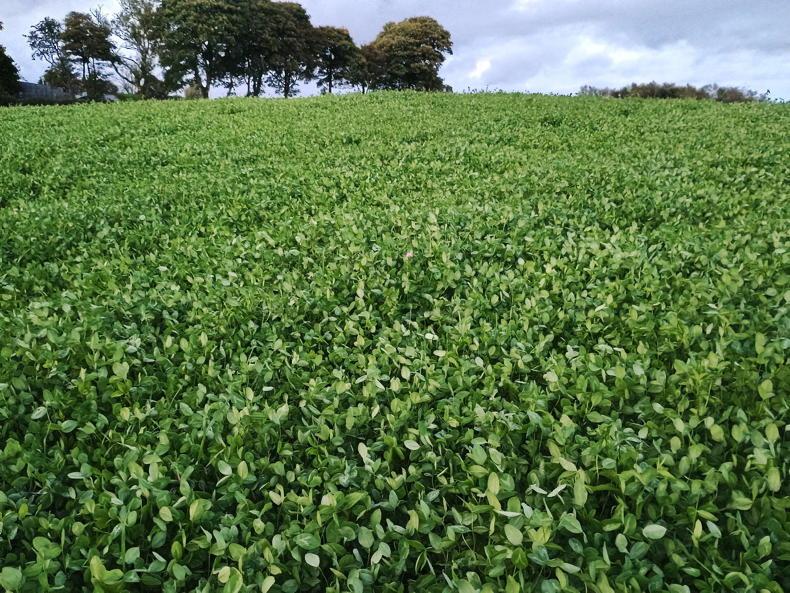
Oliver hopes he will be able to bale this red clover sward in the next couple of weeks.
Heat collars
To help lower the workload associated with heat detection, Oliver installed a Sensehub system over four years ago. It works both in the shed and at grass, with activity collars switched between both spring and autumn cows during breeding.
When outside, the Sensehub controller, located in the yard, simply needs to pointed in the direction of the area being grazed. Notification that a cow is in heat is sent to a mobile phone. The technology can also be used to monitor general health, although there are not the issues found in a suckler herd that might exist in dairy. At the time, the system cost £1,900, plus £85 per collar.
“You have to put that cost against the ability to use top AI bulls in the herd,” said Oliver.
Paddock grazing is key to beef output
The event on the McKenna farm was the last in a series being ran in recent weeks by AgriSearch across farms which measure grass growth as part of the GrassCheck programme.
In Oliver’s case, he has been measuring grass for over 10 years, having been part of the NI Suckler Beef Programme run by the Irish Farmers Journal, ABP Food Group and CAFRE.
While broken weather in September has made grazing more challenging, ground conditions on the farm were still good last week and overall, it has been an excellent year. So far in 2025, Oliver has grown 10.36t of grass dry matter per hectare (DM/ha).
He maintained that the growth being achieved and the subsequent high stocking rate, is only possible by paddock grazing.
“I would move the cows every day if I could, but the paddocks are already small enough. None of the paddocks last more than three days,” he said.
To ease management, fertiliser is blanket spread across the grazing block once a month rather than after each grazing.
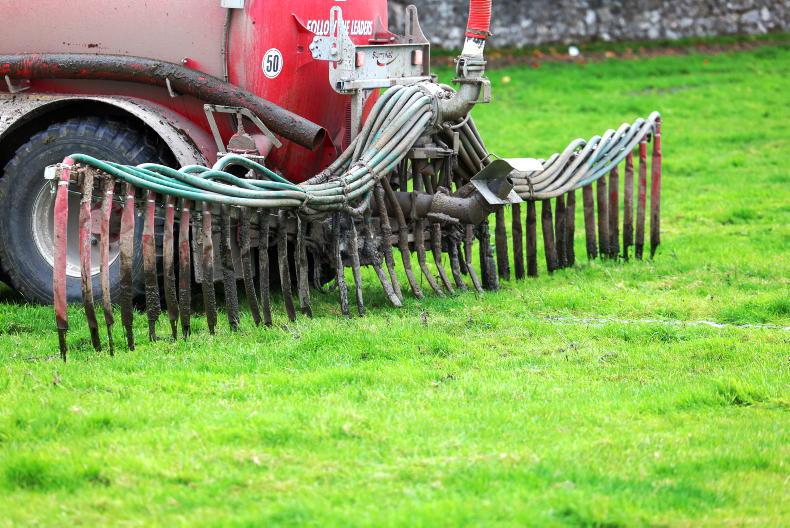
No compound fertiliser is used outside of reseeding, with Oliver relying on straight nitrogen (N) and slurry/farmyard manure.
Most fields are at index 3 for both phosphorus (P) and potassium (K).
The last fertiliser of the season went on at the start of September, with 20 units of N applied per acre (approximately two-thirds of a bag per acre).
Red clover taking over in new sward
Oliver McKenna has an exceptional clover sward, established this year in a 2.5ac field.
It is not the first time Oliver has tried to establish the crop, with a field sowed out in August 2023 with red and white clover, alongside hybrid ryegrass. It established well, but in the poor spring of 2024, the red clover was overtaken (and virtually wiped out) by the hybrid grass.
In 2025, the decision was taken to try again, but instead use conventional perennial ryegrass rather than the more aggressively growing hybrid grass. Oliver also decided to sow oats as a companion crop.
In total, 50kg of oats per acre were drilled on 14 April, with the grass seed and clover mix simply spread using a wagtail sower. Two bags per/ac of 15:15:17 was applied and the field was rolled.
A heavy crop was direct cut and ensiled on 6 August. Since then, the red clover has taken over, to the point where Oliver thinks he might have to drill in some grass seed next spring.
“The dry August seems to have suited the clover. I hope to bale it at some stage this autumn,” said Oliver.
Either way, the oats seem to have done an effective job, both in keeping weeds out of the sward and in depleting soil N reserves, thereby limiting the ability of the grass to get established ahead of the red clover.
Going forward, Oliver is keen to incorporate red clover into reseeds – even if it dies out within a couple of years, he will still be left with a grass and white clover sward. He is not interested in multispecies swards (MSS), which are probably more suited to dry parts of NI.
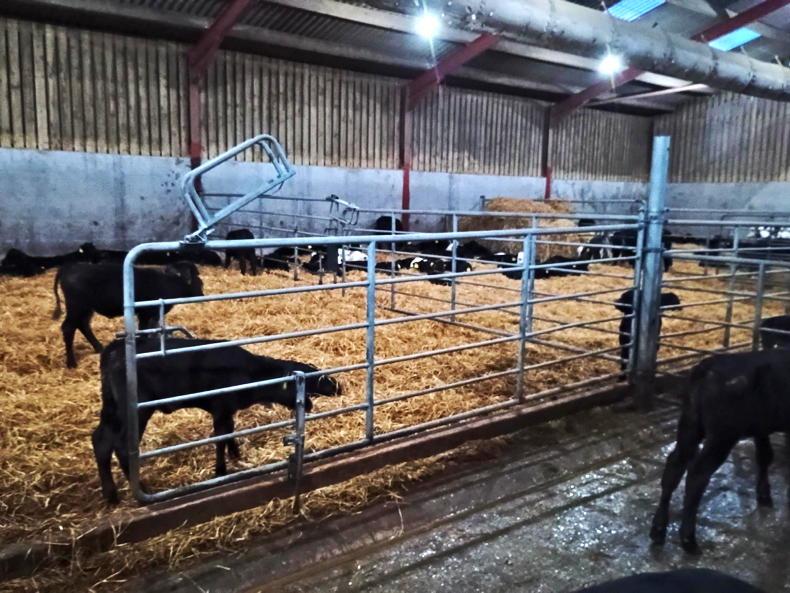
The calf-rearing unit on the McKenna farm is able to hold 140 calves.
In early with a pneumonia vaccine
On the McKenna farm, cows are routinely vaccinated for Leptospirosis and calves for blackleg and pneumonia.
In terms of pneumonia vaccine, Oliver said that Bovipast has worked in his situation and he intends to give the first shot of vaccine to his autumn-born calves before they are housed. He said that he did have a few issues with pneumonia in spring calves in 2024, so he has decided to pull forward the vaccination programme.
In previous years the first shot of vaccine would go in during July and the second shot in September. This year, the first 10 calves received their first dose of vaccine by the end of April, with all calves fully covered with two shots by July.
Calf house adding to cashflow
Just over four years ago Oliver McKenna invested in a calf house to rear animals for an integrated supply chain run by ABP Food Group.
Originally known as the Blade Farming model, it came under the control of ABP in 2011 when the company acquired the RWM Group in southwest England.
In NI, the scheme is now running approximately 10 years, with around 11,000 calves reared per year across 15 to 18 farms, explained Stuart Cromie from ABP.
He said rearers get a management fee per calf, with bonuses built in based on various key performance indicators. ABP pays for milk replacer, concentrate feed and vet costs, while calf rearers cover the cost of straw, electricity, water, labour and housing.
Calves normally arrive at around three weeks of age, with the aim to reach 120kg at 15 weeks, when the animals are moved to finishing units. Rearers all follow a set health protocol, involving the likes of a bovilis intranasal dose on day one, along with a ringworm vaccine and worm treatment.
In week three on the farm a ringworm booster is given, along with bovipast and a coccidiosis drench. A second shot of bovipast is administered one month later, along with an IBR vaccine.
In Oliver’s case, his house holds 140 calves at a time and with a batch put through every 16 weeks, he rears around 400 calves per year.
“It is a steady income and helps with cashflow. It also doesn’t take up any land,” said Oliver.
He has the option of taking calves through to finish and has kept some bulls to fill out pens in other housing.
Bulls nearing finish are currently on 8kg concentrate plus high-quality silage.
On average, he is able to get bulls away at 385kg at under 16 months.
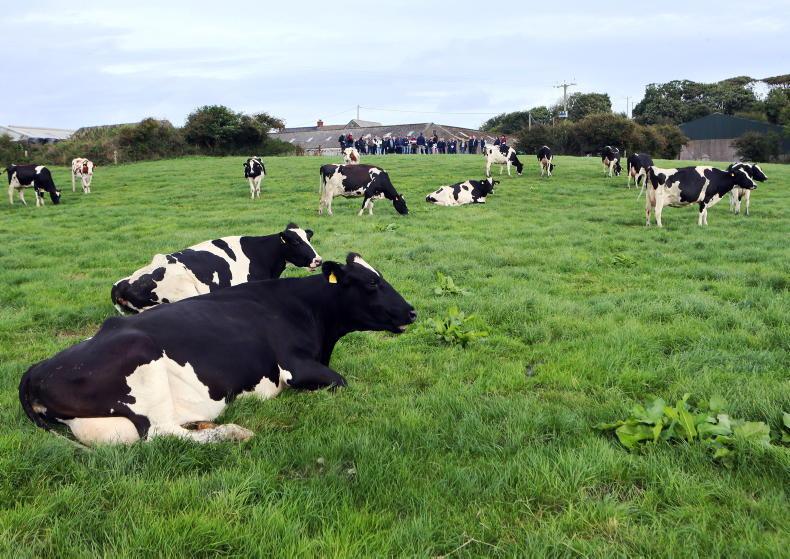
A spring-calving suckler herd might deliver more profit per cow than an autumn system, but there are a number of benefits from running both, Co Tyrone farmer Oliver McKenna told attendees at an AgriSearch event on his farm last Thursday.
Oliver keeps 40 cows on 60 acres outside Eskra, with bulls taken through to beef and heifers not retained for breeding, either finished or sold as stores. The herd is split evenly into spring and autumn, with spring cows calving in March and April, and autumn cows in August and September. At the time of the farm walk, there were only four autumn cows left to calve.
Oliver runs a high stocking rate of 2.2 to 2.5 livestock units per ha (LU/ha) and maintained this could not be achieved if all the herd was spring calving.
“It would be difficult to graze 40 spring-calving cows on this farm. The even split makes it more flexible, it divides workload, boosts cashflow and the autumn cows suit a bull beef system,” he said.
The autumn calvers are weaned the following spring, so can be ran as dry cows behind youngstock to clean out paddocks. If conditions are poor, they can also remain inside to take the pressure off grazing.
Normally Oliver houses his autumn herd from 1 October, ahead of breeding. It means he is able to hold other stock at grass, although it does require suitable facilities to house cows with young calves.
AI bred
All cows on the McKenna farm are bred exclusively using artificial insemination (AI), with Oliver doing his own insemination work. A mix of bulls are used, with heifers bred to Red Angus and Salers. Some Stabiliser genetics has been used on Simmental cows, with Limousin, Simmental and Hereford genetics also within the herd.
“I am breeding all crosses – there is never a Limousin bull put to a Limousin cow. I want easy calving, lots of milk, good temperament and good terminal traits as well,” said Oliver.
He has used some sexed semen. While availability of sexed beef bulls has been a problem, it is gradually improving every year. On average, he uses 1.5 AI straws per cow or heifer scanned in-calf.

Oliver hopes he will be able to bale this red clover sward in the next couple of weeks.
Heat collars
To help lower the workload associated with heat detection, Oliver installed a Sensehub system over four years ago. It works both in the shed and at grass, with activity collars switched between both spring and autumn cows during breeding.
When outside, the Sensehub controller, located in the yard, simply needs to pointed in the direction of the area being grazed. Notification that a cow is in heat is sent to a mobile phone. The technology can also be used to monitor general health, although there are not the issues found in a suckler herd that might exist in dairy. At the time, the system cost £1,900, plus £85 per collar.
“You have to put that cost against the ability to use top AI bulls in the herd,” said Oliver.
Paddock grazing is key to beef output
The event on the McKenna farm was the last in a series being ran in recent weeks by AgriSearch across farms which measure grass growth as part of the GrassCheck programme.
In Oliver’s case, he has been measuring grass for over 10 years, having been part of the NI Suckler Beef Programme run by the Irish Farmers Journal, ABP Food Group and CAFRE.
While broken weather in September has made grazing more challenging, ground conditions on the farm were still good last week and overall, it has been an excellent year. So far in 2025, Oliver has grown 10.36t of grass dry matter per hectare (DM/ha).
He maintained that the growth being achieved and the subsequent high stocking rate, is only possible by paddock grazing.
“I would move the cows every day if I could, but the paddocks are already small enough. None of the paddocks last more than three days,” he said.
To ease management, fertiliser is blanket spread across the grazing block once a month rather than after each grazing.
No compound fertiliser is used outside of reseeding, with Oliver relying on straight nitrogen (N) and slurry/farmyard manure.
Most fields are at index 3 for both phosphorus (P) and potassium (K).
The last fertiliser of the season went on at the start of September, with 20 units of N applied per acre (approximately two-thirds of a bag per acre).
Red clover taking over in new sward
Oliver McKenna has an exceptional clover sward, established this year in a 2.5ac field.
It is not the first time Oliver has tried to establish the crop, with a field sowed out in August 2023 with red and white clover, alongside hybrid ryegrass. It established well, but in the poor spring of 2024, the red clover was overtaken (and virtually wiped out) by the hybrid grass.
In 2025, the decision was taken to try again, but instead use conventional perennial ryegrass rather than the more aggressively growing hybrid grass. Oliver also decided to sow oats as a companion crop.
In total, 50kg of oats per acre were drilled on 14 April, with the grass seed and clover mix simply spread using a wagtail sower. Two bags per/ac of 15:15:17 was applied and the field was rolled.
A heavy crop was direct cut and ensiled on 6 August. Since then, the red clover has taken over, to the point where Oliver thinks he might have to drill in some grass seed next spring.
“The dry August seems to have suited the clover. I hope to bale it at some stage this autumn,” said Oliver.
Either way, the oats seem to have done an effective job, both in keeping weeds out of the sward and in depleting soil N reserves, thereby limiting the ability of the grass to get established ahead of the red clover.
Going forward, Oliver is keen to incorporate red clover into reseeds – even if it dies out within a couple of years, he will still be left with a grass and white clover sward. He is not interested in multispecies swards (MSS), which are probably more suited to dry parts of NI.

The calf-rearing unit on the McKenna farm is able to hold 140 calves.
In early with a pneumonia vaccine
On the McKenna farm, cows are routinely vaccinated for Leptospirosis and calves for blackleg and pneumonia.
In terms of pneumonia vaccine, Oliver said that Bovipast has worked in his situation and he intends to give the first shot of vaccine to his autumn-born calves before they are housed. He said that he did have a few issues with pneumonia in spring calves in 2024, so he has decided to pull forward the vaccination programme.
In previous years the first shot of vaccine would go in during July and the second shot in September. This year, the first 10 calves received their first dose of vaccine by the end of April, with all calves fully covered with two shots by July.
Calf house adding to cashflow
Just over four years ago Oliver McKenna invested in a calf house to rear animals for an integrated supply chain run by ABP Food Group.
Originally known as the Blade Farming model, it came under the control of ABP in 2011 when the company acquired the RWM Group in southwest England.
In NI, the scheme is now running approximately 10 years, with around 11,000 calves reared per year across 15 to 18 farms, explained Stuart Cromie from ABP.
He said rearers get a management fee per calf, with bonuses built in based on various key performance indicators. ABP pays for milk replacer, concentrate feed and vet costs, while calf rearers cover the cost of straw, electricity, water, labour and housing.
Calves normally arrive at around three weeks of age, with the aim to reach 120kg at 15 weeks, when the animals are moved to finishing units. Rearers all follow a set health protocol, involving the likes of a bovilis intranasal dose on day one, along with a ringworm vaccine and worm treatment.
In week three on the farm a ringworm booster is given, along with bovipast and a coccidiosis drench. A second shot of bovipast is administered one month later, along with an IBR vaccine.
In Oliver’s case, his house holds 140 calves at a time and with a batch put through every 16 weeks, he rears around 400 calves per year.
“It is a steady income and helps with cashflow. It also doesn’t take up any land,” said Oliver.
He has the option of taking calves through to finish and has kept some bulls to fill out pens in other housing.
Bulls nearing finish are currently on 8kg concentrate plus high-quality silage.
On average, he is able to get bulls away at 385kg at under 16 months.
SHARING OPTIONS