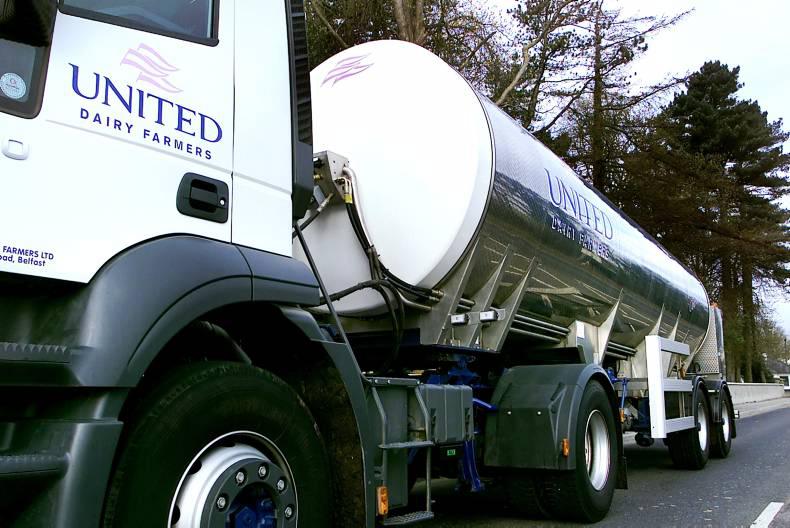
The bold decision by United Dairy Farmers to hold the price for Dale Farm Red Tractor milk while all other prices were being cut sharply for May supplies has transformed the monthly price league. The Dale Farm Red Tractor price was bottom of the league for April and has gone to the top for May for milk collected on alternate days.
This Dale Farm price is marginally above the Glanbia Milk and Fivemiletown prices and pushes them out of the joint top position that they occupied for the previous two months.
These top three prices are the only ones over 21p/l in the May league. In these comparisons, the prices are after deduction of transport charges applicable to a supplier of 650,000 litres per year collected on alternate days, with average NI seasonality of supply and with average milk quality of 3.89% butterfat, 3.21% protein, 4.7% lactose, TBC of 18 and SCC of 190.
These compositional quality and hygienic quality standards reflect the actual averages being attained in milk supplies in NI in May.
The fourth best price was paid by Aurivo, narrowly below 21p/l for milk collected on alternate days or on daily collection. The top three prices on daily collection for May were also narrowly under 21p/l, with the Dale Farm Red Tractor price edged into third spot due to its £4 every day collection surcharge.
Aurivo had been below Glanbia Cheese, Town of Monaghan and Lakeland Dairies in the April league, but has moved above them for May milk thanks to a slightly smaller cut in base price (Aurivo is down by 1.25p/l on the April level, while the others all dropped by 1.5p/l). The price cut has moved Glanbia Cheese down to sixth place for May, despite the fact that it is not deducting any milk collection charges for 12 months from November 2014.
Cut
There is very little between the prices from fifth-ranked Lakeland Dairies down to Fane Valley in eighth position in the May league. Fane Valley, with a cut of just 1p/l from its April level, has moved above the Ballyrashane price for May. The latter, even with the addition of its modest Red Tractor bonus of 0.2p/l, is bottom of this league, with the Ballyrashane Red Tractor price more than 1p below the Dale Farm Red Tractor.
That Ballyrashane price of 20.1p/l payable on around 65% of its milk, is almost identical to the price payable to members of United Dairy Farmers who do not qualify for the ‘Dale Farm Red Tractor’ farm-assured bonus (around 15% of United’s milk). United’s basic price and the Ballyrashane price in this league are below 20p/l for milk collected daily.
For the non-assured milk, United cut its price by 0.85p/l from the April level. In effect, this widened the gap between it and the Dale Farm Red Tractor price from 0.4p/l to 1.25p/l.
With the bonus more than trebled and with United offering an opportunity for the bonus to be paid retrospectively on milk supplied from 1 June by members who applied to join the Red Tractor scheme before 30 June, it’s not surprising that large numbers of United members have indeed applied to the Northern Ireland Food Chain Certification (NIFCC) to join the scheme.
Across a range of milk qualities (Table 1) and two differing sizes of supplier compared in Tables 2 and 3, the Dale Farm Red Tractor milk prices are consistently top and more than 1p/l above the bottom prices.
The bottom prices in these tables are generally those of Ballyrashane, which are close to the prices paid by United for non-assured milk and just marginally above the estimated average price of 19.72p/l paid by First Milk producer co-operative in Britain (before deduction of capital levy of 2p/l).
The estimated figure of 19.72p/l for May is a combination of an ‘‘A’’ volume price of 20.87p/l and a ‘‘B’’ volume price of 15.1p/l. These are assumptions based on the way in which First Milk’s April prices were calculated. The ‘‘blended’’ price for A and B is 19.72p/l (down 0.2p on April).
With effect from 1 June, the milk pricing arrangements at First Milk become more complicated, with seven regional prices. The prices for ‘‘A’’ volume milk in the seven regions will be cut by 0.33p/l, and B volume price will be cut by 1p/l into the range 14p to 17p/l. This will give a ‘‘blended’’ price for Lake District and Haverford West suppliers of 19.76p/l.
Prices for milk in other regions will be lower. All of this is before the 2p/l capital contribution. Another cut of 1p/l has been signalled for prices from 1 July.
Seasonality
These tables indicate prices for milk from two significantly different scales of production (350,000 litres per year and one million litres per year).
In these tables, there are differing transport charges deducted as shown in Table 4, reflecting the seasonal variation in supply from month to month.
The seasonal variation is also reflected in the monthly league table, which refers to a supplier of 650,000 litres per year with a supply ranging from just over 64,000 litres in the peak month of May to a low of 47,000 litres in November. This is a relatively ‘‘flat’’ profile when compared to milk supplies in the Republic of Ireland.
Table 3 is based on an annual milk supply of one million litres, so the calculated milk prices include volume bonuses from the companies that pay bonuses for a million litres annual supply.
In some cases, suppliers of two to three million litres or more per year are paid larger bonuses. The available information on these is listed in Table 6.
This means that a small number of large producers are receiving prices higher than those quoted in Table 3. For example:
Monaghan, whose largest suppliers receive a bonus of 0.75p/l. This is 0.5p/l above the bonus paid to the producer of one million litres per year as shown in the prices in Table 3.Aurivo and Lakeland, whose largest suppliers receive a bonus of 0.5p/l. This is 0.2p/l above the bonus paid to the producer of one million litres per year.Fane Valley whose largest producers receive a bonus of 0.4p/l. This is 0.2p/l more than the bonus taken into account in prices shown in Table 3. United/Dale Farm whose largest suppliers receive a bonus, described as a cost rebate, of 0.3p. This adds 0.2p to the prices shown in Table 3.Rolling average prices down another 1p/litre
Although still mostly above 24p/litre, the rolling average prices paid for milk in Northern Ireland over the past 12 months continue to slide as each new month is brought into the calculation and the relatively high prices of the corresponding month a year ago drop out.
Prices for May 2015 were below those of May 2014 by between 9p and 12p/litre. Replacing May 2014 with this year’s price knocked more than 1p/l off the rolling average, bearing in mind that May is the peak supply month of the year. As indicated in Tables A and B, the gap between the top and bottom rolling average prices stands close to 2p/l, with Dale Farm Red Tractor and United Dairy Farmers’ prices at the lower end. One swallow does not make a summer, but the league-topping position of Dale Farm Red Tractor prices for May milk has gone a small way towards closing the gap. More of the same is needed for a sustained period.
The top rankings are generally shared among Lakeland Dairies, Glanbia Milk, Fivemiletown and Aurivo. With dairy co-ops warning that they cannot continue to pay out more than they get in from sales of dairy products and signs of this emerging in the price cuts seen for May milk, the prospects are that the 12-month rolling average prices will continue to slide for most of 2015 and possibly into 2016. This is not good news for milk producers, who have to bear the brunt of low prices – but the alternative is that dairies could get themselves into a position like First Milk in Britain.
The recently reported loss of £22m during the year to March 2015 is the latest in a stream of drastic figures from First Milk. The producer co-operative, with around 1,200 members, is in a really dire situation. Last week, its chair, former Minister of State Sir Jim Paice, resigned. This comes shortly after having appointed a new chief executive, Mike Gallacher, who has no previous experience in the dairy industry.
Gallacher has taken to the task of turning the business around, with cost reductions and a ‘‘refocus’’. He said that the losses in 2014/15 reflect difficult market conditions, coupled with a poor operational performance from the business in a year that First Milk paid out a higher milk price to farmers than was received in commercial returns. Since December, before Gallacher’s arrival, First Milk had been deducting a capital levy of 2p/l from its milk suppliers and its payments for milk were delayed by two weeks to provide cashflow for the business. Gallacher has made it clear that First Milk will only pay out what it gets in.
Chief executives
Generally, new CEOs coming in to turn a business around seem to pack as much of the losses as possible into the accounts for the year prior to their arrival. But sources within the trade are wondering if there might be even more to come in the case of First Milk as the business is likely to shrink and sell off assets.
Shrinkage seems inevitable as many of the milk-producing members of the co-op won’t survive at the current milk prices being paid by First Milk (some in the region of 15p/l to 18p/l). The shrinkage would be happening wholesale at present, if the milk producers had any other buyer for their milk. The scary thing is that there is little or no interest from other milk processors at this time.
In a letter to suppliers, Paice said that the company needs board members with ‘‘real commercial and business skills’’. An urgent re-assessment of the skills of board members is part of the ‘‘recovery plan’’. Paice had been criticised for taking a £90,000 a year salary for 50 days work sitting on the board as chair of First Milk.
Milk prices below cost – EU Milk Market Observatory
Milk prices have been below operating costs on average across dairy farms in the EU since October 2014. This is one of the pieces of information published by the European Commission’s Milk Market Observatory (MMO), which was set up in April 2014 to provide transparency in monitoring the EU dairy sector. The MMO aims to quickly distribute up-to-date market data, including volumes, prices, EU imports and exports, throughout the milk supply chain.
Vast quantities of information are provided on prices across a large range of dairy products. Operating costs and margins for producers are covered to a lesser extent.
The bold decision by United Dairy Farmers to hold the price for Dale Farm Red Tractor milk while all other prices were being cut sharply for May supplies has transformed the monthly price league. The Dale Farm Red Tractor price was bottom of the league for April and has gone to the top for May for milk collected on alternate days.
This Dale Farm price is marginally above the Glanbia Milk and Fivemiletown prices and pushes them out of the joint top position that they occupied for the previous two months.
These top three prices are the only ones over 21p/l in the May league. In these comparisons, the prices are after deduction of transport charges applicable to a supplier of 650,000 litres per year collected on alternate days, with average NI seasonality of supply and with average milk quality of 3.89% butterfat, 3.21% protein, 4.7% lactose, TBC of 18 and SCC of 190.
These compositional quality and hygienic quality standards reflect the actual averages being attained in milk supplies in NI in May.
The fourth best price was paid by Aurivo, narrowly below 21p/l for milk collected on alternate days or on daily collection. The top three prices on daily collection for May were also narrowly under 21p/l, with the Dale Farm Red Tractor price edged into third spot due to its £4 every day collection surcharge.
Aurivo had been below Glanbia Cheese, Town of Monaghan and Lakeland Dairies in the April league, but has moved above them for May milk thanks to a slightly smaller cut in base price (Aurivo is down by 1.25p/l on the April level, while the others all dropped by 1.5p/l). The price cut has moved Glanbia Cheese down to sixth place for May, despite the fact that it is not deducting any milk collection charges for 12 months from November 2014.
Cut
There is very little between the prices from fifth-ranked Lakeland Dairies down to Fane Valley in eighth position in the May league. Fane Valley, with a cut of just 1p/l from its April level, has moved above the Ballyrashane price for May. The latter, even with the addition of its modest Red Tractor bonus of 0.2p/l, is bottom of this league, with the Ballyrashane Red Tractor price more than 1p below the Dale Farm Red Tractor.
That Ballyrashane price of 20.1p/l payable on around 65% of its milk, is almost identical to the price payable to members of United Dairy Farmers who do not qualify for the ‘Dale Farm Red Tractor’ farm-assured bonus (around 15% of United’s milk). United’s basic price and the Ballyrashane price in this league are below 20p/l for milk collected daily.
For the non-assured milk, United cut its price by 0.85p/l from the April level. In effect, this widened the gap between it and the Dale Farm Red Tractor price from 0.4p/l to 1.25p/l.
With the bonus more than trebled and with United offering an opportunity for the bonus to be paid retrospectively on milk supplied from 1 June by members who applied to join the Red Tractor scheme before 30 June, it’s not surprising that large numbers of United members have indeed applied to the Northern Ireland Food Chain Certification (NIFCC) to join the scheme.
Across a range of milk qualities (Table 1) and two differing sizes of supplier compared in Tables 2 and 3, the Dale Farm Red Tractor milk prices are consistently top and more than 1p/l above the bottom prices.
The bottom prices in these tables are generally those of Ballyrashane, which are close to the prices paid by United for non-assured milk and just marginally above the estimated average price of 19.72p/l paid by First Milk producer co-operative in Britain (before deduction of capital levy of 2p/l).
The estimated figure of 19.72p/l for May is a combination of an ‘‘A’’ volume price of 20.87p/l and a ‘‘B’’ volume price of 15.1p/l. These are assumptions based on the way in which First Milk’s April prices were calculated. The ‘‘blended’’ price for A and B is 19.72p/l (down 0.2p on April).
With effect from 1 June, the milk pricing arrangements at First Milk become more complicated, with seven regional prices. The prices for ‘‘A’’ volume milk in the seven regions will be cut by 0.33p/l, and B volume price will be cut by 1p/l into the range 14p to 17p/l. This will give a ‘‘blended’’ price for Lake District and Haverford West suppliers of 19.76p/l.
Prices for milk in other regions will be lower. All of this is before the 2p/l capital contribution. Another cut of 1p/l has been signalled for prices from 1 July.
Seasonality
These tables indicate prices for milk from two significantly different scales of production (350,000 litres per year and one million litres per year).
In these tables, there are differing transport charges deducted as shown in Table 4, reflecting the seasonal variation in supply from month to month.
The seasonal variation is also reflected in the monthly league table, which refers to a supplier of 650,000 litres per year with a supply ranging from just over 64,000 litres in the peak month of May to a low of 47,000 litres in November. This is a relatively ‘‘flat’’ profile when compared to milk supplies in the Republic of Ireland.
Table 3 is based on an annual milk supply of one million litres, so the calculated milk prices include volume bonuses from the companies that pay bonuses for a million litres annual supply.
In some cases, suppliers of two to three million litres or more per year are paid larger bonuses. The available information on these is listed in Table 6.
This means that a small number of large producers are receiving prices higher than those quoted in Table 3. For example:
Monaghan, whose largest suppliers receive a bonus of 0.75p/l. This is 0.5p/l above the bonus paid to the producer of one million litres per year as shown in the prices in Table 3.Aurivo and Lakeland, whose largest suppliers receive a bonus of 0.5p/l. This is 0.2p/l above the bonus paid to the producer of one million litres per year.Fane Valley whose largest producers receive a bonus of 0.4p/l. This is 0.2p/l more than the bonus taken into account in prices shown in Table 3. United/Dale Farm whose largest suppliers receive a bonus, described as a cost rebate, of 0.3p. This adds 0.2p to the prices shown in Table 3.Rolling average prices down another 1p/litre
Although still mostly above 24p/litre, the rolling average prices paid for milk in Northern Ireland over the past 12 months continue to slide as each new month is brought into the calculation and the relatively high prices of the corresponding month a year ago drop out.
Prices for May 2015 were below those of May 2014 by between 9p and 12p/litre. Replacing May 2014 with this year’s price knocked more than 1p/l off the rolling average, bearing in mind that May is the peak supply month of the year. As indicated in Tables A and B, the gap between the top and bottom rolling average prices stands close to 2p/l, with Dale Farm Red Tractor and United Dairy Farmers’ prices at the lower end. One swallow does not make a summer, but the league-topping position of Dale Farm Red Tractor prices for May milk has gone a small way towards closing the gap. More of the same is needed for a sustained period.
The top rankings are generally shared among Lakeland Dairies, Glanbia Milk, Fivemiletown and Aurivo. With dairy co-ops warning that they cannot continue to pay out more than they get in from sales of dairy products and signs of this emerging in the price cuts seen for May milk, the prospects are that the 12-month rolling average prices will continue to slide for most of 2015 and possibly into 2016. This is not good news for milk producers, who have to bear the brunt of low prices – but the alternative is that dairies could get themselves into a position like First Milk in Britain.
The recently reported loss of £22m during the year to March 2015 is the latest in a stream of drastic figures from First Milk. The producer co-operative, with around 1,200 members, is in a really dire situation. Last week, its chair, former Minister of State Sir Jim Paice, resigned. This comes shortly after having appointed a new chief executive, Mike Gallacher, who has no previous experience in the dairy industry.
Gallacher has taken to the task of turning the business around, with cost reductions and a ‘‘refocus’’. He said that the losses in 2014/15 reflect difficult market conditions, coupled with a poor operational performance from the business in a year that First Milk paid out a higher milk price to farmers than was received in commercial returns. Since December, before Gallacher’s arrival, First Milk had been deducting a capital levy of 2p/l from its milk suppliers and its payments for milk were delayed by two weeks to provide cashflow for the business. Gallacher has made it clear that First Milk will only pay out what it gets in.
Chief executives
Generally, new CEOs coming in to turn a business around seem to pack as much of the losses as possible into the accounts for the year prior to their arrival. But sources within the trade are wondering if there might be even more to come in the case of First Milk as the business is likely to shrink and sell off assets.
Shrinkage seems inevitable as many of the milk-producing members of the co-op won’t survive at the current milk prices being paid by First Milk (some in the region of 15p/l to 18p/l). The shrinkage would be happening wholesale at present, if the milk producers had any other buyer for their milk. The scary thing is that there is little or no interest from other milk processors at this time.
In a letter to suppliers, Paice said that the company needs board members with ‘‘real commercial and business skills’’. An urgent re-assessment of the skills of board members is part of the ‘‘recovery plan’’. Paice had been criticised for taking a £90,000 a year salary for 50 days work sitting on the board as chair of First Milk.
Milk prices below cost – EU Milk Market Observatory
Milk prices have been below operating costs on average across dairy farms in the EU since October 2014. This is one of the pieces of information published by the European Commission’s Milk Market Observatory (MMO), which was set up in April 2014 to provide transparency in monitoring the EU dairy sector. The MMO aims to quickly distribute up-to-date market data, including volumes, prices, EU imports and exports, throughout the milk supply chain.
Vast quantities of information are provided on prices across a large range of dairy products. Operating costs and margins for producers are covered to a lesser extent.







SHARING OPTIONS