



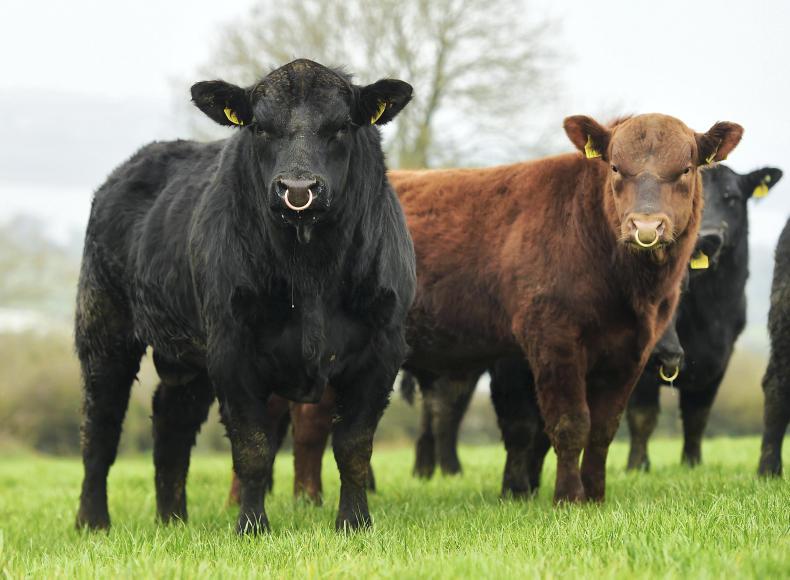
Where a horned bull and cow mate, there is just a one in 20,000 chance of producing a polled calf.
A growing trend among breeders at present is polling – the process of selective matings between polled animals so as to increase the number of polled animals in a horned breed herd.
What is surprising is that the polled gene (P) is actually dominant over the horned one (p) in cattle. So, if a bull has two polled genes (PP), or is homozygous, then all of its resulting calves will be polled.
There are obvious benefits to working with polled cattle, including the reduced risk of injury
Also if a bull has one polled and one horned gene (Pp), or heterozygous, its calves will be polled.
However, if the bull is heterozygous polled (Pp), it will pass either the polled or horned gene on, resulting in half of its calves being horned and half of them being polled.
Scurs
There are additional genes that affect horn-like growths called ‘scurs’, on an animal’s head.
Scurs are under-developed horns which are generally loose and movable and not attached to the skull. They range in size from small scab-like growths to occasionally being almost as large as horns.
Because the gene for scurs is transmitted separately, it has no effect on the presence or absence of horns. Not all horned cattle carry the gene for scurs and not all polled cattle lack the scur gene. Scurs can obviously cause a lot of confusion for someone who expected their calves to be completely polled.
The gene for scurs is expressed differently from the gene for polledness. The sex of the animal also has an effect on how scurs appear.
Scurs are more common in bulls than cows. In males the scur gene is dominant, meaning that if only one of the two parents carry the scurs gene then the resultant bull will be scurred.
Therefore, it is easy to tell if a bull carries the scur gene and to eliminate it from the herd.
For cows, the scur gene is recessive, meaning that both parents must possess the gene for scurs in order for the resultant cow to be scurred.
If the cow possesses only one scur gene, she will not have scurs herself, but has a 50% chance of passing the scur gene on to her calf. This is why you often hear of animals being either ‘smooth polled’ or ‘scurred’.
Benefits
There are obvious benefits to working with polled cattle, including the reduced risk of injury as well as putting less stress on the calf through dehorning.
However, there is another benefit that largely goes unnoticed but which is important in today’s world of €uro-Stars.
Excluding Angus and Hereford, a total of 180 polled AI bulls, covering 18 breeds, have been used in Ireland to-date
The ICBF incorporates the benefits of polledness in its breeding indexes. Polledness has an economic weighting of €5.95 in the Replacement Index. All animals, apart from Aberdeen Angus (AA), must be genotyped to establish their polledness status before a polledness contribution can be included in their index.
All AA animals will be given a polledness contribution depending on the percentage of AA genes in their breed makeup before they are genotyped. These animals receive a contribution based on that percentage.
Once genotyped, the polledness status can be properly established. AA animals will either receive the homozygous (€5.95) or heterozygous (€2.97) value.
In the past, polled cattle were considered to be behind their horned counterparts in terms of quality and performance.
However, breeding programmes around the world have greatly reduced that gap. Indeed, the number of polled beef and dairy bulls available through AI is ever increasing.
AI bulls
Angus and Hereford are two breeds that have always been well known for polledness.
However, in recent years the percentage of polled animals across other breeds is increasing.
Excluding Angus and Hereford, a total of 180 polled AI bulls, covering 18 breeds, have been used in Ireland to-date.
Traditionally breeders would have just brought in a small quantity of semen from particular polled bulls for their own pedigree matings.
Now it is becoming common for AI companies to carry the semen of polled bulls from these other breeds as well as standing such bulls in their studs.


SHARING OPTIONS