


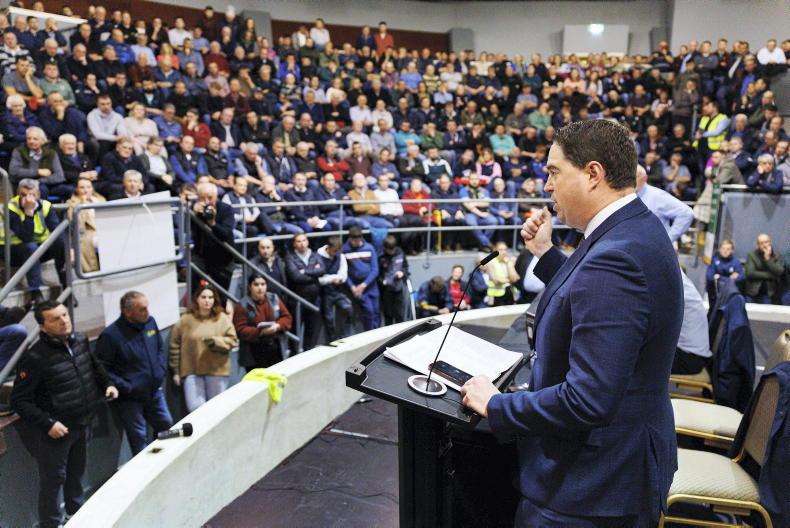
The big story from Monday night’s IFA nitrates derogation meeting was the extraordinary turnout of farmers.
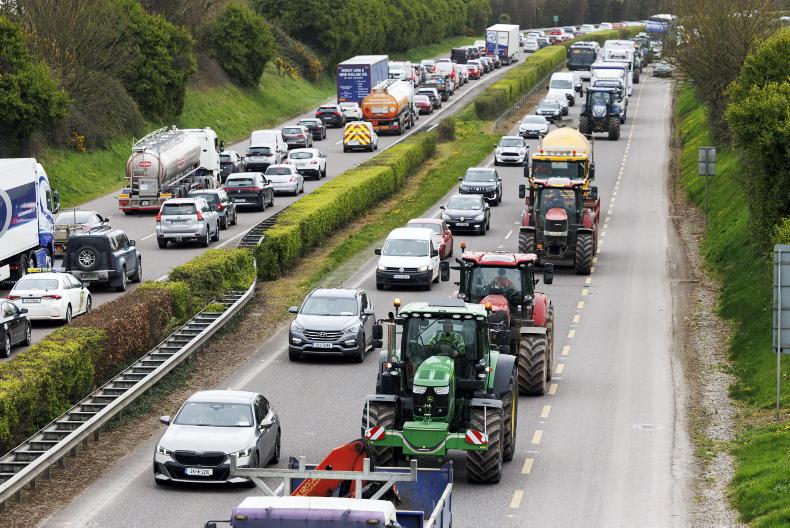
People travelled from every corner of the country on what was a very dirty evening to be present. There were people crammed into every nook and cranny of Corrin Mart’s expanse, from the outside army of volunteers parking cars, tractors and milk lorries, to the main sales ring, which was a cauldron, packed to the rafters.
An overflow room was equally full, with the proceedings being relayed onto big screens. The concourse in between was equally full of people, as many as 30 deep.
It’s fair to say that there was little disagreement between farmers and the minister. When Martin Heydon pleads Ireland’s case he will be presenting on behalf of a broad sectoral platform, aligned not just on the essential necessity of the derogation, but also the key arguments in favour of its retention.
Speaker after speaker returned to one of three essential themes. First, Ireland has a derogation allowing higher stocking rates than the standard European limit because of the unique nature of the Irish climate and our ability to grow and utilise grass with stock mostly outside in their natural environment.
Secondly, there has just been a significant change to the derogation limit, only two years ago, and a period of stability is needed to allow farmers adjust to that lower limit. We could call that the economic sustainability argument.
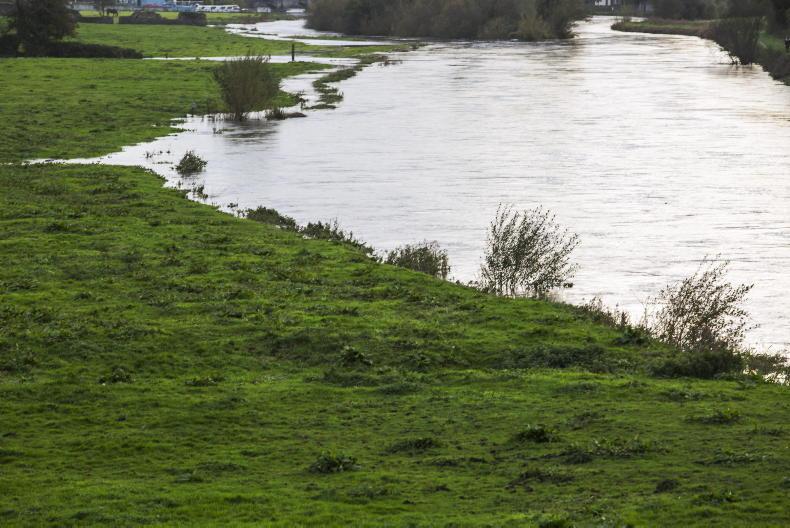
And thirdly, the relationship between current farming practice and the effect of that practice on water quality is only crudely understood by the metric of nutrient levels in water year-to-year. Soil processes are complex, travel times vary wildly in our patchwork of soil types, and crucially, other pollution sources are an external factor beyond farming’s control.
The big problem team Ireland faces is that the European Commission is the opposition, the referee and the rulemaker. The more farmers tried to load responsibility for delivering an acceptable outcome on Heydon’s shoulders, the more strongly he emphasised that he could do no more than deliver the best possible case.
Farmers will blame the minister if he fails to retain the derogation, when it’s something that is outside his control.
There is a deep irony in that, because the unfairness of being blamed for something that is outside your control is exactly what farmers are basing their opposition to further changes to the Nitrates Directive on.
Failure is not an option, but it’s a real possibility. And success could be pyrrhic, depending on the strings attached.




SHARING OPTIONS