


Just over two years ago I bought another piece of land.
It is not as good quality as my home farm, but it is close, so it was worth a chance. There had not been much work done on that farm for a long time.
It was in a lot of small fields, with the hedges growing way out into them. The sheughs were completely full of silt – so much so that it was impossible to tell they were sheughs. It was in a lot of small fields with the hedges growing out of control.
The sheughs were completely full of silt - so much so that it was impossible to tell they were sheughs.
There were practically no internal fences and it had never been reseeded in my lifetime (probably never). The only sure way of ensuring livestock stayed within the main boundary was with electric wire.
There was no cattle housing, or any handling pens. There were fields that I could not get into with a tractor and even some that I could not get into on foot.
All in all, it looked like a massive undertaking to bring it back into some kind of shape that we could make money from it.
Grazing
We decided that it would be a grazing farm and this meant that we were not too concerned about the size of the fields (a lot were small). We made the decision not to remove any of the hedges, but instead to cut them back, clean the sheughs and fence the whole thing.
There are about 25 acres in total, split by a laneway. So rather than do it all in one go, we decided to do one side of the lane to start with and then move to the other side. It turned out to be a lot more work than we had anticipated.
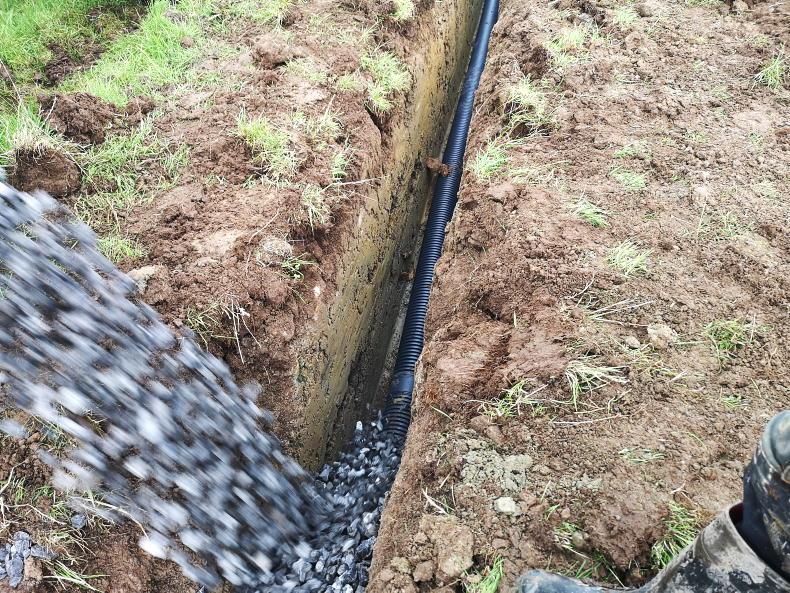
We hired in a digger to do the heavy work and tried to do all the lighter work ourselves, including tidying up hedges and all the fencing. Then this spring we got the digger back to put in a few drains in wetter parts. At last, almost two years later, we got it ploughed.
I get a lot of personal satisfaction from seeing ground ploughed. It is like turning over a new page in a book. You have excitement and trepidation about what lies beneath. It turned out to be reasonably good soil, with very few stones (which is always a bonus).
The one thing that did surprise me was the fact that it was badly panned. The roots only went down about 2” and then there was a hard layer. This was surprising, as there had been very little tractor work ever carried out on this farm – any compaction was just due to grazing livestock.
Thankfully, the plough went down below this level, and I am hopeful that we will have rectified this problem.
Down through the years I have tried different methods of reseeding, but I have found that a full plough reseed works a lot better here. It is more expensive, but I feel that it is money well spent.
Looking out over the finished job gives me a lot of personal satisfaction. We have just a few little things left to do, including a few gates to hang, water drinkers to install and then set up a paddock system. Hopefully, next year this part of the farm will start to yield a return on investment.
It is our intention to move across the lane now and start work on the rest of the farm. It is a bit daunting, but when we look across the lane and see what we have done, it will give us the incentive to move on. It would have been nice to have been able to do the whole farm in the one go, but with trying to do most of the work ourselves that was impossible.
There is an old saying, “Rome was not built in a day”, which seems very appropriate at this stage.



SHARING OPTIONS