Wagyu beef has hit Irish supermarket shelves in the past couple of months, with the breed front and centre in many stores. The country’s three main beef factories, Kepak, ABP and Dawn Meats, have all jumped on the Wagyu train and have farmer Wagyu programmes up and running.
Why Wagyu? The factories outlined that consumers were seeking a finer home-dining experience and an increased selection of premium products to choose from when they do their weekly shop. Wagyu ticked all the boxes.
Supervalu has partnered with Kepak and Warrendale Wagyu with the aim of producing premium quality Wagyu beef for the Irish market.
They are working with both dairy and beef farmers and currently have over 200 farmers enrolled in the scheme.
A price bonus is guaranteed from the factory at slaughter for beef farmers, while dairy farmers involved in the programme are guaranteed a flat price for calves at sale.
The partnership sees dairy farmers breed Wagyu calves, before the calves are transported to a beef farmer who rears them and brings them to finish.
Cathal Doyle of Warrendale Wagyu Ireland said the system works for both dairy and beef farmers. He also finishes Wagyus on his own farm at home.
“When the dairy farmer is AI’ing the cow, they know what price they are getting for the calf – they are guaranteed a price of €400 a head – for bulls and heifers,” he said.
“The Wagyu is an easy calving breed, which is important for the dairy farmer, in terms of milk production and getting her in-calf again.”
Calves are around four weeks when they are bought from dairy farmers, and it is a requirement that the dairy farmer be a participant of the National Genotyping Programme, to ensure a quality animal is bred.
Straightforward
“It is a very straightforward system. The dairy farmer gives us a ring when the calves are ready to go, and we collect them from the yard for free. We give them a herd number to do a movement cert, and they are paid the next day for their calves.
"All we ask is that the calves are fit and healthy and in-spec for the beef farmer,” Doyle said.
“The contract guarantees the beef farmer a price of €1.50/kg over the flat price on top of the weekly AQP if they finish the animal with us.”
In terms of management, Cathal said that it is similar to any other calf.
“They are reared the same way and match in well with any other stock on the farm, farmers like them because they are a quiet and easily managed animal.”
“We made the price as competitive as possible. Farmers know going into the factory that they are being paid on carcase weight. Kill reports so far match with any Angus and Hereford of their age.
"A lot of our Wagyu are killing out at 51%. So, any farmers that are weighing animals before they are finished can do the maths, and they know what they are getting before the animal leaves the yard.”
Animals in the contract must be finished as bullocks and heifers and under 30 months of age.
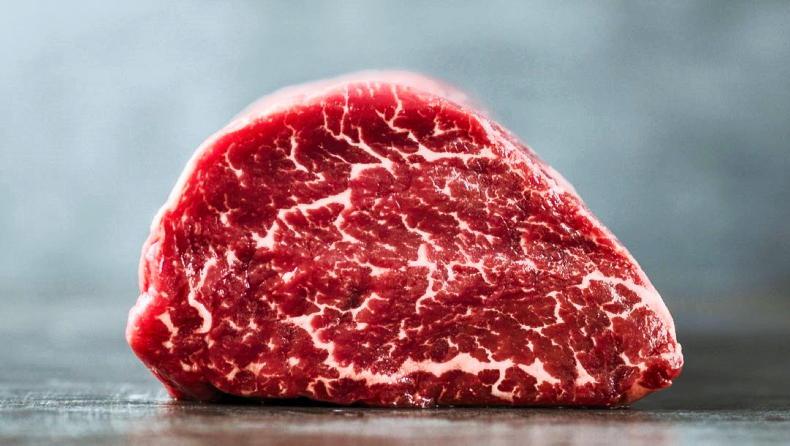
“The selling point of Wagyu is the eating quality – the meat is marbled, it is quite tender which makes for a great eating experience,” Doyle said.
ABP
Stephen Connolly, ABP agri sustainability manager, said that there were a number of reasons why ABP decided to get involved in Wagyu beef.
“We had Aldi looking for something as a point of difference for customers, a fine dining experience at an affordable price. We settled on Wagyu because of its high eating quality,” he said.
The supermarket now stocks Wagyu steaks, meatballs and burgers.
While consumers might feel like Wagyu is a new departure for the beef sector, ABP started off on this journey in 2022, Connolly said.
“We did trials on our Carlow farm to see how they formed, and that went quite well. They were first on the shelf in 2023. This is our third year now with Aldi with the product.”
ABP operates a Wagyu integrated scheme for farmers where Connolly says the processor selects the best pedigree Wagyu genetics from across the world. Much of the straws are sourced in Australia, with bulls selected based on marbling quality of their beef and animal performance.
“There are various options available to get involved in the programme: dairy farmers can sell Wagyu calves to ABP or an ABP finisher at three to four weeks of age with a guaranteed minimum prices for their calves and free semen; dairy farmers can bring their Wagyu beef cattle to finish in ABP; beef farmers can purchase a calf at three to four weeks of age from our dedicated dairy farms and bring to finish.
"ABP support the delivery and purchase of the calves; and there is an option for dedicated calf rearers to rear these Wagyu calves for the first 12 weeks before they go to dedicated Wagyu finisher farms. This may be an option for young farmers with available sheds and may aid cashflow,” he said.
Connolly said that the there is a guaranteed minimum price for farmers who take part in the ABP programme and prices are based on the cost of production.
He did not say what bonus structure or payment was in place in the scheme.
However, he warned that anyone thinking of going into rearing Wagyu calves needs to be linked up with a processor. The key to getting Wagyus to finish at 24 months is to get the genetics right, he said, adding that they are a slightly smaller animal compared to an Angus or Hereford cross calf and they “take a bit more minding”.
“They get up to 300kg carcase weight and they kill out around the same as an Angus, at around 51%.”
Dawn Meats
As a company, Dawn Meats would always pride itself on being to the forefront of innovation and that involves meeting consumer needs, Paul Nolan, Dawn Meats’ Group development manager told the Irish Farmers Journal.
“We are very conscious of listening to what market signals are out there and certainly there seems to be an interest among the retailers in giving a choice in terms of quality and luxury food experiences – the idea of taking restaurant dining to the home – and we thought that Wagyu would certainly fit that niche.
He said that Wagyu beef is something that Dawn has been working on in the background for a number of years.
“We went out and identified a small number of farmers that were breeding a few Wagyu and worked closely with them. Over the last 12 months, with a bit of momentum starting to gather, we have started to work specifically with farmers where Dawn would provide the semen to be crossed on their cows, then the farmer rears the animals with and for us,” he said.
In terms of getting farmers involved, he said that a farmer can make it known that they have stock available and Dawn Meats buys them or alternatively, Dawn Meats provides the dairy farmer with semen and guarantees to buy the stock from them when they are ready for slaughter.
“The farmer can offer us back the calf or take it through to finish themselves,” he said, and if it is the case that the farmer does not want to finish the animal, Dawn offers to “take the animals and place them elsewhere”.
He said that a grass-finished animal achieves better flavour and taste and enhanced eating quality, while an intensively grain fed animal achieves a more marbled carcase.
“When people often think of Wagyu they think of animals that are very heavily marbled, which is the Japanese model, and that is the way they value the animal. What we find people want in this part of the world is a very tasty product with reasonable marble, so we are typically looking for 4+ on a Japanese scale, whereas in Japan you’d want to be at 12+.”
Dawn Meats also pays a bonus for Wagyu beef, which Nolan said is “based on the specification, and it is a bonus above the market price”.
He noted that it is “based on a minimum market price, which is based on mutual assumptions about what the market will be”.
Best steak
Nolan referenced Dawn Meat’s Wagyu grass-fed steak which won best grass-fed rib eye steak at the world steak challenge last year and said that “there is a certain amount of pride for farmers in producing meat to a high level”.
Irish Wagyu has also gone global, with Bord Bia launching Dawn Meats’ Irish Wagyu steak on the Canadian market earlier this year.
ABP and Dawn Meats would not confirm what their bonus payment was for Wagyu animals when queried by the Irish Farmers Journal. In April, Supervalu invested €2.4m to develop an end-to-end Wagyu beef supply chain with Kepak and Warrendale Wagyu.
Áine Geary, beef and lamb trading manager with Musgraves, the owner of Supervalu, told the Irish Farmers Journal that it has been working on the programme intensely for the last three years.
“We are constantly interacting with our consumers, out meeting with our retailers and as part of that, interacting with shoppers.
Real interest
“We knew from our retail partners that there was real interest in this.
“We could see there was a demand for more premium products. Consumers are looking to recreate restaurant experiences at home; they are travelling more than they ever have before.
“We had a very small-scale offering across the summer months, on a very limited scale. We could see the demand was there for it. Wagyu is here to stay; we are really committed to it. We believe that the consumer is really interested in it as well. Retailers are positive about it too,” she said.
The Wagyu breed and Irish breeding
Wagyu is a breed native to Japan, with the beef renowned for its marbling and flavour. Numbers of the breed are increasing Ireland, with very low numbers, likely in the hundreds, of the breed recorded in Ireland up until 2024.
In 2024, 5,525 Wagyu sired calves were born in Ireland. The vast majority of these were out of Frieisan cows with 4,255, followed by 495 Jerseys and 238 Anguses. A total of 211 calves were from purebred Wagyu animals.
Some 85 Wagyu cattle were imported from Northern Ireland in 204 and went direct to slaughter.
Last year, a record number of Wagyu sired calves were recorded with 7,441. Some 6,444 of these calves were out of Friesian dams, 257 were from Jerseys and 221 were from Angus cows. Some 219 pedigree Wagyu animals were recorded.