



Beef price quotes have fallen again this week, resuming the downward trend of 2026 after a few weeks of stability. Prices are now just over €1/kg lower than they were this time last year. With factory throughput at 31,474 head last week and the year-to-date kill down by over 14% or 81,328 head, it certainly isn’t a glut of cattle that is the issue. That leaves the market as the obvious other place to look for an answer.
Ireland has two main markets for beef shipments: the UK, which takes just under half of all beef exports, and EU countries, which between them take most of the rest with between 5% and 10% sold in international markets.
Around 10% of our production is sold in the home market. What happens in the UK is, therefore, the most significant influence on the value of Irish beef.
Within that market, the highest value segment is the supermarket sector for a range of beef cuts and burger chains which are high value customers for mainly forequarter ground or minced beef.
Shopper and consumer behaviour
The farm gate price increases throughout the spring of last year didn’t result in an immediate increase in UK supermarket beef prices at the same rate.
There was a time lag of several weeks before retail prices began to rise significantly but it is notable that they have kept rising right into this year when farm gate beef prices have been falling.
The latest Worldpanel by Numerator UK data, published by AHDB, shows that total beef retail spend increased by 7.6% in the twelve weeks to 19th April compared with the same period last year.
This reflected an average price increase of 14.7%, which meant that even though shoppers spent more money, there was a decline of 6.2% in the volume of beef sold in retail outlets.
This is the latest in a series of these reports which show that shoppers are spending more money but getting less beef in their basket.
The three largest UK supermarkets –Tesco, Sainsbury’s and Asda – offer exclusively British and Irish beef.
The industry view is that they are quite relaxed about losing volume sales as they are focused on restoring their margin on beef which had disappeared during 2025.
Supermarkets are buyers of the full range of beef cuts , however their low purchases of steak meat has meant a build up of stocks.
The Irish Farmers Journal has learned of a processor offering a similar price for steak meat to what they were getting a decade ago in an attempt to move volume on promotion.
The imports factor
At the end of May this year, it will have been three years since the UK trade deals with Australia and New Zealand came into operation.
However, it has only been over the past year that their beef exports to the UK increased significantly which coincided with the period in which UK and Irish cattle prices increased.
Figure 1 shows that Australia’s beef exports to the UK in April were 2,709 tonnes, the highest monthly total since the trade deal came into effect.
New Zealand exports to the UK (Figure 2) were lower in the first quarter of 2026 compared with the previous quarter, but are 211% ahead of where they were in the first quarter of 2025.
While this beef may not be entering the retail sector in any significant volumes at present, it does however impact on the wholesale and catering beef markets.
Impact of chicken
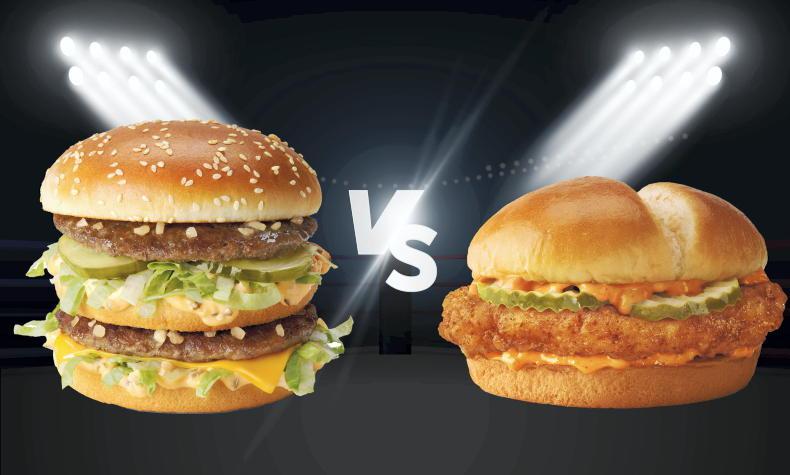
The current McDonald’s campaign which encourages their customers to switch from their usual order to chicken is the latest example of how poultry meat’s dominance of the meat market continues to increase.
For decades, the competitive advantage of poultry meat and to a lesser extent pork has increased due to huge genetic progression in poultry and pigs as well as the grain used in animal feed. Grain prices were relatively low in 2025, making pork and poultry meat competitive compared to the ruminant-based beef and sheep meat over the past year.
While the current McDonald’s campaign has coincided with this, they have had a long-term strategy of product diversification often tailored to reflect the different cultures around the world where its stores are located. Not all products are an outstanding success and some are sidelined or even dropped. Earlier this year, the Irish Farmers Journal reported that McDonald’s was revising its UK and Irish menus to remove all the plant-based options with the exception of the McPlant burger.
While McDonald’s are synonymous with the Big Mac, chicken has been integral to their product portfolio for several years. In its “Accelerating the Arches” strategy which it made public in 2023, the company identified chicken as well as burgers and coffee in the “commit to the core” segment of its “M C D growth pillars.” Chicken-based products have been and will continue to be an integral part of the menu.
OECD/FAO Outlook
The Organisation for Economic Co-operation and Development (OECD) and Food and Agriculture Organisation (FAO) of the United Nations (UN) publish a ten-year agricultural outlook, updated annually.
In the 2025 edition, they forecast that the global production of all meats will increase in the decade to 2034 by 46m tonnes to 406m tonnes.
Poultry meat is forecast to account for 62% of the increase with volume increasing to 173.4m tonnes.
Pig meat will remain the second largest meat category with a 5% increase to 129.6m tonnes with beef increasing by 10m tonnes to 83.7m tonnes and sheep meat increasing by 2.5m tonnes to 19.3m tonnes.
As Table 1 shows, in high income countries, per capita poultry meat consumption is expected to grow to 23.9kg in 2034, an increase of more than 5kg over two decades. Pig meat consumption increases slightly to 22kg per person but beef consumption is forecast to dip below 13kg per person, a slight decline. Sheep meat is forecast to stay stable at just over 1kg per person.
Upper middle income countries also show a 5kg increase in per capita poultry meat consumption over two decades to just over 16kg per person.
Interestingly from a beef perspective, these countries show that per capita beef consumption is forecast to grow to 7.6kg per person in 2034, up from 6.2kg per person between 2012-2014.
Sheep meat consumption is also forecast to increase to 2kg per person, up from 1.5kg per person.
Comment
Intensively produced pig and poultry meat has increased their advantage over ruminant meats during the past year thanks to low grain prices. However, they have enjoyed an overall price advantage for decades and increasing per capita consumption along the way.
While beef production in Ireland, the UK and much of Europe is among the most efficient in the world, it hasn’t made the same strides in genetic improvement as the white meats.
Furthermore, EU and since Brexit, UK policy has been to ban the use of growth promoting hormones that would increase output from beef production making it more efficient.
The quid pro quo for European beef producers has been access to supports from the Common Agricultural Policy (CAP) and an EU market protected by tariffs and trade policy.
Both these policies have undergone change. Reforms have reduced the level of support for beef producers and market access has opened up, particularly in the UK post Brexit through their deals with Australia and New Zealand.
The EU deal with Mercosur will be phased in and is limited to 99,000 tonnes at a 7.5% tariff plus a reduction on the Hilton quota tariff from 20% to zero. The challenge to beef from poultry in the meat protein market has been increasing for decades and will continue to do so. However, competition in the UK imported beef market has only significantly increased in recent months, and that has had the greater impact on Irish beef.
As for McDonald’s current focus on chicken over beef, this is the latest initiative in diversifying their product range using a competitively priced product. Given the price difference between poultry meat and beef, they likely have a better margin on it as well.
However, if they ever choose to abandon their British and Irish origin sourcing policy for beef, then they would be able to offer a lower cost Big Mac made with less expensive imported beef from outside Europe.
If they were to adopt this policy it would be a bigger threat to irish beef than promoting chicken. It isn’t either chicken or trade deals that is the competition for Irish beef, it is both!





SHARING OPTIONS