



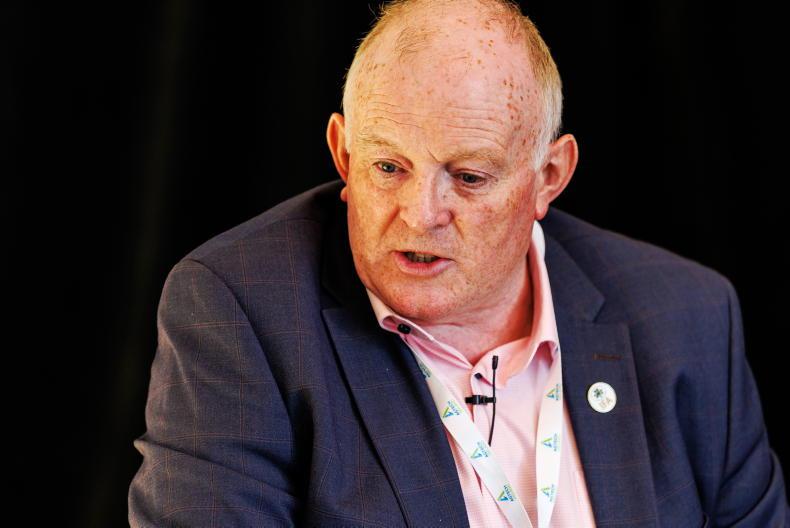
The Irish Farmers Association (IFA) discussed the medium- and long-term priorities for the agricultural sector with Minister for Agriculture Martin Heydon and Tánaiste and Minister for Foreign Affairs Simon Harris on Monday.
Topics such as the retention of the nitrates derogation, the danger of the Mercosur deal, excessive regulation, input costs and the challenges facing the tillage sector were the main topics of conversation, according to the IFA.
IFA president Francie Gorman highlighted to the Tánaiste two trade issues to dedicate resources towards - opposing the Mercosur deal and the US imposed tariffs.
Gorman highlighted that the uncertainty around the US tariffs for Irish whiskey exports is unhelpful given the current existing challenges facing tillage farmers.
He said support for the tillage sector is “crucial for its future”.
Mercosur
Speaking on the Mercosur deal, Gorman said: “We impressed on the Tánaiste and Minister Heydon that a sustained diplomatic effort is needed to find the numbers to oppose the deal. There is no upside in the proposed deal from a farming perspective.”
The overdue TB proposals were also raised at the meeting with the Minister.
Gorman said: “When the Minister brings forward his plan, he will have to recognise these if he wants buy-in from farmers.
"TB has taken a huge toll on those farmers who have been impacted by a breakdown and this has to be considered.”
The recently announced Common Agricultural Policy (CAP) proposals were also mentioned and the IFA has said that the proposals will have to be reworked in a way that supports farmers on the front line.
It was highlighted to the ministers that those who produce food will have to be rewarded by an increased budget which will underpin food security, according to the IFA.
ICMSA
The Irish Creamery Milk Suppliers Association (ICMSA) also met with Minister Heydon and the Tánaiste.
A spokesperson for the ICMSA said that during the meeting, it was stressed to the ministers that accelerating problems around the volatility of farm incomes and the endemic difficulties of getting the next generation to choose farming as a career are inextricably linked.
Speaking after the meeting, ICMSA deputy president Eamon Carroll said: “We have to smooth off the most volatile elements of farm income if we are to make it in any way comparably attractive for young people.”
Carroll said that agriculture is competing against other sectors for employment of young people. He said that the other sectors can tell potential employees what their annual income would be to the cent, unlike agriculture where it cannot be narrowed down to the €1,000.
“We have to come up with a mechanism that allows farmers to put away funds in good years that they can draw down in bad years. There has to be a degree of predictability,” he said.
Carroll also pointed out that unreliability of incomes could cause issues for mortgage applications, which is a key priority for many young people and puts them off working in the sector.
He also highlighted how the commission on generational renewal is reported to be issuing its findings in September, which Carroll says is much too late to incorporate into Budget 2026 proposals.
“We’ll have lost a year that, bluntly, we don’t have to lose. We must start making farming an attractive option for the next generation or our whole system of farms, that is our heritage and the foundation of our food and farming system, just will not be able to keep going,” he said.
ICSA
Irish Cattle and Sheep Farmers' Association (ICSA) president Seán McNamara has said that low-income drystock and tillage farmers cannot be sacrificed in the rush to secure the nitrates derogation or in any other policy decisions.
Speaking after his organisation’s meeting with the Tánaiste and Minister Heydon, he said: “The survival of family farms must be the test of every Government policy - from CAP and nitrates to trade and TB control.
“The new twist linking the derogation to the habitats directive is deeply concerning. We now face a situation where over 100,000 non-derogation farmers could be dragged into restrictions that were designed to solve problems elsewhere.
"Nobody is against getting another derogation - but the real question is: at what cost and what impact on drystock farmers?”
McNamara said that CAP funding must remain ringfenced and directed squarely at frontline food producers.
“Despite some recent improvement in prices, the beef, sheep, suckler and tillage sectors continue to struggle with very low incomes.
"It is essential that CAP supports are not diluted or siphoned away, but used to sustain viable farm businesses in these vulnerable sectors. Food security depends on it.”
On the importance of generational renewal, Mr McNamara said: “We need policies that support those who wish to enter farming, but we also must look after those who are exiting or retiring.
"If older farmers are left behind or excluded, renewal will stall. A balanced approach that respects both generations is the only way to secure a sustainable future for Irish agriculture.”



SHARING OPTIONS