



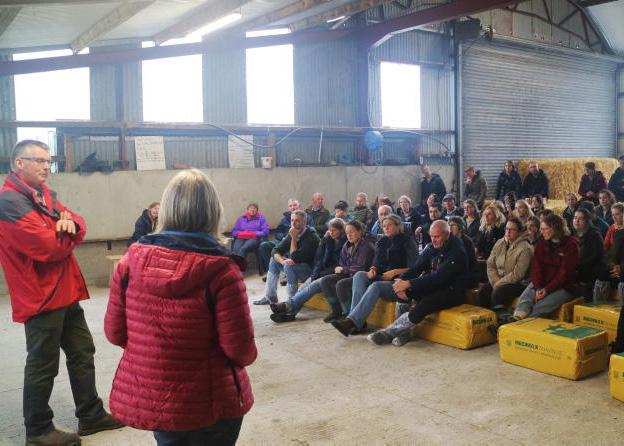
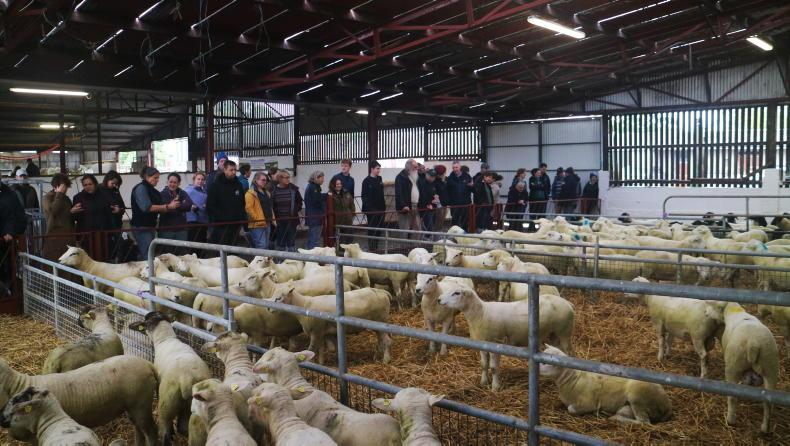
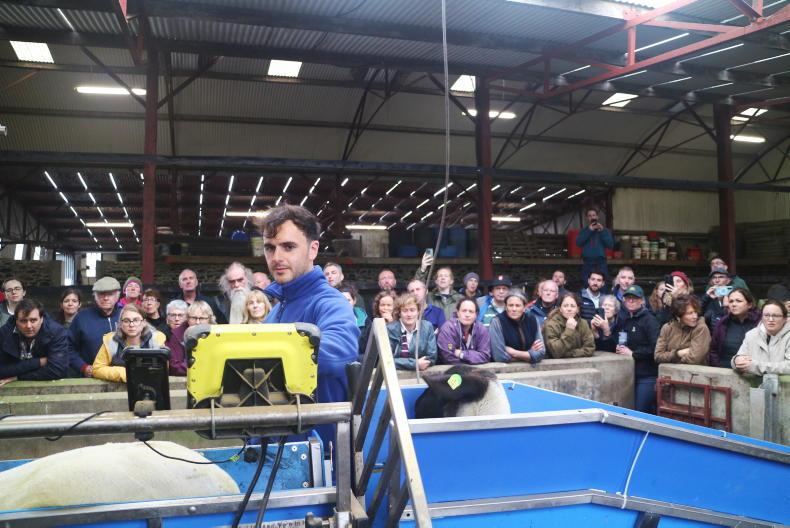
The health programme of the Chapelizod pedigree and commercial flocks run by William Hutchinson and his family in Chapelizod, Kells, Co Kilkenny recently hosted a delegation of vets from the UK and Ireland as part of the UK Sheep Veterinary Society’s autumn conference. The focus of the visit centred on the health programme in place on the farm while there was also a demonstration of the Cotter Agritech SmartWorm technology and a demonstration of ultrasound scanning to identify laryngeal chondritis.
The Hutchinson’s run mixed pedigree/ commercial sheep flocks alongside beef and tillage enterprises. The ratio of sheep to beef is in the region of 75:25 with William commenting that the beef enterprise has reduced in size in recent years due to increased volatility in trading systems and fluctuation in the purchase and sale price of stock.
Health focus
William outlined to vets in attendance that there is a strong focus on flock health, not only to maximise on-farm performance but also to ensure that animals sold of the farm have a high health status.
The farm works closely with veterinarian Mairead O’Grady and has a robust health plan that majors on a preventing disease and is reviewed regularly or as threats emerge.
For example, Mairead said that the farm was one of the first flocks in the country to vaccinate for the bluetongue virus.
“Prevention is everything. When a threat like bluetongue emerges we assess the damage that it could cause and in this case we felt the risk [of disease] far outweighed the expense [of the vaccine]. We hope it won’t become a permanent vaccine but for the next year or two we have to budget it in”.
Vaccine use
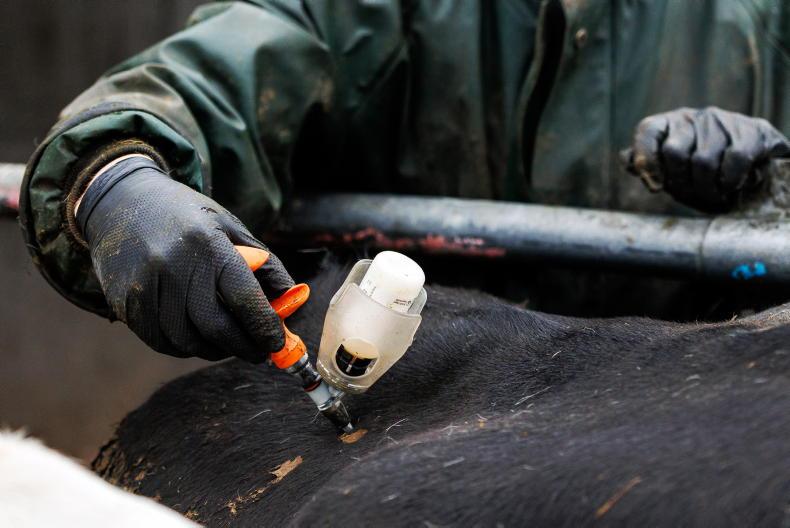
While on the topic of vaccines the farm vaccinates against toxoplasmosis but not enzootic abortion. William explains that there is no history of disease and although rams may be purchased, females rarely are – and if they are then extensive quarantine protocols are followed to ensure that risks of introducing disease are minimised.
The farm has, up until recent years, used Covexin-10 to protect against clostridial diseases. This has changed to Heptavac-P in the last couple of years to capitalise on protection against pasteurellosis.
“We found we were having the odd or sporadic case of pneumonia and were struggling to get on top of it so we have gone with Heptavac for now. We were using 10 in one to protect against sordellii and it is a case of weighing up which currently poses the greatest risk”.
He explained that quick administration of an oxytetracycline antibiotic along with an anti-inflammatory works well in solving any issues provided that they are identified quickly. He adds that James Long, who works on the farm, is an excellent stockman in this regard. Mairead added that antibiotic use on farm is “a tiny fraction of overall inputs which is a good reflection on management”.
Anthelmintic use
Worm control is very much based on “administering as little as possible but as much as is necessary”.
According to Mairead faecal egg counts are collected every two weeks while the farm is also partaking in a targeted selective treatment programme where treatment is based on the performance of animals and recommendations from a SmartWorm programme developed by Cotter Agritech.
The programme takes in to account the performance of lambs along with aspects such as grass quality/diet, weather, age etc and lambs that are not hitting performance targets are highlighted to the farmer who can then decide to act upon the recommendation to treat animals.
Nick Cotter stated that group treatment of lambs has not been practiced for the last four years with the exception of nematodirus.
He said that data analysed for the 2025 calendar year showed 1,061 fewer animal treatments and 14l less product used.
He said that 21% of lambs were drafted with no dose apart from for nematodirus with 64% of lambs requiring only a single worm treatment and 16% two treatments.
There is also practical measures taken to try and reduce the worm burden such as alternating silage ground and not cutting the same area twice in one season. The area where cattle and sheep graze is also alternated with forage crops and tillage crops providing a good rotation.
Fluke treatment
The farm is dry in nature with no history of liver fluke. Mairead explained that fluke antibody testing was carried out last winter to ensure that liver fluke was still not an issue and a negative result was recorded.
Rumen fluke has caused sporadic issues in the past depending on the area of the farm being grazed but is generally not an issue. The farm has no reason to suspect that a new emerging worm threat, haemonchus contortus, or barbers pole worm is an issue.
Lameness control
The handling unit on the farm has a batch footbath that sheep pass through post-handling. The fact that a sizeable footbath is available allows a significant number of sheep to stand in the solution if required without delaying other tasks.
William added that the lameness vaccine, Footvax, is also used in pedigree ewes which are housed for a significant period of time. No Easycare ewes are vaccinated and William added that he is weighing up if he will cease vaccinating ewes.
Mineral supplementation
Mineral supplementation is also used in a similar format to anthelmintic treatment. William is happy to administer where he feels there is a need or benefit from doing so. Lambs destined for slaughter receive cobalt every couple of weeks during the high-risk period for cobalt deficiency while pedigree lambs receive a Cosiecure bolus.
The farm grows a significant area of forage crops to aid in finishing lambs and to break up the grass rotation to reduce the worm burden on pasture. William experimented last year with administering a mineral drench to half of the lambs with the other half receiving none.
There was no difference in performance and no health issues . That is not to say that this is a policy for all farmers with each farm advised to assess their own risk.
Hygiene
Hygiene at lambing is critical and the farm differs in its approach to lambing pens. Bedmax woodshavings which claim to combat E coli is used in lambing pens while William said that he is happy with NoBACZ navel, a new antiseptic solution designed to protect newborn lambs from navel infections. He added that he likes to also use it when tagging lambs as any broken skin is a possible entry route for infection to enter an animals system.
The farm had an issue with laryngeal chondritis in 2016 following the purchase of a ram with all progeny culled once identified. William has since incorporated New Zealand Texel genetics in to his breeding programme, which he feels has reduced the risk of repeat issues.
Farm details
William and Lesley Hutchinson and children Robyn, Holly and Adam farm over 800 ewes including a mixture of Easycare, Suffolk, Texel, Ile de France, Bluefaced Leicester and Dutch Spotted sheep .


SHARING OPTIONS