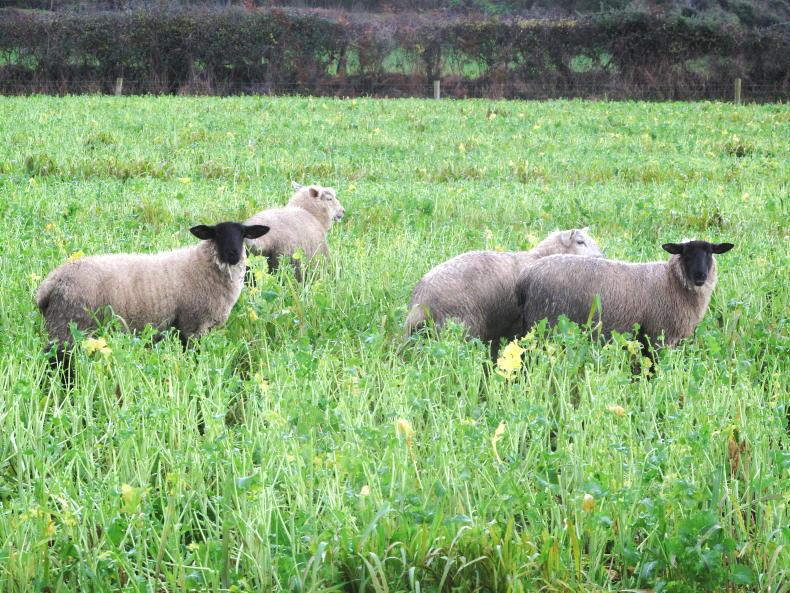
It is not overly surprising that forage crops have faced significant challenges in 2026. While tillage crops were harvested in excellent time to deliver bumper forage crops in a normal year, the reality is that 2026 has been far from normal.
Prolonged drought conditions left ground in a rock-hard state which, along with an absence of moisture to support germination, led to long delays in many tillage strongholds in getting crops sown.
When crops were sown, growth was also negligible for a long period of time. This left some farmers who normally apply a top dressing of fertiliser to reassess, with many opting not to apply any top up.
Growth was positive for a few weeks in October but has fallen off sharply, with ground frost over the last week not helping. Some crops also have a high presence of volunteer plants due to higher screenings during harvesting.
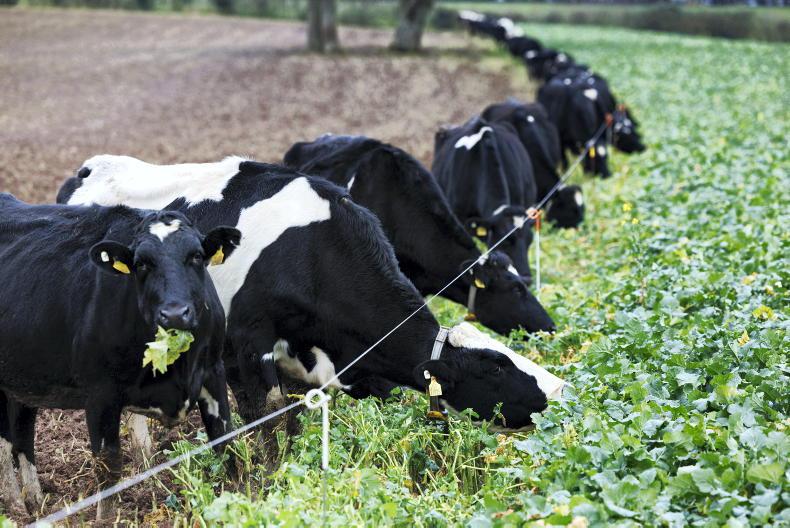
Farmers who normally avail of crops to finish lambs or to graze ewes or cattle for a few months would be best to calculate the volume of feed available and establish if plans need to be tweaked.
Forage crops
Calculating the volume of feed present is relatively straightforward. You will need three tools – a shears or clippers to cut the crop, a quadrant or measuring tape to mark out a 1m2 area and a weighing scale to weigh the volume of forage cut.
A bag such as a concentrate or fertiliser bag is useful to hold cuttings for weighing. A large shopping bag will also likely suffice this year given the lower volume of feed in many places.
The first task is to determine if there is significant variability in the crop. If the crop is even then one cutting may be sufficient, but if there is significant variability then two to three cuttings may be needed to get a more accurate estimate of feed availability. Also, if dealing with a mixed forage/root crop then roots present in that 1m2 area will need to be factored in.
Calculating the volume of crop available
There are some pretty good crops in places where drought was not as severe. If we use an example of 3.5kg fresh weight in 1m2 and a dry matter of 13%, that gives 4.55t DM/ha (3.5kg x 10,000 x 13%).
In contrast, there are poor crops where there is barely 1kg to 2kg fresh weight forage, and in such cases the volume of dry matter available is as low as 2.6t and 1.3t, respectively.
Utilisation and carrying capacity
This is the volume of feed potentially available, but when grazing any crops there will be some of the crop walked on, soiled, knocked over and uneaten.
In good weather and good underfoot conditions, utilisation can be in the region of 75%. This can fall sharply during sustained rainfall and where the crop is located on more marginal soils.
Using our example above, the 4.55t crop at 75% utilisation gives approximately 3.41t of crop to utilise. Where utilisation drops to 50% it halves the volume of feed to be utilised to a little over 2.25t, which has a big effect on carrying capacity of the crop.
To calculate the number of days grazing you then need to know the intake potential of the animal grazing the crop. For cattle, the typical consumption is 2 to 2.2 % of bodyweight. For a store lamb ranging in weight from 35kg to 45kg, their dry matter intake potential is in the region of 1.4kg.
Lighter hill lambs weighing 28kg to 35kg liveweight will have an intake potential of 70% to 75% of heavier lowland lambs equating to about 0.9kg to 1kg. Mature ewes will consume about 1.6kg dry matter daily, if consuming just the forage crop. To calculate the grazing days divide the volume of dry matter feed available by the intake potential of the category of lamb grazing the crop.
If we use lowland lambs capable of eating 1.4kg dry matter, then a crop with 3.41t of dry matter feed per hectare will supply about 2,435 grazing days provided utilisation remains at 75%.
Looking at it another way, it will provide almost 120 days grazing for 20 lambs or 49 days grazing for 50 lambs. Where lambs are destined for finishing, then the optimum scenario is where lambs are finished off the crop, as a significant change in diet from removing lambs off a forage crop on to an alternative diet can greatly curtail performance. As such, it is important where aiming to finish animals on the crop to determine the volume of feed and the carrying capacity at the outset so that numbers can be aligned to feed availability.
This is particularly important where purchasing lambs to finish on the crop or where short term rental agreements are being negotiated.
Supplementation factors
The above calculations do not take into account that approximately 25% to 30% of the diet of animals should have an additional fibre or forage source such as hay/silage/straw or concentrates. Plus it does not take into account grazing available in lie-back areas. To satisfy conditionality requirements, the ratio of forage crop to lie-back area must be 70:30 when grazing the crop, ie, three acres of lie-back for seven acres of forage crop.
However, many farmers do not adjust the above figures to take account of this as once animals become accustomed to the crop intake of alternative forage sources reduces. The exception to this is if the dry matter content of the crop reduces significantly. It also provides some leeway for utilisation dropping significantly and not running short of feed.
Useful tips
The following are useful tips that will improve the success of grazing forage crops.
Key points