


Flock researcher Philip Creighton tells Darren Carty that with growth rates averaging 40kg DM/ha/day in the last week, grass reserves are still building in the low stocking rate (10 ewes/ha) and medium stocking rate (12 ewes/ha) groups
The two low stocking rate groups (medium and high prolificacy) are in an excellent position with about 52 days grazing ahead. This means that if grass growth were to cease today, and taking normal weather and grass utilisation levels, there is enough grass available in paddocks to graze ewes for 52 days.
Taking even a small volume of grass growth in the coming weeks means that there should be enough grass available to graze ewes to the end of January or even into February.
The medium stocking rate group has about 30 days grazing ahead but, with grass growth continuing to exceed demand, Philip said that there should hopefully be enough grass available to graze ewes well into December.
Grass supply in the high stocking rate group (14 ewes/ha) is under more pressure. At present, there are approximately 25 days grazing ahead but demand in this group is higher due to a greater number of lambs left to be finished. The target is to retain lambs outdoors to see if they can be finished off grass and graze ewes until at least early December. Grass availability will be monitored closely and, depending on the situation, a decision will be made on whether or not to bring lambs indoors for finishing.
Grass utilisation
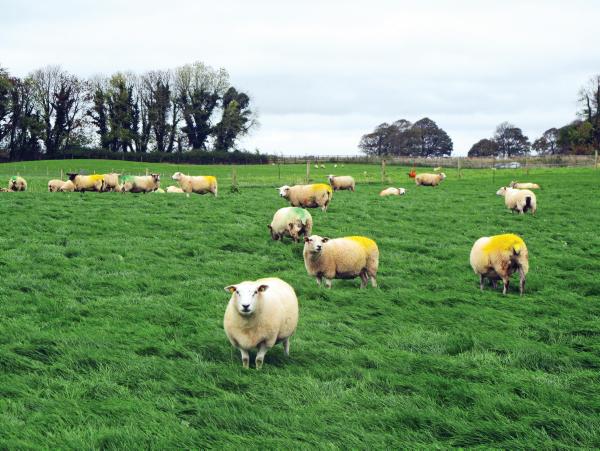
A number of paddocks in each group have fairly high grass covers of at least 10cm to 12cm. These are located mainly in the high stocking rate group’s paddocks as grass covers were allowed to bulk up to boost grazing days ahead. This is also a common occurrence for many farmers who were saving grass for grazing ewes during the breeding season.
An example of this type of cover is shown in the main picture. The focus in grazing these paddocks is to achieve high levels of grass utilisation and graze out these paddocks adequately before closing. This has become more complicated with high levels of rainfall since the weekend.
Paddocks with high grass covers are being split with temporary electric fencing into block grazing. Offering ewes a smaller area to graze means ewes will not waste as much grass by tramping on it and fresh grass can be offered to ewes more regularly.
Philip explains that grazing management will be balanced between grazing out these areas and ensuring that ewes have access to a high plane of nutrition during and for a few weeks after mating.
A technique that may be implemented in paddocks with a very high cover is to graze these paddocks down to 70% to 80% but not force ewes to clean out paddocks fully.
Ewes can be brought back to this paddock in a few weeks and forced to graze it down to betwen 3.5cm and 4cm when there is less nutritional demand entering the second month of pregnancy.
Improved condition
This should not be an issue as ewe condition has also improved significantly since the start of the breeding season. At this stage, the average body condition score in the low, medium and high stocking rate groups was 3.5, 3.4 and 3.3, respectively. It is estimated that the body condition score of ewes has improved by 0.2 to 0.3 in the last few weeks, which could improve further before the end of the breeding season.
The first paddocks for grazing next spring will be closed from 1 November. Paddocks identified for grazing first are those with the best shelter for ewes with young lambs.
Grazing management is focused on achieving high levels of grass utilisation, setting the farm up for winter grazing and closing paddocks to have a supply of grass next spring.
Ewes have improved body condition with good grass supplies and this has also helped breeding performance with about 80% of ewes mated in the first two weeks.
Lamb drafting patterns are currently running 10% or two to three weeks behind 2012 levels.
The majority of lambs should, however, be drafted in the next few weeks.
Forage supplies are on target for the high stocking rate group while the medium and low groups have a surplus of 43% and 80%, respectively.
Pedigree Progress
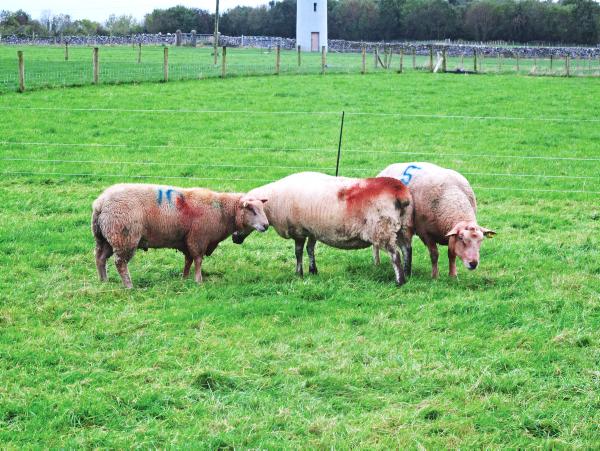
Breeding performance has been excellent with ewes coming into heat faster than anticipated. Rams were out with ewes two weeks last Friday (18 October), with approximately 80% of ewes covered in the first two weeks. Raddle colour is being changed weekly as a management tool to predict the lambing date and to identify any infertility problems shown by high repeat rates. Colours started with yellow, green and red and will move on to blue tomorrow (Friday). Rams are also being rotated between groups every three to four days to minimise the risk of infertility issues and balance the effect of possible genetic differences across different rams.
A number of Charollais replacement ram lambs were also purchased this year. Ram lambs are being run alongside a mature ram to ensure that ewes are picked up immediately. There are also a couple of substitute rams that are being switched between groups if any lameness issues occur. Having this level of ram power is beneficial in ensuring ewes are covered satisfactorily, especially as they are coming into heat fast.
Lamb drafting comparison
Lamb performance is averaging 140g to 160g per day. Over 80% of lambs have been drafted in the low stocking rate groups, 75% in the medium stocking rate groups and about 60% in the high stocking rate groups.
There is no significant difference between lambs drafted in the high versus medium prolificacy groups, with both averaging about 70%.
Philip explains that the drafting rate across all groups is about 10%, or two to three weeks, behind the same period last year.
The main reason behind the slower drafting rate is thought to be poorer performance during the hot spell in July.
Analysis of weight data shows that the average daily gain in this period fell to as low as 80g to 90g per head per day for a three to four-week period.
Philip said he is not worried about a higher number of lambs remaining on farm as lambs are much more evenly matched this year and are weighing, on average, between 41kg and 43kg. This means lambs will be ready for drafting in the immediate weeks ahead.
INDOORS
If required, the option of bringing lambs indoors for finishing will be considered, as mentioned above. Drafting weights range from 43kg to 46kg, with an average kill-out percentage of 44%.
The average liveweight of all lambs drafted to date is 44.9kg, with an average carcaseweight of 19.7kg and an average kill-out of 44%.
Variation in winter forage supplies
Fodder reserves saved during the grazing season vary significantly between groups. In the low stocking rate groups there is 180% of the required forage available. This could rise to over 200% if the grazing season is extended to February, as currently looks possible.
The medium stocking rate groups have 143% of their required winter forage while the high stocking rate groups have just enough silage available at 100% of their requirement.
The calculations are based on a 100-day winter and a daily intake allowance of 1kg DM/ewe/day (or 5kg silage fresh weight at 20% DM).
If the high stocking rate group have to be brought indoors earlier, there will have to be silage transferred between groups with this included as a cost to the groups in their financial analysis.
Financial performance of demo flocks
An overview of the financial performance for 2012 is positive.
There are six flocks with varying stocking rate and prolificacy levels.
The stocking rates are low (10 ewes/ha), medium (12 ewes/ha) and high (14 ewes/ha).
There are two prolificacy levels within each stocking rate, a flock of 60 ewes with medium prolificacy targeting 1.5 lambs weaned/ewe and a flock of 60 ewes with high prolificacy targeting weaning 1.8 lambs/ewe put to the ram. All systems are self-sufficient which means that if extra inputs have to be purchased, this is factored into the financial performance.
The gross margin from the low stocking rate, medium prolificacy flock is €581/ha.
The effect of higher output in the high prolificacy group increases the gross margin to €732/ha.
The low stocking rate groups produced surplus forage and when the value of this is factored in as a sale from the flock the gross margin increases to €756/ha and €907/ha, respectively.
The gross margin in the medium stocking rate and medium prolificacy group is €804/ha, while the gross margin in the high prolificacy group comes in at €1,001/ha.
There was also a small amount of forage sold from the medium stocking rate flocks and this increases the gross margin in the medium prolificacy and high prolificacy groups to €889/ha and €1,086/ha, respectively.
The gross margin was highest in the high stocking rate and medium and high prolificacy groups at €1,007/ha and €1,085/ha.
The underlying reason behind this was higher kilos produced and sold per hectare.
There was no surplus silage forage produced in the high stocking rate group so the gross margin remains the same.
gross margins
The gross margins compare favourably with the top third of sheep farmers analysed in the Teagasc profit monitor analysis, with an average of €837/ha.
The figures presented do not explain differences in output/ha, mortality, labour required, etc. A detailed analysis looking at the physical and financial performance will be covered in the coming weeks.
New addition to Athenry demo flock research team
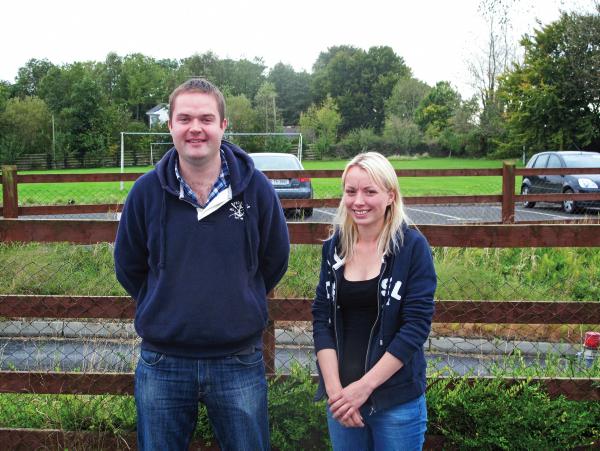
Elizabeth Earle has joined flock researcher Philip Creighton (both pictured) on the research team for the Athenry demo flocks. Elizabeth recently graduated from University College Dublin with a degree in Animal Science and has just started a PhD study looking at the effects of stocking rate and ewe prolificacy on lamb production from grassland-based production systems. This is a joint project between Teagasc and UCD.




SHARING OPTIONS