



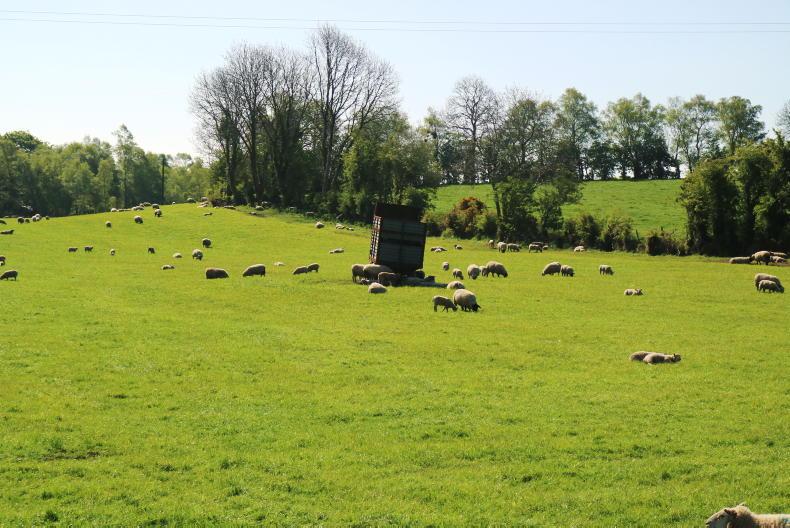
Grassland Management: this week’s welcome increase in temperatures will boost soil temperatures and when combined with forecast rain should deliver a significant increase in grass growth rates.
Growth rates on some closed swards are already hitting upwards of 80kg to 100kg grass DM/ha/day. Steps will need to be taken to maintain sward quality. The aim should be to have sheep entering paddocks at pre-grazing sward heights of 7cm to 9cm, or covers of about 1,200kg to 1,500kg DM/ha, and removed once swards are grazed to 4cm to 4.5cm or higher as the season progresses.
There are two main options to make this happen – increase the size of the grazing group, so that sheep graze through a given area faster or split paddocks temporarily.
The situation also provides a good opportunity for farmers to get a source of high feed-value silage by dropping surplus grass out of the grazing rotation and cutting at a relatively low grass height.
In addition to securing good-quality silage for feeding to ewes in late pregnancy it will also ensure that there is a source of high-quality grazing coming back into the rotation for lambs post-weaning. This should be a consideration for mid-season lambing flocks with weaning approaching.
In terms of fertiliser application, the practice of applying little and often will also help to maintain growth and slow down the rate at which swards head out.
Blowfly protection: there has been an increase in reports of fly activity but as yet no major reports of blowfly strike. This could change, however as temperatures decline from their peak.
It is important to implement a preventative control programme or flock sheep regularly to pick up any strikes quickly.
Ewes on their backs: the fine spell of weather has also brought a heightened risk of ewes being cast on their backs. Where there are repeat offenders then there is little option to solve this other than shearing.
Housing such ewes temporarily until such a time that shearing can take place will also help. Some farmers also report good success with placing a piece of equipment such as a trailer, land roller, etc, in the field that allows sheep to scratch on.
Shearing and SWS: remember for the Sheep Welfare Scheme, shearing needs to be carried out on the payable number of sheep applied for at application stage. This can include ewes and dry or lactating yearling ewe hoggets.
If a contractor is carrying out the shearing then a receipt of payment or cheque showing payment needs to be made available in the case of an inspection along with payment remittance from wool sales.
Where there is no contractor receipt then remittance for the sale of wool will generally suffice or evidence that ewes have been shorn either through verification by an inspector in the case of an on-farm inspection or submission of time-stamped photos of shorn sheep. Therefore, it is advisable to take a few photos at shearing time.
The terms and conditions state that “if shearing has been carried out by the applicant, a photograph of the shorn sheep will be required. If wool has not been sold to a wool merchant, a photograph of the wool on the holding will be required”.



SHARING OPTIONS