Farmers can use AgNav to develop farm-specific sustainability action plans to reduce on-farm emissions and improve water quality.
Michael O’Donnell, a calf-to-beef farmer, explains how he is using AgNav, supported by his Teagasc Signpost climate adviser Leonard Betts.
Micheal O’Donnell, Clonmel, Co Tipperary
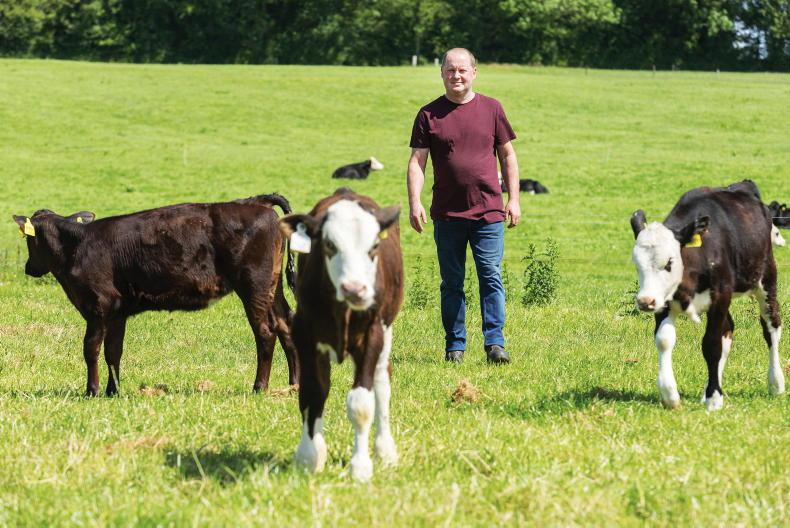
Michael O’Donnell with his cattle on his farm in Clonmel, Co Tipperary.
“I’m farming 130 acres near Clonmel – a mix of owned and rented land. I’m calf-to-beef the last four years. Before that, it was store-to-beef. I buy-in calves both in autumn and in spring to spread the workload. My focus is really just on producing them as efficiently as I can.
“I was introduced to AgNav by my Teagasc climate adviser last year and I’m using it to try to improve efficiencies on the farm. I logged in with my ICBF login, which is handy, and all the information from my previous Bord Bia audit was there.
“It’s actually very simple to use. You can log in and play around with the forecaster tool. For example, you can change the dates for when you let animals out to grass in spring and when they’re brought in and you’ll see the difference that this makes to your emissions.
“I would say to other farmers to try it. Play with it and see how you can reduce your emissions with small, incremental changes on your farm.
“I’ve made a few small but significant changes. All the nitrogen I’ve bought this year is protected urea – I’ve used no CAN. I targeted getting all the slurry out in springtime and after the first cut of silage.
"Usually I would leave some until the autumn time, but you get more use out of it in the spring. I’ve also been using LESS equipment for the last few years, which is another big improvement I’ve made to reduce emissions.
“Definitely getting the animals out on to grass earlier is a big help and keeping them out longer. Those extra one or two weeks at grass can make a big difference to your emissions and you can see that when you play with the forecaster tool. There are big improvements to be made from simple actions on the farm.”
Leonard Betts, Signpost climate adviser
“When I sit down with a farmer, the first thing we look at is where they are right now – their carbon footprint, their total emissions and where they could potentially go by taking certain actions.
“AgNav is a huge help in my work. You could take an option, such as protected urea, and show the farmer exactly how much they can reduce their emissions just by making that one switch.
“I worked with Michael to put together a plan of actions that were appropriate for his farm – practical steps that he’s likely to take on. The other advantage with AgNav is that you can print out a clear action plan. If it’s written down, it’s more likely to happen.
“I’ve now engaged with over 1,000 farmers to introduce them to AgNav – at local co-ops, in discussion groups and as part of the ACRES programme. And the feedback has been overwhelmingly positive because the action farmers are being asked to do are straightforward and they can make them more profitable.”
Michael’s AgNav Actions
Extended grazing season. Incorporation of clover. 100% protected urea. Enhance soil fertility. Use of LESS. Spring slurry application.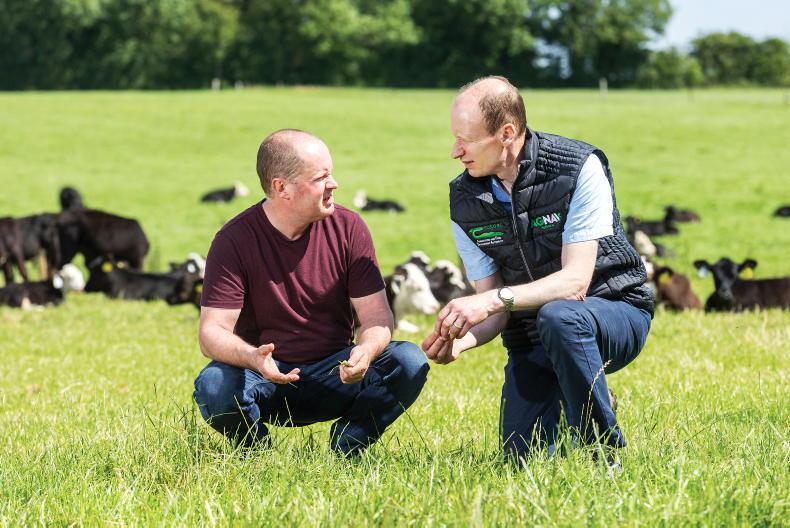
AgNav is available to all beef, dairy and tillage farmers through the AgNav website (www.agnav.ie). Additionally, all beef, dairy and tillage farmers can sign up for the free Teagasc Signpost Advisory Programme for support and guidance on using and implementing AgNav. Beef and dairy farmers can also join through an affiliated processor sustainability scheme. Farmers can learn more about AgNav at the Sustainable Livestock Village at Tullamore Show on 10 August.
ASSESS
AgNav shows an assessment of current farm performance using data from Bord Bia, ICBF, Teagasc and farmer-completed surveys. For beef and dairy farms, animal and production data from the ICBF, along with Bord Bia audit data, is automatically entered into AgNav, which removes the need for farmers to do it themselves. Scientific models developed by Teagasc then use this data to calculate the individual farm’s performance under key sustainability metrics:
Greenhouse gas (GHG) emissions. Ammonia emissions. Production. Nutrient balance. Soil carbon: this can only be calculated if a farmer chooses to complete an AgNav-hosted survey on their farm’s soils. If they do, AgNav will calculate how much carbon is captured in their soil and can adjust the farm’s GHG emissions accordingly.Analyse
The AgNav Forecaster is a core feature of the AgNav platform and is currently available for dairy and beef enterprises. Farmers, or their advisers, can use the forecaster to analyse how changes in farming practices and management can impact each sustainability metric.
Act
Based on the forecaster analysis, dairy and beef farmers can identify which actions are most appropriate for their farm, allowing them to create a personalised farm sustainability action plan. Farmers can choose actions to address water quality, gaseous farm emissions and biodiversity.
For more information, please visit AgNav.ie.
Farmers can use AgNav to develop farm-specific sustainability action plans to reduce on-farm emissions and improve water quality.
Michael O’Donnell, a calf-to-beef farmer, explains how he is using AgNav, supported by his Teagasc Signpost climate adviser Leonard Betts.
Micheal O’Donnell, Clonmel, Co Tipperary
Michael O’Donnell with his cattle on his farm in Clonmel, Co Tipperary.
“I’m farming 130 acres near Clonmel – a mix of owned and rented land. I’m calf-to-beef the last four years. Before that, it was store-to-beef. I buy-in calves both in autumn and in spring to spread the workload. My focus is really just on producing them as efficiently as I can.
“I was introduced to AgNav by my Teagasc climate adviser last year and I’m using it to try to improve efficiencies on the farm. I logged in with my ICBF login, which is handy, and all the information from my previous Bord Bia audit was there.
“It’s actually very simple to use. You can log in and play around with the forecaster tool. For example, you can change the dates for when you let animals out to grass in spring and when they’re brought in and you’ll see the difference that this makes to your emissions.
“I would say to other farmers to try it. Play with it and see how you can reduce your emissions with small, incremental changes on your farm.
“I’ve made a few small but significant changes. All the nitrogen I’ve bought this year is protected urea – I’ve used no CAN. I targeted getting all the slurry out in springtime and after the first cut of silage.
"Usually I would leave some until the autumn time, but you get more use out of it in the spring. I’ve also been using LESS equipment for the last few years, which is another big improvement I’ve made to reduce emissions.
“Definitely getting the animals out on to grass earlier is a big help and keeping them out longer. Those extra one or two weeks at grass can make a big difference to your emissions and you can see that when you play with the forecaster tool. There are big improvements to be made from simple actions on the farm.”
Leonard Betts, Signpost climate adviser
“When I sit down with a farmer, the first thing we look at is where they are right now – their carbon footprint, their total emissions and where they could potentially go by taking certain actions.
“AgNav is a huge help in my work. You could take an option, such as protected urea, and show the farmer exactly how much they can reduce their emissions just by making that one switch.
“I worked with Michael to put together a plan of actions that were appropriate for his farm – practical steps that he’s likely to take on. The other advantage with AgNav is that you can print out a clear action plan. If it’s written down, it’s more likely to happen.
“I’ve now engaged with over 1,000 farmers to introduce them to AgNav – at local co-ops, in discussion groups and as part of the ACRES programme. And the feedback has been overwhelmingly positive because the action farmers are being asked to do are straightforward and they can make them more profitable.”
Michael’s AgNav Actions
Extended grazing season. Incorporation of clover. 100% protected urea. Enhance soil fertility. Use of LESS. Spring slurry application.
AgNav is available to all beef, dairy and tillage farmers through the AgNav website (www.agnav.ie). Additionally, all beef, dairy and tillage farmers can sign up for the free Teagasc Signpost Advisory Programme for support and guidance on using and implementing AgNav. Beef and dairy farmers can also join through an affiliated processor sustainability scheme. Farmers can learn more about AgNav at the Sustainable Livestock Village at Tullamore Show on 10 August.
ASSESS
AgNav shows an assessment of current farm performance using data from Bord Bia, ICBF, Teagasc and farmer-completed surveys. For beef and dairy farms, animal and production data from the ICBF, along with Bord Bia audit data, is automatically entered into AgNav, which removes the need for farmers to do it themselves. Scientific models developed by Teagasc then use this data to calculate the individual farm’s performance under key sustainability metrics:
Greenhouse gas (GHG) emissions. Ammonia emissions. Production. Nutrient balance. Soil carbon: this can only be calculated if a farmer chooses to complete an AgNav-hosted survey on their farm’s soils. If they do, AgNav will calculate how much carbon is captured in their soil and can adjust the farm’s GHG emissions accordingly.Analyse
The AgNav Forecaster is a core feature of the AgNav platform and is currently available for dairy and beef enterprises. Farmers, or their advisers, can use the forecaster to analyse how changes in farming practices and management can impact each sustainability metric.
Act
Based on the forecaster analysis, dairy and beef farmers can identify which actions are most appropriate for their farm, allowing them to create a personalised farm sustainability action plan. Farmers can choose actions to address water quality, gaseous farm emissions and biodiversity.
For more information, please visit AgNav.ie.





SHARING OPTIONS