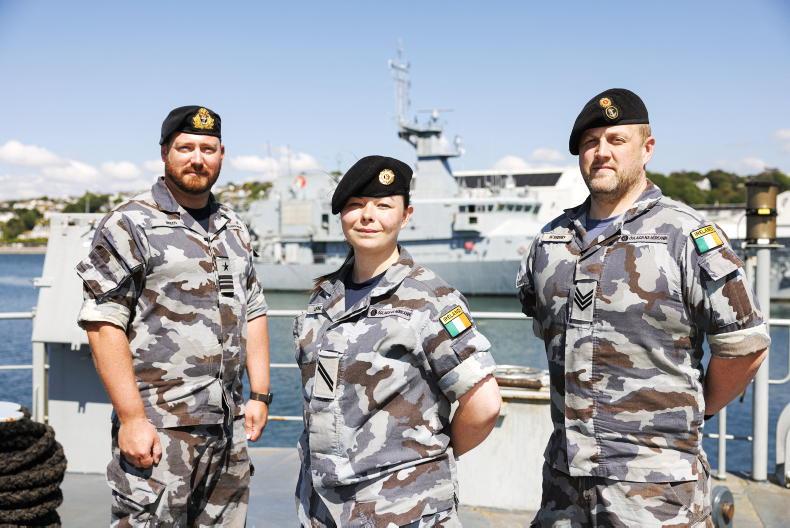
The Irish Naval Service is actively recruiting, aiming for a net increase of 100 personnel per year for the next five years. This is as a result of the significant personnel shortfall they are facing which is impacting its operational capacity.
Naval Service numbers are nearly 400 short of what they should be under department levels (employee levels are at 722, when they should be in the region of 1,100).
As a result, they have introduced financial and non-financial retention initiatives to help keep current staff. The starting pay is competitive and rates include €47,245 for a graduate cadet on commissioning, €41,962 for school leaver cadets on commissioning and €38,016 for recruits on completion of basic training.
The Military Service Allowance (MSA) is a sector-specific allowance paid to all members of the Defence Forces. It is intended to compensate personnel for the unique conditions and disadvantages of military life.
Kieran Breen, lieutenant commander (OF-3) and officer commanding, LÉ James Joyce, says the roles are varied, with something for everyone.
“Salaries are competitive, and it’s a good wage. Traditionally, the perceptions would have been that you’re away a lot. But in recent years, the balance has become a lot better. The Working Time Directive is coming into play in the naval service; if you’re at sea now, you get roughly the same time off when you return.”
Staff retention can be challenging for the navy. These days they have a lot of competition, including big pharmaceutical companies (some based in Cork) who are offering financially lucrative packages.
“The sea-going allowance has doubled in the last year, which is a significant financial factor helping to keep people in the service. Our people are disciplined, highly trained and experienced,” says Kieran, which means they are highly sought after.
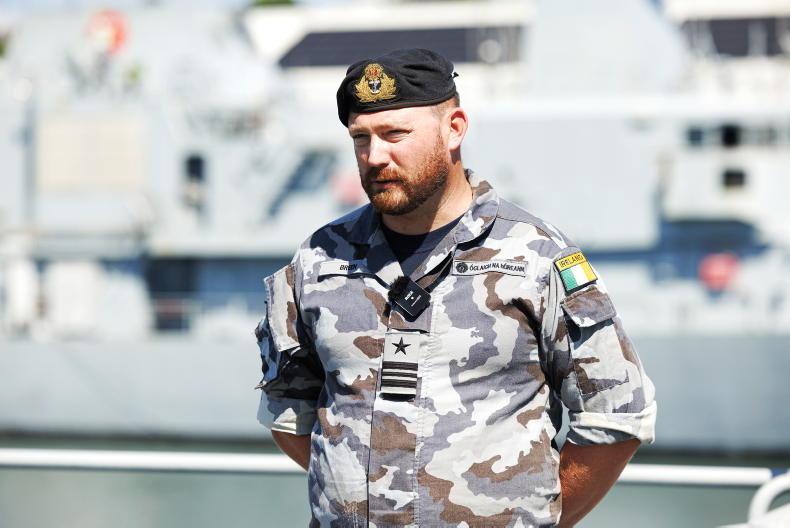
Lt Cdr Kieran Breen chatting with Sarah McIntosh, Irish Country Living on the Naval base in Haulbowline, Co Cork. \ Donal O' Leary
Entry points
For those interested in a career with the navy, there are three ways to access it. You can come in as a school leaver, either into recruits or cadets; you can enter as a graduate, either into recruits or as a cadet; or you can avail of direct entry, as a qualified officer, a qualified electrician or tradesperson.
If you enter as a recruit, you undergo 12 weeks of basic training followed by a further 12 weeks of training to specialise in certain areas.
Kieran explains, “A recruit would be rated in four main areas, which are seamanship, logistics, comms, and mechanics. You can specialise further with a trade as your career progresses. I’d recommend having your Leaving Cert, because it opens up more opportunities when in service.”
If you come in as a cadet, you have a longer training period of two years.
Irish Country Living visited the naval headquarters in Haulbowline, off Cork Harbour. We spoke to Emmy Lehane, able communications operator, who wanted to join the navy from the age of 10 and Tim McSweeney, Petty Officer (PO) programmer and suckler farmer, who joined seeking a more adventurous career.
Emmy Lehane, Lismore,
Co Waterford
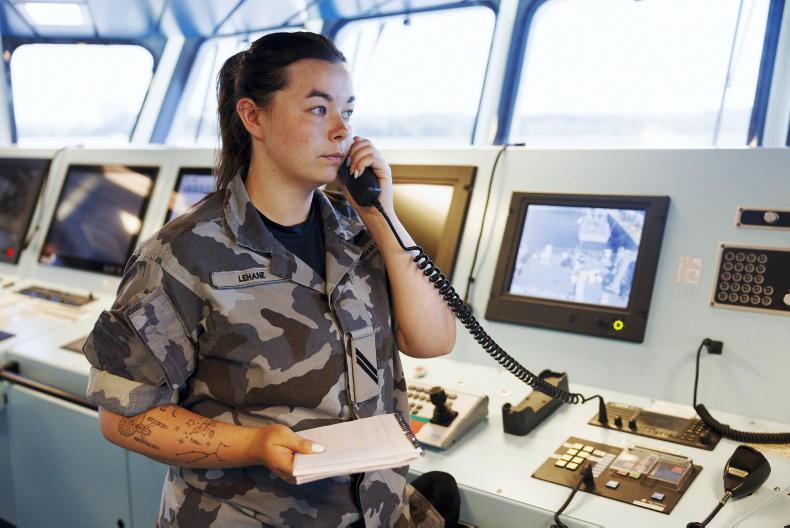
Able Comm Emmy Lehane pictured on the Naval base in Haulbowline, Co Cork. \ Donal O' Leary
As able communications operator, Emmy Lehane is responsible for handling communications, including radio, signals, and logistics.
“When I was 10, I said to my parents that I was joining the navy – it’s always been what I wanted to do. My mum is from France and we always got the ferry over during the summer. I loved the sea and knew I wanted to work on a ship one day.
“When I finished school, I started the nautical science course at the National Maritime College of Ireland (NMCI). After two years in college, COVID-19 hit, and all of the cadet ships stopped working. I left and applied for recruits in the navy, and here we are, four years later.
“I am based in Cork full time. At the start, when I was leaving home, I was a bit apprehensive about moving away from my family, but I got used to it very quickly. You make friends, and the minute you go out to sea, it’s like a family.
“There were 26 of us who started together, and the training period was six months. The biggest learning curve was the structure and discipline. I like the routine now, we start at 6am and finish at 4pm. You have your dinner and then you get your equipment ready for the next day. It is very intense at the start, but you do get off periods.
“I got lucky in my first year. I was part of Operation Irini, which is a European Union naval operation in the Mediterranean Sea. I was away for six weeks and got to see so many countries. I was also part of the EV Matthew, the biggest drug bust in Irish history. I’ll never forget those two moments; it is what made me love the sea even more.
“We need more women in the defence forces. You will always be strong enough; you have your mindset.
“I work with the communications branch, so my training was 13 weeks altogether, which is the longest branch training. That’s everything to do with our military radios and civilian radios that we use with the merchant and fishing vessels, along with the flags you see on the ship. When I come onto a ship, my main job is in the communication centre.”
Tim McSweeney, Ballingeary, Co Cork
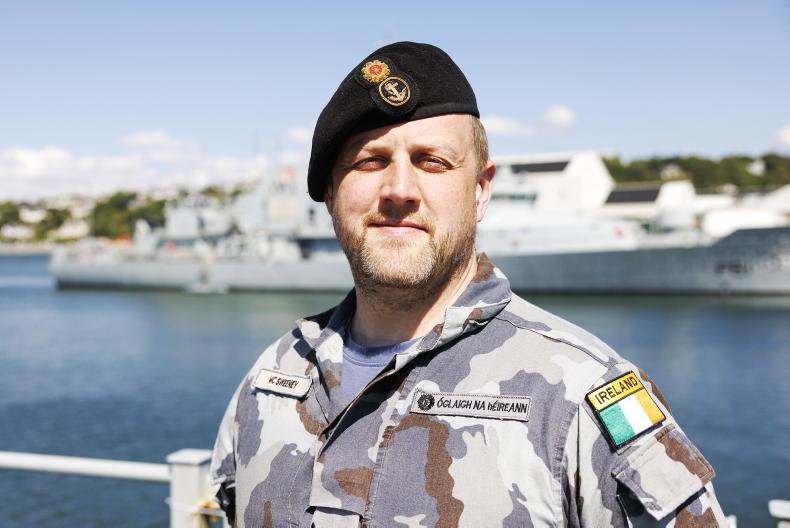
PO Programmer Tim McSweeney pictured on the Naval base in Haulbowline, Co Cork. \ Donal O' Leary
Tim is an enlisted information systems technician (IT) who specialises in programming and software development.
“In 2008, I was working the night shift on a factory assembly line. I decided I wanted to be outdoors and lead a more adventurous life. I saw the advertisement for the defence forces; I applied for both the navy and the army and sat the interviews.
“I signed up – and to be honest, I didn’t really know what I was getting into – and here I am 18 years later. When I first joined, I was a general recruit and went through basic training.
“In 2014, I did my standard NCOs course, which is the first course to progress into a leadership role.
“I got my level 6 in leadership management and went to sea on one of the peacock-class patrol vessels. I came back ashore after that and started my two-year rotation.
“The navy is built like some rural communities in the fact that you exist as a unit together and rely on each other an awful lot. Once you build up that trust in here and people get to know who you are, more opportunities open up for you.
“I always had an interest in the Tech Trainee (TT) schemes. I applied for them in 2017 and got accepted for the programmers course, which changed things up again. I went to MTU for three years and was a full-time student on the college block, getting a full wage. You’re the best-paid student.
“When I was growing up, we had a dairy farm. I was the youngest of three and didn’t think farming was in my future. The year after I got the tech trainee scheme, my dad passed away. I found myself back in farming again unexpectedly and fell back in love with it.
“Years one and two were turbulent enough, but the navy have been very good to me. The technology has been a great help on the farm; I plan a lot of my holidays around the calving season. I have 30 sucklers, mostly Limousin and Simmental crosses. I commute every day, and it takes me just over an hour.
“The navy and farming have a lot in common – no matter what plans you make, they nearly always change, and you have to be able to adapt.”
The Irish Naval Service is actively recruiting, aiming for a net increase of 100 personnel per year for the next five years. This is as a result of the significant personnel shortfall they are facing which is impacting its operational capacity.
Naval Service numbers are nearly 400 short of what they should be under department levels (employee levels are at 722, when they should be in the region of 1,100).
As a result, they have introduced financial and non-financial retention initiatives to help keep current staff. The starting pay is competitive and rates include €47,245 for a graduate cadet on commissioning, €41,962 for school leaver cadets on commissioning and €38,016 for recruits on completion of basic training.
The Military Service Allowance (MSA) is a sector-specific allowance paid to all members of the Defence Forces. It is intended to compensate personnel for the unique conditions and disadvantages of military life.
Kieran Breen, lieutenant commander (OF-3) and officer commanding, LÉ James Joyce, says the roles are varied, with something for everyone.
“Salaries are competitive, and it’s a good wage. Traditionally, the perceptions would have been that you’re away a lot. But in recent years, the balance has become a lot better. The Working Time Directive is coming into play in the naval service; if you’re at sea now, you get roughly the same time off when you return.”
Staff retention can be challenging for the navy. These days they have a lot of competition, including big pharmaceutical companies (some based in Cork) who are offering financially lucrative packages.
“The sea-going allowance has doubled in the last year, which is a significant financial factor helping to keep people in the service. Our people are disciplined, highly trained and experienced,” says Kieran, which means they are highly sought after.

Lt Cdr Kieran Breen chatting with Sarah McIntosh, Irish Country Living on the Naval base in Haulbowline, Co Cork. \ Donal O' Leary
Entry points
For those interested in a career with the navy, there are three ways to access it. You can come in as a school leaver, either into recruits or cadets; you can enter as a graduate, either into recruits or as a cadet; or you can avail of direct entry, as a qualified officer, a qualified electrician or tradesperson.
If you enter as a recruit, you undergo 12 weeks of basic training followed by a further 12 weeks of training to specialise in certain areas.
Kieran explains, “A recruit would be rated in four main areas, which are seamanship, logistics, comms, and mechanics. You can specialise further with a trade as your career progresses. I’d recommend having your Leaving Cert, because it opens up more opportunities when in service.”
If you come in as a cadet, you have a longer training period of two years.
Irish Country Living visited the naval headquarters in Haulbowline, off Cork Harbour. We spoke to Emmy Lehane, able communications operator, who wanted to join the navy from the age of 10 and Tim McSweeney, Petty Officer (PO) programmer and suckler farmer, who joined seeking a more adventurous career.
Emmy Lehane, Lismore,
Co Waterford

Able Comm Emmy Lehane pictured on the Naval base in Haulbowline, Co Cork. \ Donal O' Leary
As able communications operator, Emmy Lehane is responsible for handling communications, including radio, signals, and logistics.
“When I was 10, I said to my parents that I was joining the navy – it’s always been what I wanted to do. My mum is from France and we always got the ferry over during the summer. I loved the sea and knew I wanted to work on a ship one day.
“When I finished school, I started the nautical science course at the National Maritime College of Ireland (NMCI). After two years in college, COVID-19 hit, and all of the cadet ships stopped working. I left and applied for recruits in the navy, and here we are, four years later.
“I am based in Cork full time. At the start, when I was leaving home, I was a bit apprehensive about moving away from my family, but I got used to it very quickly. You make friends, and the minute you go out to sea, it’s like a family.
“There were 26 of us who started together, and the training period was six months. The biggest learning curve was the structure and discipline. I like the routine now, we start at 6am and finish at 4pm. You have your dinner and then you get your equipment ready for the next day. It is very intense at the start, but you do get off periods.
“I got lucky in my first year. I was part of Operation Irini, which is a European Union naval operation in the Mediterranean Sea. I was away for six weeks and got to see so many countries. I was also part of the EV Matthew, the biggest drug bust in Irish history. I’ll never forget those two moments; it is what made me love the sea even more.
“We need more women in the defence forces. You will always be strong enough; you have your mindset.
“I work with the communications branch, so my training was 13 weeks altogether, which is the longest branch training. That’s everything to do with our military radios and civilian radios that we use with the merchant and fishing vessels, along with the flags you see on the ship. When I come onto a ship, my main job is in the communication centre.”
Tim McSweeney, Ballingeary, Co Cork

PO Programmer Tim McSweeney pictured on the Naval base in Haulbowline, Co Cork. \ Donal O' Leary
Tim is an enlisted information systems technician (IT) who specialises in programming and software development.
“In 2008, I was working the night shift on a factory assembly line. I decided I wanted to be outdoors and lead a more adventurous life. I saw the advertisement for the defence forces; I applied for both the navy and the army and sat the interviews.
“I signed up – and to be honest, I didn’t really know what I was getting into – and here I am 18 years later. When I first joined, I was a general recruit and went through basic training.
“In 2014, I did my standard NCOs course, which is the first course to progress into a leadership role.
“I got my level 6 in leadership management and went to sea on one of the peacock-class patrol vessels. I came back ashore after that and started my two-year rotation.
“The navy is built like some rural communities in the fact that you exist as a unit together and rely on each other an awful lot. Once you build up that trust in here and people get to know who you are, more opportunities open up for you.
“I always had an interest in the Tech Trainee (TT) schemes. I applied for them in 2017 and got accepted for the programmers course, which changed things up again. I went to MTU for three years and was a full-time student on the college block, getting a full wage. You’re the best-paid student.
“When I was growing up, we had a dairy farm. I was the youngest of three and didn’t think farming was in my future. The year after I got the tech trainee scheme, my dad passed away. I found myself back in farming again unexpectedly and fell back in love with it.
“Years one and two were turbulent enough, but the navy have been very good to me. The technology has been a great help on the farm; I plan a lot of my holidays around the calving season. I have 30 sucklers, mostly Limousin and Simmental crosses. I commute every day, and it takes me just over an hour.
“The navy and farming have a lot in common – no matter what plans you make, they nearly always change, and you have to be able to adapt.”

SHARING OPTIONS