


Leaves on many winter wheat crops are curled up in an effort to conserve moisture with lower leaf loss also evident. Spring barley fields show white patches as the awns die back. Lower leaf die-back is also very evident as crops strive to fill grains where moisture is limiting.
While wheat plants might intercept more sunlight if the leaves were open, both winter wheat and spring barley grow at a much faster rate in higher temperatures and we must hope that this will result in very low ear blight infection and higher grain quality. We will continue to hope that an additional side effect will be better grain fill and higher yields.
White patches are increasingly visible in spring crops as patches burn in. At the Boortmalt site last week many plots were losing their lower leaves to help grain fill where the plant was under stress. This is happening in many other fields and crops too. White awns are a telltale sign in barley crops but so too are the patches of dying glumes in oats and wheat. Wheat hides the problem better but many are still enduring moisture stress through curled up leaves and lower leaf die-back.
Boortmalt research
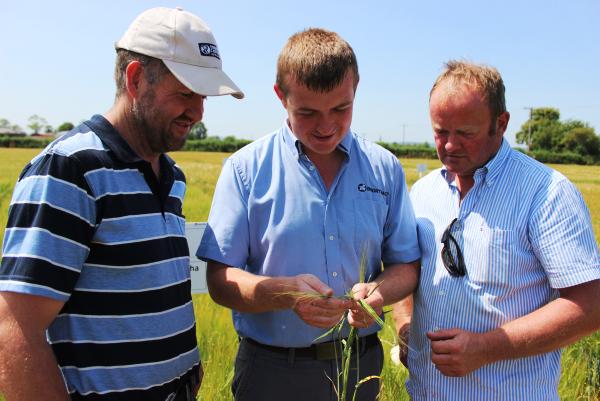
Nitrogen approaches for specific varieties of malting barley featured strongly at the Boortmalt open day in Athy last Friday. Rates, timings and quantities featured, alongside seed rates in some instances, to help produce large ear counts, an important component of high grain yield potential in spring barley. Malting adds an additional requirement for satisfactory grain protein levels and this must be optimised with yield potential.
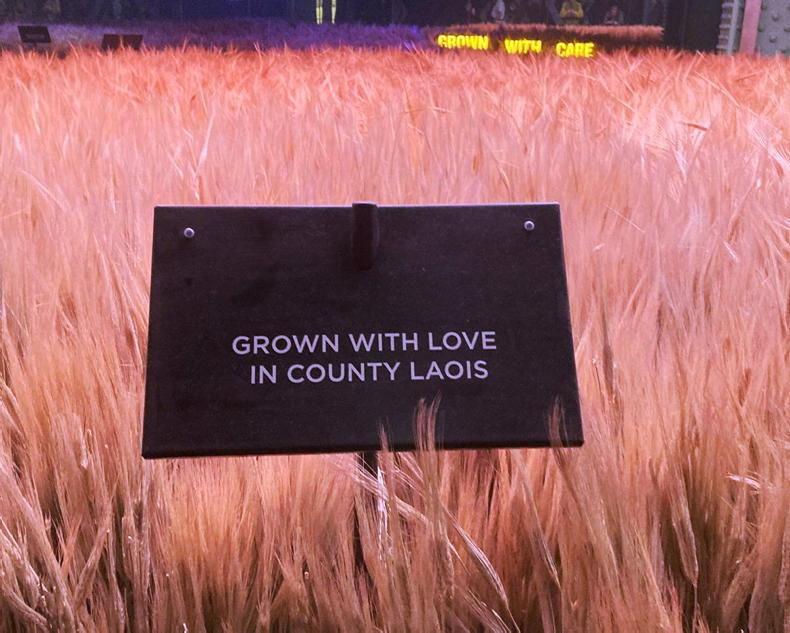
Boortmalt has undergone considerable expansion this year with a requirement for distilling barley to supply the Diageo distillery expansion in Scotland. This means a new spec and a new variety, as malt for this market has some different requirements to brewing. The main differences are lower grain protein and zero glycosidic nitrile (GN) level.
||PIC2||
The variety being grown is Overture and the nitrogen programmes are being tested to learn how best to combine the requirements for yield and protein.
Individual varieties have individual characteristics. Some have naturally bigger or smaller seed and this may impact on tillering ability or tiller survival rate.
Some varieties have lower tillering capacity and so seed rate, nitrogen and growth promotion are being tested to help production stability. Late nitrogen systems were also being examined, along with fungicides, seed dressings and new varieties.
There was much for growers to see but perhaps caution should be urged in terms of taking away any finite messages. Boortmalt have engaged in a three-year programme of trials on the very many aspects of husbandry for malting barley production. This is core information that is essential to provide best advice for the grower and the maltster and it is terrific to see the company engaged in this basic research, in conjunction with UCD.
The trials are being conducted at two sites and so the final results will be capable of providing regional specific variety advice if a site effect is found.
Seedtech
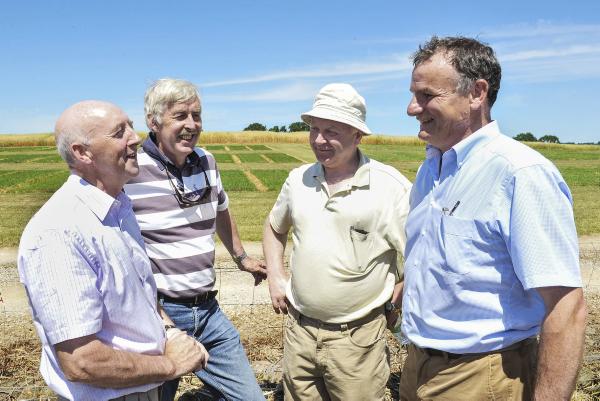
Down in Seedtech, south Kilkenny, earlier this week, curling of the leaves was very obvious on virtually all varieties, especially on winter wheat. However, one new variety, SY Epson, appeared to be much less effected by leaf curling than most other varieties. There is always a chance that the soil could have favoured this variety but perhaps those of you looking at variety trials could confirm is this is the case at all sites, or not.
Also at Seedtech, the benefit of using three growth regulators could be easily seen in plant height and straw stiffness on the hybrid winter barley. The benefit of using Modus on spring barley also looked obvious with more green leaf visible in these plots and less lower leaf loss. Could this be a result of improved rooting?
I am also wondering if the addition of Amistar Opti to Magnello at T3 on winter wheat was the reason for the improved green leaf retention on this treatment.
In east Cork earlier this week winter barley crops were speeding towards harvest but they needed a few more days. Ripe grains appeared to be between 22% and 25% moisture but there were still green heads present to delay harvest. Some crops of six-row are closest to being ripe with what looks to be good grain fill. All winter barley crops look to have good yield potential.
Spring barley crops are a bit more variable but most have recovered well. But signs of drought are now obvious in many crops. These can also be seen in spring wheat and oat crops and, to a lesser extent, in winter wheat and oat crops. But all crops have remained remarkably clean of most major diseases and aphid numbers have remained lowish in unsprayed crops.
Maize is really flying in this heat and east Cork is no different. Despite a pale start, this crop is up and running and has become a lovely deep colour. One crop I looked at, sown under plastic, was over six feet tall with the tassels appearing. Most maize crops are the picture of health, which was not the case in recent years.
However, given its pace of growth, it is possible that moisture availability could begin to pinch some crops soon, especially those on lighter land, tips of hills, etc.
Crops in well minded soil, fresh ground or where slurry was frequently applied in good conditions should withstand moisture stress for longer.




SHARING OPTIONS