We take the breeding of new varieties of our main field crops for granted, but I never before wondered if there was any breeding effort for other crops such as catch crops. Well, there may be fewer breeders and the millions invested may not be as big, but there is a real breeding effort for many of these crops also.
Last week, I partly reported on a gathering in Wexford which looked at many aspects of catch crop production. I will stay with that definition as it is the one used by the Department to work within the GLAS schemes.
A catch crop is defined as one whose purpose is to take up free nutrients from the soil in the autumn and render them unavailable for leaching.
But catch crops bring many other benefits and we now have a payment, through GLAS, to support their establishment.
That focused gathering was organised by Germinal and the Cooney Furlong Grain Company. One of the speakers on the day was Jérôme Vasseur from Jouffray-Drillaud, a plant breeding company, which is part of a large French agricultural cooperative called Terrena. It is involved in breeding fodder crops species near Poitiers and it has a cover or catch-crop breeding station near Orléans.
Why plant catch crops?
While we can specify a single function for these autumn crops, they will always provide multiple benefits. Jérôme suggested the main potential benefits as:
Trap nutrients to prevent loss.Produce green manure to benefit the soil.Their roots colonise the ground to help keep it open.They cover the ground to protect it from rain and the canopy also helps to prevent or minimise weed growth.They help improve soil structure.They increase biodiversity in the eco-system.Increase crop yields.When plants grow, their roots scavenge through the soil to find the necessary nutrients to support growth. While the amount of growth will depend on the planting date, the species planted and the nutrients available, Jérôme told us that each tonne of dry matter produced by a catch crop can account for around 20kg to 30kg of nitrogen, about 8kg of P, 35kg of K, 25kg of CaO and 5kg each of Mg and S. This represents a significant quantity of nutrient that can be recycled in time and made available to a following crop.
We think of green manures as organic matter to stimulate biological activity but it does more than that. Jérôme talked about the symbiosis that can occur between the root systems of different plant species, the different soil microbiology that is stimulated and the effects that these can have in the soil complex. Some individual species can fix nitrogen from the air and make it available to plant roots to support additional growth.
Having a canopy in place on the soil over winter keeps a root mass in place to help keep the soil open. It also helps to remove some moisture from the ground for as long as it continues to grow. Where a number of species are grown, which have different rooting and foliage characteristics, they can help to suppress weed growth.
The creation of additional organic matter that is then returned to the soil will help with the improvement of soil structure by increasing biological activity when the food is there to feed it. But there is also a direct benefit generated by the different and complementary root systems (tap roots, fiberous roots, etc) of the crop species, Jérôme stated. The cultivation system will also have an impact in this regard.
Having different crop species growing also provides opportunities for birds and insects to feed on them, but they provide opportunities for different microbiological species, many of which may subsequently help to suppress common parasites. Ultimately, the sum of all of these benefits will help to increase yields and possibly decrease other costs in time.
Differences between
species
Autumn-planted crops can have many benefits. As well as the basic ones of mopping up nutrients, providing organic matter and protecting the soil, they can also be used to provide forage for livestock.
Jérôme said that the breeding station in Orléans has different breeding criteria for its catch crop breeding programme compared with its forage breeding site.
For catch crops, the objectives focus heavily on:
Earliness.Behaviour during mineralisation (C:N ratio).Seed size.Frost sensitivity.The major focus for forage crop breeding includes:
Dry matter yield.Nutritional value.Disease resistance.Frost resistance.Carbon nitrogen ratio
The carbon to nitrogen (C:N) ratio is important because it influences the speed with which plants can break down and release their nutrients, via mineralisation, to the following crop. This is shown for different species in Figure 1, where species such as vetch (C:N 10) or Berseem clover (C:N 15) are capable of mineralising and recycling their nutrients much faster than something like straw (C:N 80).
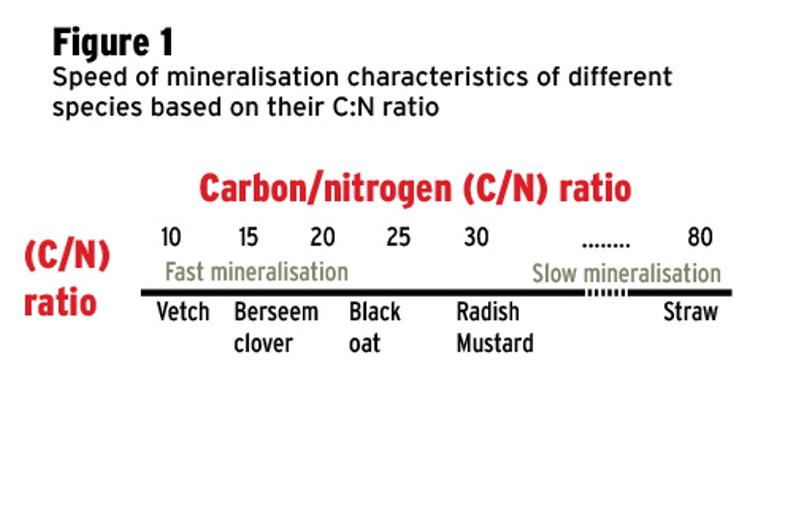
Interestingly, Jérôme indicated that crops like mustard and radish are neither the fastest nor the slowest to break down and this can add to their attractiveness in a mix of planted species. And, for a crop like mustard, the longer it grows the more stemmy it becomes and the longer it will take for total breakdown.
But this is not just a species characteristic. Jérôme stated that individual varieties within a species can show considerable difference in their C:N ratio and their speed of mineralisation also. And this is not the only important characteristic that can differ between varieties. For these reasons, Jérôme emphasised the importance of understanding what you want your catch crop to do and when it is to be destroyed.
Autumn growth potential
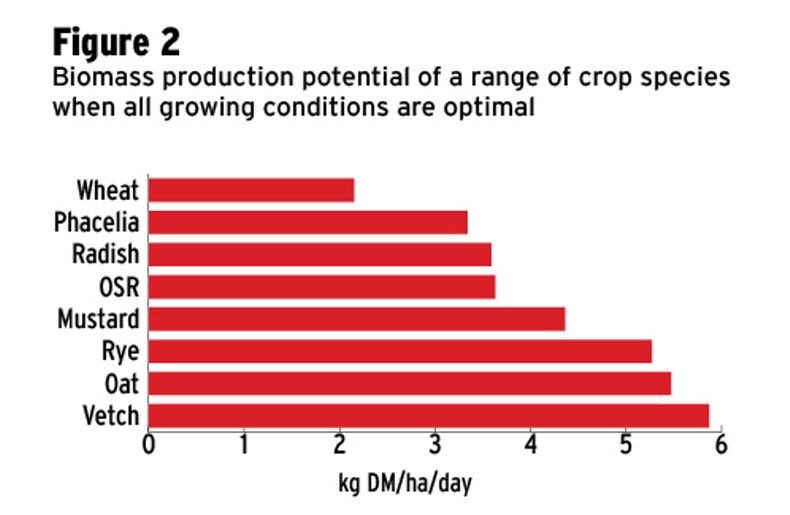
Earliness of development and speed of autumn growth are also very important criteria for catch crops to drive biomass production. “We are targeting these characteristics as breeders”, Jérôme stated. Species differ in their potential to respond to autumn growth and Figure 2 shows that crops such as rye, oats and vetch show significant potential in this regard.
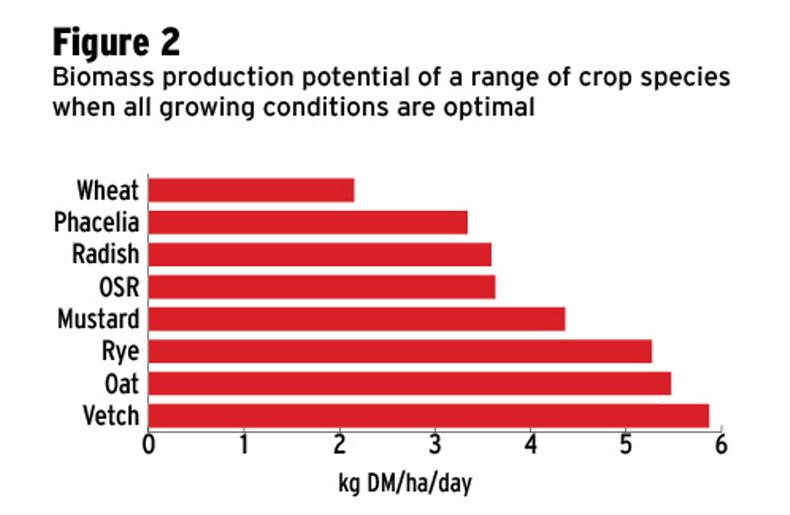
According to these figures, mustard produces double the biomass in the autumn compared with wheat and vetch. So, the choice of species should not be influenced by the cost of seed as the benefit to you will relate to biomass production. However, as temperatures drop and/or planting date is delayed, these differences get much smaller. But for any grower going to the trouble of planting catch crops, the objective should be to do everything possible to maximise biomass production for the long-term benefit of your soil.
Interestingly, Jérôme said that phacelia can be a useful and interesting catch crop but that it is also very temperature and day-length sensitive. This can make it useful for August planting, but it can be a challenge to get benefits from the additional seed cost if it is planted in September.
All species are temperature sensitive for yield, but their overall potential differs according to Jérôme. Table 1 shows that vetch requires more accumulated temperature and if it gets this through early planting, it gives additional benefit by producing nitrogen for the following crop. When temperature is limited by planting date, options such as mustard, oats or radish can be better.
Interestingly, in mentioning oats, Jérôme is not referring to the Avena sativa species which we grow but rather the black oat or Avena strigoza species. There are a number of reasons for this:
It is faster to establish and cover the ground.Resistant to crown rust.It needs a low seeding rate.It fits well with legumes.Has high autumn biomass potential.Easy to destroy (frost sensitive).These characteristics are most valuable when planting in late August. It does not form a green bridge for oat diseases and it will produce much more bulk than standard oats. It produces a lot of its total bulk early on, so it suits autumn planting. However, it can go to seed if planted very early in a mild autumn, so Jérôme advised not to plant early maturing varieties of this species.
Jouffray-Drillaud has a broad range of varieties ranging from slow to fast-developing. Black oats are all spring types and are susceptible to even slight frost levels in winter.
Early drilling poses an additional threat for cereals in respect to barley yellow dwarf virus (BYDV) infection. However, Jérôme said that the black oat is not favoured by the aphid species that transmit BYDV, compared with other cereals. However, there is nothing to suggest that the crop is resistant to BYDV in the event of severe infection pressure.
Another issue for catch crops is winter versus spring types. In general, winter types were bred to give their growth in spring, while spring types grow once they are planted. This probably holds for all species, but Jérôme made particular reference to vetch in this regard.
Breeding programme
The breeding programme for catch crops at Jouffray-Drillaud covers:
Common vetch.Hairy vetch.Purple vetch.Pannonica vetch.Black (strigoza) oats.Lupins.Horse beans.Berseem clovers.Persian clovers.Lentils.And others.The listing above indicates that vetches are seen as an important species. They bring many benefits including:
Good rooting system for soil structure.Early biomass production.Quick ground cover to suppress weeds.Fast mineralisation.Nitrogen fixation.Good resistance to diseases.Useful to suppress soil-borne parasites.The different sub-species exhibit different characteristics. Common vetches are suitable for catch crops, companion crops and forage production. Purple vetch suits catch or cover crops and companion crops, but not forage. Hairy vetch suits as a forage, catch or cover crop but appears to be less suitable in mixtures. And Pannonia vetch is mainly for forage or pollinator crop use.
Jérôme stated that catch crops must be treated like a real crop if they are to perform to their potential. This means getting the seedbed and seeding rate well matched.
Berseem clover (Trifolium alexandrinum) is an annual plant which has rapid establishment and more vertical growth, so it suits in mixtures. It is mainly a forage crop with high palatability. It also attracts pollinators and is frost-sensitive. Varieties differ considerably in their autumn growth potential and some can recover from frost damage and regrow in spring.
Different types of radish also have different characteristics, uses and benefits. Forage radish has fast and easy establishment and it is late to flower. It has good soil structure benefits and some varieties exhibit anti-nematode activity.
Jérôme said that Asian radish is easy to drill and also has fast establishment. It also has good soil structure benefits, it is late flowering and it is easier to kill than forage radish.
Again, individual varieties show big differences on a number of characteristics, so you need to know what to select for.
Commercial mixes
Jérôme said that his company markets these crops in mixtures branded as Chlorofiltre. This means that the company makes the variety and species selection for specific end uses. It provides the customer with ready-to-use seed mixtures, which have an average seed rate of around 25kg/ha. But the farmer must know the objective in growing these crops to get the most suitable crop mix.
Being able to purchase a mixture gives the buyer the security of using certified seeds with specified purity and high germination capacity. It also means that the pre-mixed Chlorofiltre products have a species makeup that ensures diverse germination behaviour and a level of synergy between the species included in the mix.
There is little doubt but that the eagerness to grow some form of catch crop will attract species to the market that are less suited to the job in hand. These are likely to come at a low cost to try and unload stocks, or they can be camouflaged by a high cost, with no benefit. For this reason, it is preferable that farmers purchase from reputable sources in the early years because one or two bad experiences might turn one off the useful practice of catch cropping forever.
Plant breeding is taking place with a specific focus on the requirements of catch crops. Species differ in their temperature requirement to produce autumn growth.Only spring varieties should be planted because they grow more rapidly in the autumn.There are big variety
differences with species.
We take the breeding of new varieties of our main field crops for granted, but I never before wondered if there was any breeding effort for other crops such as catch crops. Well, there may be fewer breeders and the millions invested may not be as big, but there is a real breeding effort for many of these crops also.
Last week, I partly reported on a gathering in Wexford which looked at many aspects of catch crop production. I will stay with that definition as it is the one used by the Department to work within the GLAS schemes.
A catch crop is defined as one whose purpose is to take up free nutrients from the soil in the autumn and render them unavailable for leaching.
But catch crops bring many other benefits and we now have a payment, through GLAS, to support their establishment.
That focused gathering was organised by Germinal and the Cooney Furlong Grain Company. One of the speakers on the day was Jérôme Vasseur from Jouffray-Drillaud, a plant breeding company, which is part of a large French agricultural cooperative called Terrena. It is involved in breeding fodder crops species near Poitiers and it has a cover or catch-crop breeding station near Orléans.
Why plant catch crops?
While we can specify a single function for these autumn crops, they will always provide multiple benefits. Jérôme suggested the main potential benefits as:
Trap nutrients to prevent loss.Produce green manure to benefit the soil.Their roots colonise the ground to help keep it open.They cover the ground to protect it from rain and the canopy also helps to prevent or minimise weed growth.They help improve soil structure.They increase biodiversity in the eco-system.Increase crop yields.When plants grow, their roots scavenge through the soil to find the necessary nutrients to support growth. While the amount of growth will depend on the planting date, the species planted and the nutrients available, Jérôme told us that each tonne of dry matter produced by a catch crop can account for around 20kg to 30kg of nitrogen, about 8kg of P, 35kg of K, 25kg of CaO and 5kg each of Mg and S. This represents a significant quantity of nutrient that can be recycled in time and made available to a following crop.
We think of green manures as organic matter to stimulate biological activity but it does more than that. Jérôme talked about the symbiosis that can occur between the root systems of different plant species, the different soil microbiology that is stimulated and the effects that these can have in the soil complex. Some individual species can fix nitrogen from the air and make it available to plant roots to support additional growth.
Having a canopy in place on the soil over winter keeps a root mass in place to help keep the soil open. It also helps to remove some moisture from the ground for as long as it continues to grow. Where a number of species are grown, which have different rooting and foliage characteristics, they can help to suppress weed growth.
The creation of additional organic matter that is then returned to the soil will help with the improvement of soil structure by increasing biological activity when the food is there to feed it. But there is also a direct benefit generated by the different and complementary root systems (tap roots, fiberous roots, etc) of the crop species, Jérôme stated. The cultivation system will also have an impact in this regard.
Having different crop species growing also provides opportunities for birds and insects to feed on them, but they provide opportunities for different microbiological species, many of which may subsequently help to suppress common parasites. Ultimately, the sum of all of these benefits will help to increase yields and possibly decrease other costs in time.
Differences between
species
Autumn-planted crops can have many benefits. As well as the basic ones of mopping up nutrients, providing organic matter and protecting the soil, they can also be used to provide forage for livestock.
Jérôme said that the breeding station in Orléans has different breeding criteria for its catch crop breeding programme compared with its forage breeding site.
For catch crops, the objectives focus heavily on:
Earliness.Behaviour during mineralisation (C:N ratio).Seed size.Frost sensitivity.The major focus for forage crop breeding includes:
Dry matter yield.Nutritional value.Disease resistance.Frost resistance.Carbon nitrogen ratio
The carbon to nitrogen (C:N) ratio is important because it influences the speed with which plants can break down and release their nutrients, via mineralisation, to the following crop. This is shown for different species in Figure 1, where species such as vetch (C:N 10) or Berseem clover (C:N 15) are capable of mineralising and recycling their nutrients much faster than something like straw (C:N 80).
Interestingly, Jérôme indicated that crops like mustard and radish are neither the fastest nor the slowest to break down and this can add to their attractiveness in a mix of planted species. And, for a crop like mustard, the longer it grows the more stemmy it becomes and the longer it will take for total breakdown.
But this is not just a species characteristic. Jérôme stated that individual varieties within a species can show considerable difference in their C:N ratio and their speed of mineralisation also. And this is not the only important characteristic that can differ between varieties. For these reasons, Jérôme emphasised the importance of understanding what you want your catch crop to do and when it is to be destroyed.
Autumn growth potential
Earliness of development and speed of autumn growth are also very important criteria for catch crops to drive biomass production. “We are targeting these characteristics as breeders”, Jérôme stated. Species differ in their potential to respond to autumn growth and Figure 2 shows that crops such as rye, oats and vetch show significant potential in this regard.
According to these figures, mustard produces double the biomass in the autumn compared with wheat and vetch. So, the choice of species should not be influenced by the cost of seed as the benefit to you will relate to biomass production. However, as temperatures drop and/or planting date is delayed, these differences get much smaller. But for any grower going to the trouble of planting catch crops, the objective should be to do everything possible to maximise biomass production for the long-term benefit of your soil.
Interestingly, Jérôme said that phacelia can be a useful and interesting catch crop but that it is also very temperature and day-length sensitive. This can make it useful for August planting, but it can be a challenge to get benefits from the additional seed cost if it is planted in September.
All species are temperature sensitive for yield, but their overall potential differs according to Jérôme. Table 1 shows that vetch requires more accumulated temperature and if it gets this through early planting, it gives additional benefit by producing nitrogen for the following crop. When temperature is limited by planting date, options such as mustard, oats or radish can be better.
Interestingly, in mentioning oats, Jérôme is not referring to the Avena sativa species which we grow but rather the black oat or Avena strigoza species. There are a number of reasons for this:
It is faster to establish and cover the ground.Resistant to crown rust.It needs a low seeding rate.It fits well with legumes.Has high autumn biomass potential.Easy to destroy (frost sensitive).These characteristics are most valuable when planting in late August. It does not form a green bridge for oat diseases and it will produce much more bulk than standard oats. It produces a lot of its total bulk early on, so it suits autumn planting. However, it can go to seed if planted very early in a mild autumn, so Jérôme advised not to plant early maturing varieties of this species.
Jouffray-Drillaud has a broad range of varieties ranging from slow to fast-developing. Black oats are all spring types and are susceptible to even slight frost levels in winter.
Early drilling poses an additional threat for cereals in respect to barley yellow dwarf virus (BYDV) infection. However, Jérôme said that the black oat is not favoured by the aphid species that transmit BYDV, compared with other cereals. However, there is nothing to suggest that the crop is resistant to BYDV in the event of severe infection pressure.
Another issue for catch crops is winter versus spring types. In general, winter types were bred to give their growth in spring, while spring types grow once they are planted. This probably holds for all species, but Jérôme made particular reference to vetch in this regard.
Breeding programme
The breeding programme for catch crops at Jouffray-Drillaud covers:
Common vetch.Hairy vetch.Purple vetch.Pannonica vetch.Black (strigoza) oats.Lupins.Horse beans.Berseem clovers.Persian clovers.Lentils.And others.The listing above indicates that vetches are seen as an important species. They bring many benefits including:
Good rooting system for soil structure.Early biomass production.Quick ground cover to suppress weeds.Fast mineralisation.Nitrogen fixation.Good resistance to diseases.Useful to suppress soil-borne parasites.The different sub-species exhibit different characteristics. Common vetches are suitable for catch crops, companion crops and forage production. Purple vetch suits catch or cover crops and companion crops, but not forage. Hairy vetch suits as a forage, catch or cover crop but appears to be less suitable in mixtures. And Pannonia vetch is mainly for forage or pollinator crop use.
Jérôme stated that catch crops must be treated like a real crop if they are to perform to their potential. This means getting the seedbed and seeding rate well matched.
Berseem clover (Trifolium alexandrinum) is an annual plant which has rapid establishment and more vertical growth, so it suits in mixtures. It is mainly a forage crop with high palatability. It also attracts pollinators and is frost-sensitive. Varieties differ considerably in their autumn growth potential and some can recover from frost damage and regrow in spring.
Different types of radish also have different characteristics, uses and benefits. Forage radish has fast and easy establishment and it is late to flower. It has good soil structure benefits and some varieties exhibit anti-nematode activity.
Jérôme said that Asian radish is easy to drill and also has fast establishment. It also has good soil structure benefits, it is late flowering and it is easier to kill than forage radish.
Again, individual varieties show big differences on a number of characteristics, so you need to know what to select for.
Commercial mixes
Jérôme said that his company markets these crops in mixtures branded as Chlorofiltre. This means that the company makes the variety and species selection for specific end uses. It provides the customer with ready-to-use seed mixtures, which have an average seed rate of around 25kg/ha. But the farmer must know the objective in growing these crops to get the most suitable crop mix.
Being able to purchase a mixture gives the buyer the security of using certified seeds with specified purity and high germination capacity. It also means that the pre-mixed Chlorofiltre products have a species makeup that ensures diverse germination behaviour and a level of synergy between the species included in the mix.
There is little doubt but that the eagerness to grow some form of catch crop will attract species to the market that are less suited to the job in hand. These are likely to come at a low cost to try and unload stocks, or they can be camouflaged by a high cost, with no benefit. For this reason, it is preferable that farmers purchase from reputable sources in the early years because one or two bad experiences might turn one off the useful practice of catch cropping forever.
Plant breeding is taking place with a specific focus on the requirements of catch crops. Species differ in their temperature requirement to produce autumn growth.Only spring varieties should be planted because they grow more rapidly in the autumn.There are big variety
differences with species. 





SHARING OPTIONS