The area of oilseed rape has declined in recent years. Unfortunately, area has declined when varieties are probably at the best they ever have been. Once considered a risky crop to grow due to losses from pod shatter, oilseed rape has become much more consistent.
This year yields look to have ranged from about 1.8-2.5t/ac, with a lot of crops falling into the 2.3-2.4t/ac category, among the highest yields farmers have grown.Sunshine at flowering no doubt helped with this yield, but genetics have been a big help too.
In recent years there have been four main traits added to varieties, which have helped winter oilseed rape to become more dependable. These traits are not included in all varieties.
Important traits available in oilseed rape varieties:
Turnip yellows virus resistance: similar to BYDV this is spread by aphids.Pod shatter resistance: this gene reduces pod shatter massively, which reduces yield losses and reduces the levels of volunteer oilseed rape in fields.Scleroflex: this reduces the risk of the crop getting sclerotinia and reduces the level of infection if it does get it. Sclerotinia disease moves to the stem and cuts off the plant. It is generally sprayed for at flowering, but in long flowering periods it can be hard to keep on top of. N-flex: these varieties can cope better when nitrogen application is delayed in the springtime.LG Armada has all four of these relatively new traits, while a number of varieties have three of the four.
LG Avenger does not have N-flex, while LG Aviron, LG Ambassador, LG Academic and LG Auckland have three of the traits and are missing the Scleroflex trait.

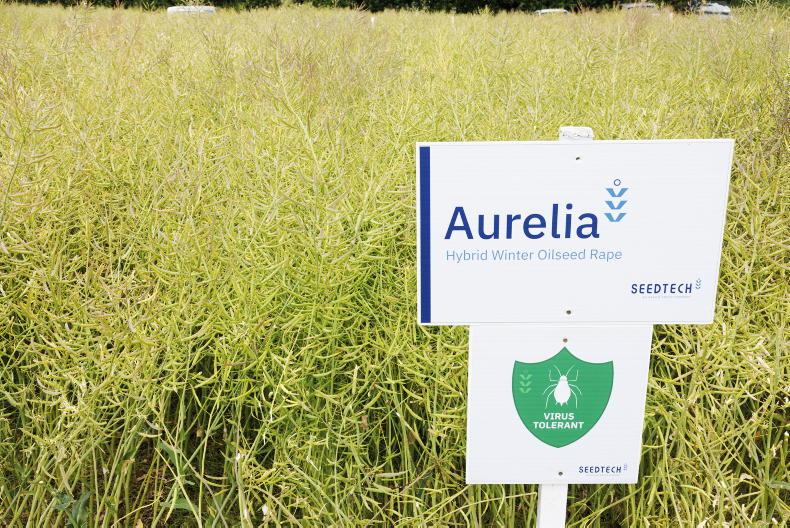
Aurelia Oil Seed Rape. \ Donal O' Leary
Sclerotinia
The Scleroflex trait can reduce the amount of the fungus in the soil and so reduce the risk to other crops. Sclerotinia can also affect beans and peas, but spring crops can still be in a rotation with oilseed rape as they will be far enough apart in the rotation at three years.
Ploughing can help to reduce the level of sclerotinia spores that can affect crops. Both LG Armada and LG Avenger contain the Scleroflex trait.
Clubroot
Clubroot is a big problem in oilseed rape where it takes hold, but is prevented with rotation. Clubroot lives in the soil and can be carried by brassica crops including oilseed rape and catch crops like forage rape, mustard and kale. Rotation is key to keeping clubroot at bay. It likes warm and damp soils with poor drainage and generally likes a pH of around 6.5. It often starts in a patch in a field. The roots stop growing and look like a stump.
Clubroot resistant varieties are now available. However, they are considerably behind on yield compared with others at present.
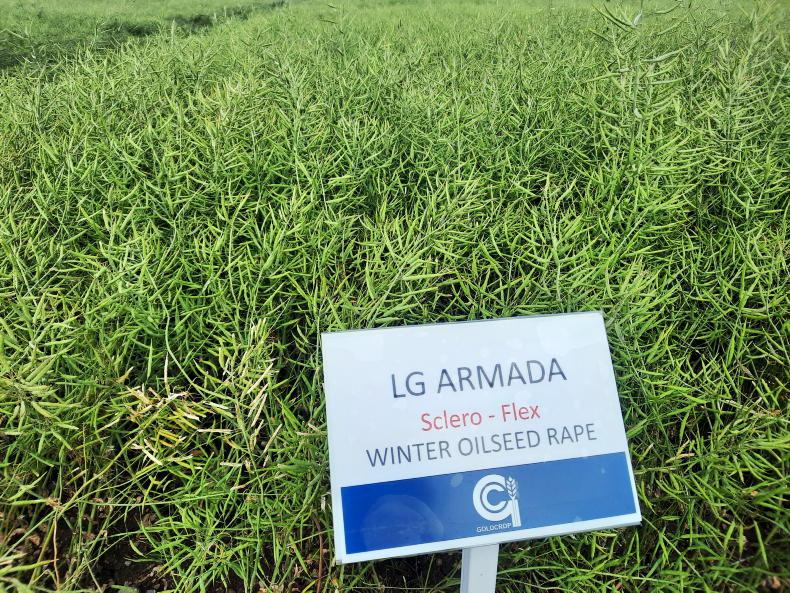
LG Armada oilseed rape.
Pests
Pigeons and slugs are the biggest pest threats to crops over the winter. However, if crops get established well early in the season they should be able to re-establish themselves after a pigeon attack. Slugs will need to be watched.
Research has shown that having 15 plants/m2 in the springtime is enough to produce a profitable yield.
Sowing rate
Advice from industry suggests drilling 40-60 seeds/m2 to establish 35-40 plants/m2 by the end of October. The aim is to have 25-30 plants/m2 at the start of February and 25 main stems/m2 at the start of flowering.
Green area index
In years gone by oilseed rape received blanket nitrogen applications. However, the measurement of green area index (GAI) has helped to reduce the amount of nitrogen applied to crops significantly.
The GAI can be measured very easily by downloading an application to your smartphone which allows you to take pictures to assess the GAI. You can also assess the GAI by hand.
Once the GAI is established you can apply rates accordingly. Crops with lower GAIs will get nitrogen earlier and more of it, while crops which have taken up nitrogen over the winter and grown well and covered the ground will need less nitrogen and won’t need it as early. The aim is to have a GAI of about two in February and 3.5 at the start of flowering. Crops need about 175kg N/ha to achieve a GAI of 3.5. If you are aiming for a yield of 4.5t/ha you can apply 60kg/ha more N.
A GAI of one indicates that the crop has taken up about 50kg N/ha. Teagasc place the soil N availability at about 40kg N/ha. This crop would require about 202kg N/ha, while a crop with a GAI of two would require about 135kg N/ha.
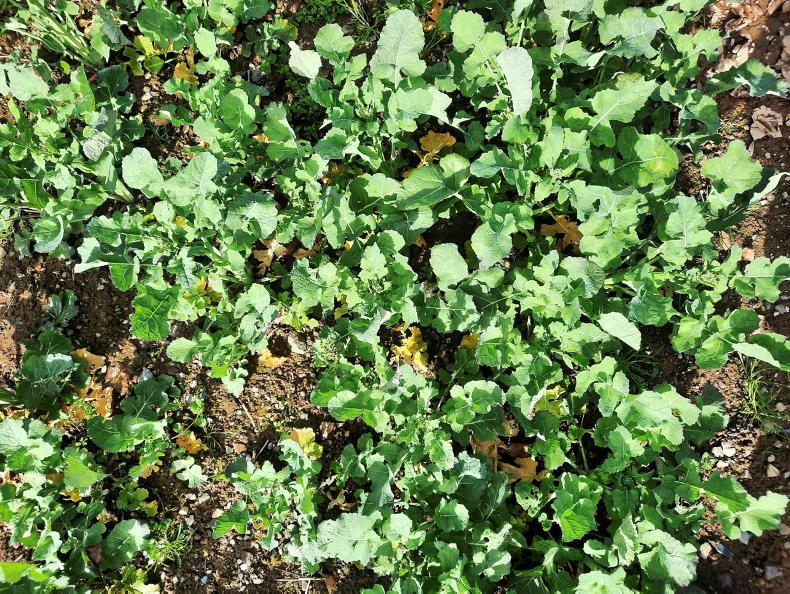
Oilseed rape.
Recommended list
The Department of Agriculture’s Recommended List for winter oilseed rape has five varieties this year – Ambassador, Aurelia, LG Aviron, Dart and LG Auckland. As winter oilseed rape may only be harvested in August and is being sown again in a few weeks this list is often behind on some of the newer varieties coming through, so you may well be sowing a variety that is not on the list.
The Department assesses varieties for light leaf spot resistance which can be an issue in crops. LG Aviron, Dart and LG Auckland all rate an eight out of nine for resistance to light leaf spot.
Will the area increase?
The area of winter oilseed rape planted in this country hit approximately 20,500ha in 2023. This declined to almost 16,000ha in 2024 and to almost 11,300ha in 2025.
Good prices and suitable weather conditions drove area up, while poor weather at planting and a shortage of rotation slots probably limited the crop area this year. The price has been relatively consistent, compared to other commodities.
This year we have had an extremely early harvest. It is an ideal year to plant oilseed rape. Crops are cleared and in some cases cultivations have been carried out and stale seedbeds created to improve weed control. It could help to improve your rotation.
Why plant oilseed rape?
It is a more dependable crop than it has been previously.Price has been good.It helps to balance workload on the farm.It offers another method of weed control to get better control and prevent resistance build-up.Crops of cereals after break crops yield better.Oilseed rape can help with soil compaction issues.
The area of oilseed rape has declined in recent years. Unfortunately, area has declined when varieties are probably at the best they ever have been. Once considered a risky crop to grow due to losses from pod shatter, oilseed rape has become much more consistent.
This year yields look to have ranged from about 1.8-2.5t/ac, with a lot of crops falling into the 2.3-2.4t/ac category, among the highest yields farmers have grown.Sunshine at flowering no doubt helped with this yield, but genetics have been a big help too.
In recent years there have been four main traits added to varieties, which have helped winter oilseed rape to become more dependable. These traits are not included in all varieties.
Important traits available in oilseed rape varieties:
Turnip yellows virus resistance: similar to BYDV this is spread by aphids.Pod shatter resistance: this gene reduces pod shatter massively, which reduces yield losses and reduces the levels of volunteer oilseed rape in fields.Scleroflex: this reduces the risk of the crop getting sclerotinia and reduces the level of infection if it does get it. Sclerotinia disease moves to the stem and cuts off the plant. It is generally sprayed for at flowering, but in long flowering periods it can be hard to keep on top of. N-flex: these varieties can cope better when nitrogen application is delayed in the springtime.LG Armada has all four of these relatively new traits, while a number of varieties have three of the four.
LG Avenger does not have N-flex, while LG Aviron, LG Ambassador, LG Academic and LG Auckland have three of the traits and are missing the Scleroflex trait.

Aurelia Oil Seed Rape. \ Donal O' Leary
Sclerotinia
The Scleroflex trait can reduce the amount of the fungus in the soil and so reduce the risk to other crops. Sclerotinia can also affect beans and peas, but spring crops can still be in a rotation with oilseed rape as they will be far enough apart in the rotation at three years.
Ploughing can help to reduce the level of sclerotinia spores that can affect crops. Both LG Armada and LG Avenger contain the Scleroflex trait.
Clubroot
Clubroot is a big problem in oilseed rape where it takes hold, but is prevented with rotation. Clubroot lives in the soil and can be carried by brassica crops including oilseed rape and catch crops like forage rape, mustard and kale. Rotation is key to keeping clubroot at bay. It likes warm and damp soils with poor drainage and generally likes a pH of around 6.5. It often starts in a patch in a field. The roots stop growing and look like a stump.
Clubroot resistant varieties are now available. However, they are considerably behind on yield compared with others at present.

LG Armada oilseed rape.
Pests
Pigeons and slugs are the biggest pest threats to crops over the winter. However, if crops get established well early in the season they should be able to re-establish themselves after a pigeon attack. Slugs will need to be watched.
Research has shown that having 15 plants/m2 in the springtime is enough to produce a profitable yield.
Sowing rate
Advice from industry suggests drilling 40-60 seeds/m2 to establish 35-40 plants/m2 by the end of October. The aim is to have 25-30 plants/m2 at the start of February and 25 main stems/m2 at the start of flowering.
Green area index
In years gone by oilseed rape received blanket nitrogen applications. However, the measurement of green area index (GAI) has helped to reduce the amount of nitrogen applied to crops significantly.
The GAI can be measured very easily by downloading an application to your smartphone which allows you to take pictures to assess the GAI. You can also assess the GAI by hand.
Once the GAI is established you can apply rates accordingly. Crops with lower GAIs will get nitrogen earlier and more of it, while crops which have taken up nitrogen over the winter and grown well and covered the ground will need less nitrogen and won’t need it as early. The aim is to have a GAI of about two in February and 3.5 at the start of flowering. Crops need about 175kg N/ha to achieve a GAI of 3.5. If you are aiming for a yield of 4.5t/ha you can apply 60kg/ha more N.
A GAI of one indicates that the crop has taken up about 50kg N/ha. Teagasc place the soil N availability at about 40kg N/ha. This crop would require about 202kg N/ha, while a crop with a GAI of two would require about 135kg N/ha.

Oilseed rape.
Recommended list
The Department of Agriculture’s Recommended List for winter oilseed rape has five varieties this year – Ambassador, Aurelia, LG Aviron, Dart and LG Auckland. As winter oilseed rape may only be harvested in August and is being sown again in a few weeks this list is often behind on some of the newer varieties coming through, so you may well be sowing a variety that is not on the list.
The Department assesses varieties for light leaf spot resistance which can be an issue in crops. LG Aviron, Dart and LG Auckland all rate an eight out of nine for resistance to light leaf spot.
Will the area increase?
The area of winter oilseed rape planted in this country hit approximately 20,500ha in 2023. This declined to almost 16,000ha in 2024 and to almost 11,300ha in 2025.
Good prices and suitable weather conditions drove area up, while poor weather at planting and a shortage of rotation slots probably limited the crop area this year. The price has been relatively consistent, compared to other commodities.
This year we have had an extremely early harvest. It is an ideal year to plant oilseed rape. Crops are cleared and in some cases cultivations have been carried out and stale seedbeds created to improve weed control. It could help to improve your rotation.
Why plant oilseed rape?
It is a more dependable crop than it has been previously.Price has been good.It helps to balance workload on the farm.It offers another method of weed control to get better control and prevent resistance build-up.Crops of cereals after break crops yield better.Oilseed rape can help with soil compaction issues.
SHARING OPTIONS