In autumn 2025, Wexford farmer Isaac Wheelock decided to set himself a challenge – he wanted to push the yield of one of his winter wheat fields. Over the winter, Isaac watched on as rain battered that winter wheat crop and springs created floods and streams in the field.
The challenge he set had become more difficult. It was then about minding the crop that was there, trying to keep plants in the ground and get them to compensate for the gaps.
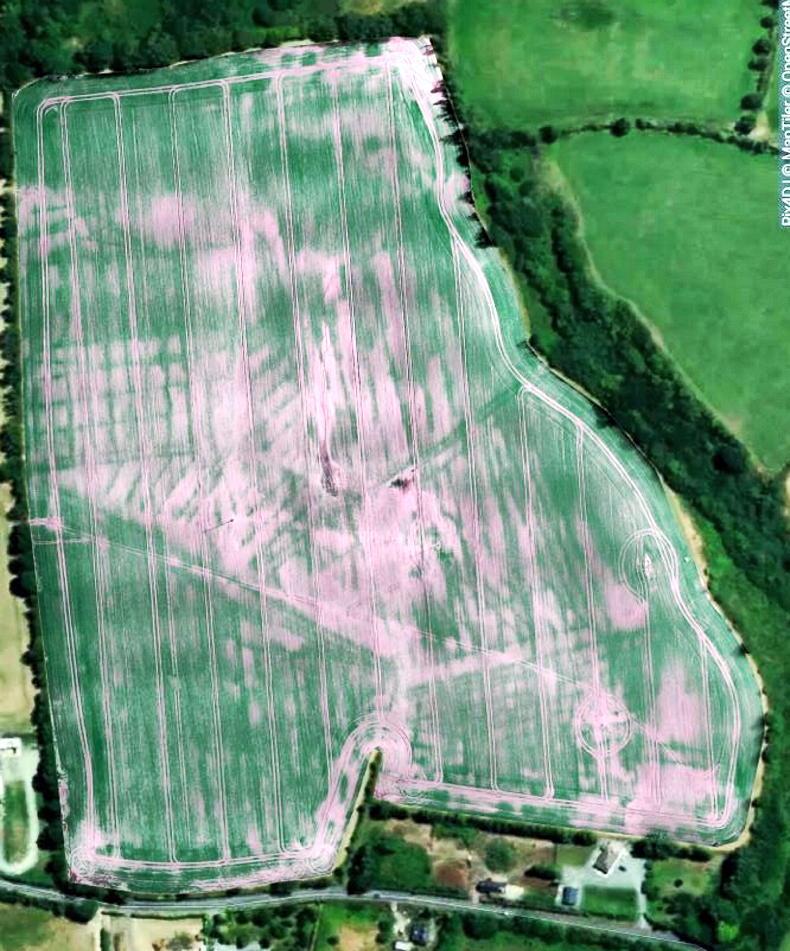
An NDVI map showed that approximately 10ac of the 35ac field had low plant counts and was severely impacted by wet weather.
The crop needed nutrition, but the tractor couldn’t travel. On 6 March, a drone applied NK Phite and Novofour at 1l/ha each, providing important nutrition to help with rooting to retrieve other nutrients and to help with leaf growth. The total extra cost from using the drone was €17.80/ac.
Isaac said he walked into that field every day and it was getting worse, but he had the money invested and said he had to try and keep it.
“I think it [the drone] was the saving of that crop. We even noticed it in the field beside it where it just got the drone. It didn’t get the extra nutrition. The yield difference there was substantial.”
Isaac worked closely with his agronomist George Blackburn from Cooney Furlong Grain Company. From early in the season, George decided to feed the crop, little and often. It needed to be nursed to get out of the wet ground.
George is always clear with growers that winter wheat requires a lot of work or it won’t make money. He warned that getting timings on winter wheat right is essential.
“My programmes are focused on trying to deliver 5t/ac in every field. It doesn’t always happen, but you have to try and achieve that or give the crop the potential to do that,” George commented.
“I think the best way to keep people in business is to keep their yields up,” he said.
The compound went out in two splits and the nitrogen was put out in four splits. It was acknowledged this might not be too practical, but in some cases, this is needed where crops are struggling, so while you might not do it in every field, in every year it might be something to consider in difficult conditions.
The fertiliser spreader travelled seven times in the high-input programme compared to four in the standard.
The sprayer travelled nine times plus once with the drone, compared to seven times in the standard programme.
The variety was KWS Scope, which has great yield potential. John Dunne of Goldcrop noted that we are not achieving the yield potential from crops in this country and that attention to detail is essential to work to that potential.
“Every single detail needs to be looked at from your plant numbers, your seed rate to your seedbed conditions all the way up. This is the level of detail we need to get our potential.
“We talk about adding value, adding value to the acre, adding value to the tonne. If we can get our yields up that’s adding value. That is bringing margin straight onto it,” John said.
Yield
Isaac’s field of wheat that received the standard programme yielded 3.81t/ac. The field which received the standard programme with the drone yielded 4.22t/ac. The field that received the high-input programme yielded 5.03t/ac. So, there was a yield difference of 1.2t/ac.
“The reality of the situation is that the standard programme was very disappointing, 3.8t/ac of winter wheat is not going to butter any bread,” George said, but it should be noted that this was close to the average yield of winter wheat in our agronomist’s survey, which was 3.9t/ac.
George commented there was virus in that field and the high-input field did get a second insecticide, which may also have helped.
The field is about 7.8% soil organic matter, receives organic manures, has been in minimum-tillage for 20 years and George noted that the Wheelock’s care for the soil helped the crop to recover.
See table for a breakdown of income, variable costs and margin over fixed costs. Remember land rental is not added into this as well as costs like insurance.
Extra-spend
The drone inputs and flight added €17.90/ac to the spend (see Table 1). So, the second field had an extra spend of just €17.90/ac, but returned an extra €92.25/ac over the standard programme, meaning the return on the extra spend was €74.45/t.
The high-input programme had an extra spend of €61.90/ac over the standard programme, but returned €309.25/ac more, resulting in a return on spend of €247.35/ac. These returns are based on a wheat price of €225/t at 20% moisture content and a straw price of €65/8X4X3 bale.
Looking at the figures and the extra income created, Isaac said: “It’s basically the difference between going broke and staying in business.
“It’s tonnes over the weighbridge that pay the bills,” he added, and working off 100% rented land he needs to get those tonnes. “I learned a massive amount out of this and probably the biggest thing that I learned out of it is you need to be in the field very regularly.”
Note
To note, Isaac focused on one field in a block of winter wheat. The yield was measured off of three fields in the block. The first field measured received the standard programme. The second field received the drone nutrition and the standard programme and the final field received the drone nutrition and an enhanced agronomy programme including increased inputs and machinery costs.
This was not a scientific research trial. This was a farmer-led trial. So, we cannot give specific reasons for the yield increase, but what is clear is that where the crop was managed with greater detail and received more inputs it yielded higher.
The extra aphicide may also have been a factor. Virus seemed to be lower in the higher-input fields.
The main extra costs in the field came from nutrition and extra travel with the fertiliser spreader and sprayer.