The Irish Tillage and Land Use Society held its winter conference last month. The event featured a number of farmers who shared stories on management and alternative income.
It placed an emphasis on economics and highlighted the low-carbon traits of Irish grain and its use in animal feed.
Tillage incomes at all time low
Dr Fiona Thorne said that in her almost 25 years carrying out economic analysis on tillage farms the tillage income has never been below drystock farmers.
However, she expects drystock farmers to move ahead of tillage farmers in terms of income in 2025 and the trend will likely continue into 2026.
Fiona, added that six out of 10 tillage farms don’t meet the threshold for viability. This means that the labour unit on the farm is not remunerated with the minimum wage.
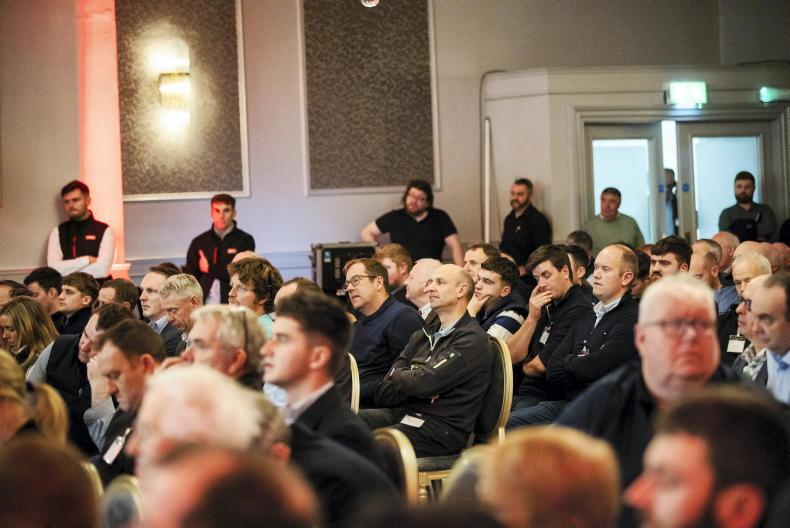
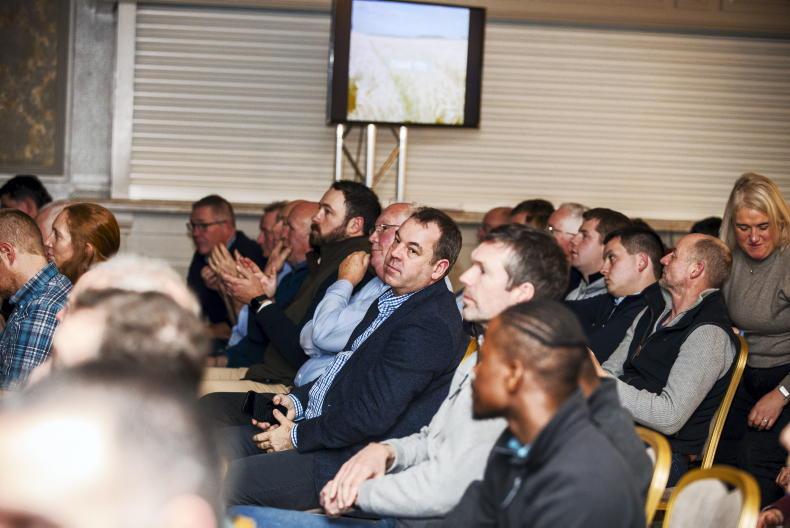
Some of the crowd at the ITLUS Conference 2025 at the Clanard Court Hotel. \ Justin Lynch
Fiona explained that on bigger tillage farms, scale gets some farmers out of trouble.
However, she said that there is “no dressing it up” as tillage farms are under severe pressure at present.
The researcher explained that figures for 2026 are a forecast based on trend yields and assuming average weather conditions. She expects prices to remain unchanged at present, but advised farmers the best indication of price they can get is those they get when they ask their merchant or co-op.
She also noted that farmers need to be doing their profit monitors and calculating the return from their farms.
Making use of schemes and other income sources
Andy Mahon is originally from Rathfarnham in Dublin. He studied agriculture at Harper Adams, worked on farms in England, Australia and New Zealand. He also worked for Velcourt, an advisory and share farming business.
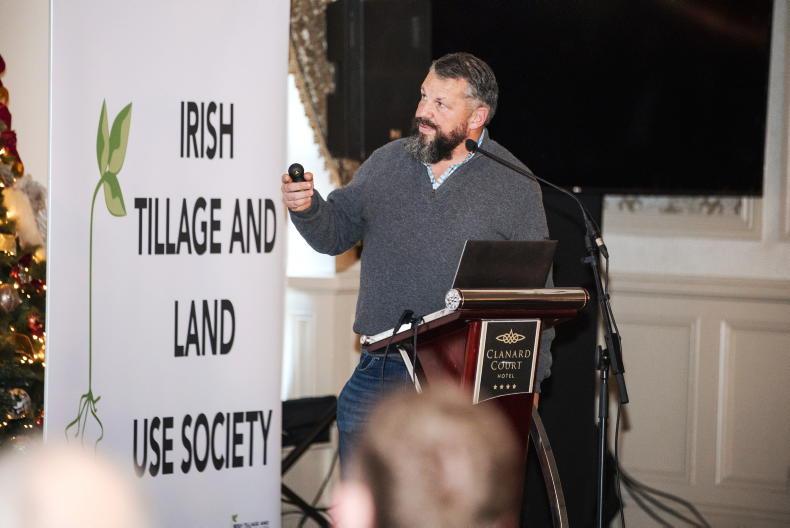
Andy Mahon who manages an estate in England. \ Justin Lynch
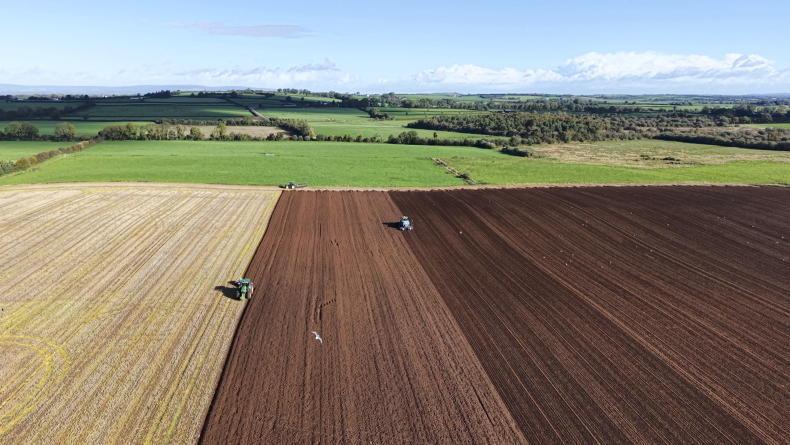
Now, he is well settled at Bromborough Estate, managing their 840ha farm. In his time there, there have been many changes, chief among them a move from a plough-based system. Policy has also changed with the farm now in two sustainable farming system agreements. 75% of the farm is under SFI and Andy says while he has these payments he will make use of them. The farm had to diversify in recent years and there are a huge number of different enterprises contributing to income. There is agroforestry on the farm, commercial units, houses, solar parks, paddle courts and the farm is also selling carbon.
Andy commented that a 10-year solar park equates to income replacement for the subsidies that have been lost.
On the cropping side of things cover cropping started in 2013, along with reduced tillage. Insecticides have not been used on the farm since 2013 and over time fertiliser and fungicide use has reduced.
There is a focus on soil health to overcome the reductions in these inputs and in recent times Andy has started to apply compost extracts to land. Average wheat yields on the farm are about 9.2t/ha (3.72t/ac). He’s looking at premium contracts for wheat to bring up income, but also focuses on basic management like having diesel storage on the farm to buy when the price drops.
Kevin and Michelle Rosenbohm farm with their family in Missouri in the mid-west of the US. They own 5,000ac. Kevin travelled to Ireland this year and told the ITLUS conference that he prefers to own land and pay for it over time. However, his sons are renting some land.
Kevin’s family run a smooth system.
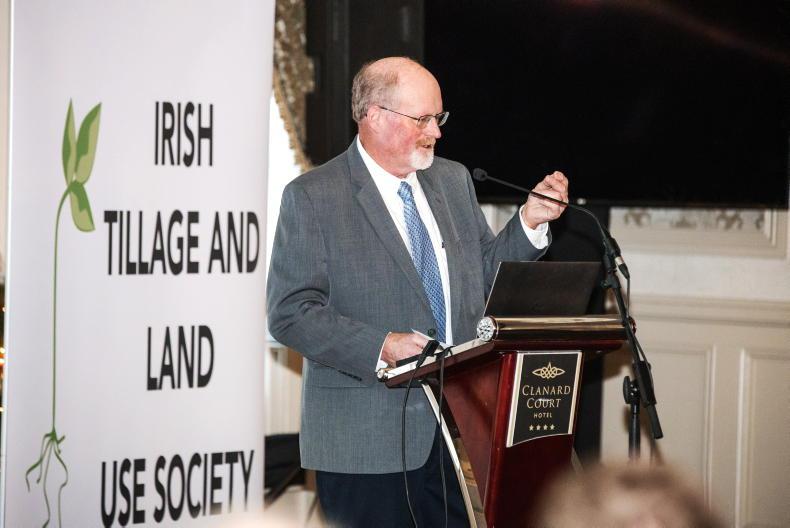
Kevin Rosenbohm from the US. \ Justin Lynch
Each has their own job. Michelle is the financial officer for example and their son Nick is in charge of spraying. Everyone knows their job and does it well.
We often associate the US with GM crops, but Kevin’s maize is non-GM and is grown for Ingredion processing to make starch. This delivers a 70%premium over standard maize.
The soybeans are GM and the Rosenbohms have their own seed business for soybeans. Their soybeans go straight to the seed plant at harvest and they also receive about 400,000 units of seed from other growers.
The plant is mainly run by Michelle and their daughter-in-law Kylie, along with college students in the busy times.
Kevin got out of cattle a number of years ago to invest in the seed plant, but he said son Matt and Kylie have now brought the cattle back.
Kevin noted they do everything themselves on the farm apart from fly airplanes and soil sample. Soil sampling is carried out every four years and lime and fertiliser are applied every year based on these tests. They use variable application to make sure that lime and fertiliser go where they are needed.
They apply about 4,000t of lime on average every year.
They also apply about 350t of phosphorus, 300t of potassium as well as sulphur and zinc.
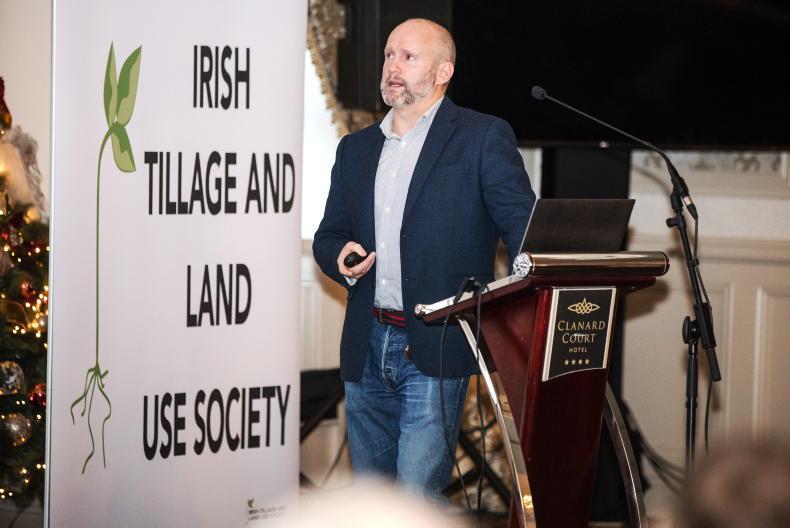
Will Stokes from Co Tipperary. \ Justin Lynch
Quotable quotes from the ITLUS conference
The difference between a good farmer and a bad farmer is a week”
– Will Stokes from Tipperary on getting timings right.
There is a competitive pressure from mills that don’t use native
– Pat Ryan, Liffey Mills
The only thing that gets us out of jail is the scale. There’s no dressing that up
– Fiona Thorne, Teagasc on tillage farm incomes.
We do everything except fly airplanes and soil sampling
– Kevin Rosenbohm, US farmer.
The Irish Tillage and Land Use Society held its winter conference last month. The event featured a number of farmers who shared stories on management and alternative income.
It placed an emphasis on economics and highlighted the low-carbon traits of Irish grain and its use in animal feed.
Tillage incomes at all time low
Dr Fiona Thorne said that in her almost 25 years carrying out economic analysis on tillage farms the tillage income has never been below drystock farmers.
However, she expects drystock farmers to move ahead of tillage farmers in terms of income in 2025 and the trend will likely continue into 2026.
Fiona, added that six out of 10 tillage farms don’t meet the threshold for viability. This means that the labour unit on the farm is not remunerated with the minimum wage.

Some of the crowd at the ITLUS Conference 2025 at the Clanard Court Hotel. \ Justin Lynch
Fiona explained that on bigger tillage farms, scale gets some farmers out of trouble.
However, she said that there is “no dressing it up” as tillage farms are under severe pressure at present.
The researcher explained that figures for 2026 are a forecast based on trend yields and assuming average weather conditions. She expects prices to remain unchanged at present, but advised farmers the best indication of price they can get is those they get when they ask their merchant or co-op.
She also noted that farmers need to be doing their profit monitors and calculating the return from their farms.
Making use of schemes and other income sources
Andy Mahon is originally from Rathfarnham in Dublin. He studied agriculture at Harper Adams, worked on farms in England, Australia and New Zealand. He also worked for Velcourt, an advisory and share farming business.

Andy Mahon who manages an estate in England. \ Justin Lynch
Now, he is well settled at Bromborough Estate, managing their 840ha farm. In his time there, there have been many changes, chief among them a move from a plough-based system. Policy has also changed with the farm now in two sustainable farming system agreements. 75% of the farm is under SFI and Andy says while he has these payments he will make use of them. The farm had to diversify in recent years and there are a huge number of different enterprises contributing to income. There is agroforestry on the farm, commercial units, houses, solar parks, paddle courts and the farm is also selling carbon.
Andy commented that a 10-year solar park equates to income replacement for the subsidies that have been lost.
On the cropping side of things cover cropping started in 2013, along with reduced tillage. Insecticides have not been used on the farm since 2013 and over time fertiliser and fungicide use has reduced.
There is a focus on soil health to overcome the reductions in these inputs and in recent times Andy has started to apply compost extracts to land. Average wheat yields on the farm are about 9.2t/ha (3.72t/ac). He’s looking at premium contracts for wheat to bring up income, but also focuses on basic management like having diesel storage on the farm to buy when the price drops.
Kevin and Michelle Rosenbohm farm with their family in Missouri in the mid-west of the US. They own 5,000ac. Kevin travelled to Ireland this year and told the ITLUS conference that he prefers to own land and pay for it over time. However, his sons are renting some land.
Kevin’s family run a smooth system.

Kevin Rosenbohm from the US. \ Justin Lynch
Each has their own job. Michelle is the financial officer for example and their son Nick is in charge of spraying. Everyone knows their job and does it well.
We often associate the US with GM crops, but Kevin’s maize is non-GM and is grown for Ingredion processing to make starch. This delivers a 70%premium over standard maize.
The soybeans are GM and the Rosenbohms have their own seed business for soybeans. Their soybeans go straight to the seed plant at harvest and they also receive about 400,000 units of seed from other growers.
The plant is mainly run by Michelle and their daughter-in-law Kylie, along with college students in the busy times.
Kevin got out of cattle a number of years ago to invest in the seed plant, but he said son Matt and Kylie have now brought the cattle back.
Kevin noted they do everything themselves on the farm apart from fly airplanes and soil sample. Soil sampling is carried out every four years and lime and fertiliser are applied every year based on these tests. They use variable application to make sure that lime and fertiliser go where they are needed.
They apply about 4,000t of lime on average every year.
They also apply about 350t of phosphorus, 300t of potassium as well as sulphur and zinc.

Will Stokes from Co Tipperary. \ Justin Lynch
Quotable quotes from the ITLUS conference
The difference between a good farmer and a bad farmer is a week”
– Will Stokes from Tipperary on getting timings right.
There is a competitive pressure from mills that don’t use native
– Pat Ryan, Liffey Mills
The only thing that gets us out of jail is the scale. There’s no dressing that up
– Fiona Thorne, Teagasc on tillage farm incomes.
We do everything except fly airplanes and soil sampling
– Kevin Rosenbohm, US farmer.
SHARING OPTIONS