



As well as slurry and tillage equipment, Simon Cross of Cross Engineering has long been associated with beet handling equipment and has majored in beet washing and chopping machines in recent years, with washers now sold around the world.
A portion of each variety area was harvested prior to the event and the gross and washed yields were shown. Each variety could be seen growing and the washed harvested portion could also be seen.
The different varieties were sown in 18 inch rows on 1 May last. This is very much the continental method where an increasing number of diploid varieties, with their more upright leaf growth, are now grown.
The varieties were harvested using an Agrifac six-row self-propelled machine. This machine was also demonstrated during the event and generated a lot of interest.
Part of Simon’s reason for growing the different varieties was to show potential beet growers the level of yield potential in modern fodder and sugar beet cultivars. The genetic potential has moved on and higher yield levels are now realistic.
It is interesting that the general dirt tare level tended to be lower in the newer varieties. But this is hardly surprising given that one of the objectives of modern breeding programmes is to alter the root characteristics so that it holds less soil at harvest.
Root yields
The measured yields from the varieties were very impressive, ranging from 40.67t/ac with Minotaure fodder beet to 25.31 t/ac from the high dry matter Touareg.
The majority of varieties yielded in the 30t/ac to 35t/ac range and many of these had high dry matter. But two points must be remembered.
||PIC2||
Firstly, these were observation plots rather than replicated plots so a level of caution is required when comparing the specific yields of individual varieties.
Secondly, this is a particularly good year for crops like beet and maize and these yield levels will not be achievable every year.
It is also worth noting that this was a fresh field and this would help yield potential.
Each variety board also included a dry matter percentage. This was not measured from the harvested samples but is the average dry matter level recorded for each variety from replicated trials in recent years.
Dry matter level in the roots is important. It governs how the roots can be utilised, as low dry matter types down around 12% to 14% can be grazed, sometimes in situ, while the higher dry matter (18% to 20+%) types need to be chopped for feeding.
The higher dry matter types also have more of their roots in the ground (compared to the low dry matter types) and so they need to be washed or cleaned for feeding.
But root dry matter content has greater implications than that. It is the dry matter that carries the feeding value – the rest is just water.
So to get a real comparison of the feeding value of varieties, one must consider dry matter content. While growers are often happier to sell more tonnes of a lower dry matter variety, buyers seldom differentiate value on the basis of dry matter purchased.
However, this is changing. Many discerning feeders will now differentiate high versus low dry matter varieties and pay accordingly.
Variety is very important here because, regardless of the year, the relative difference in dry matter content between varieties will tend to hold true year on year. This is a variety characteristic that has proven true over time.
Dry matter yield
Converting field yield into clean dry matter yield is where the user gets value.
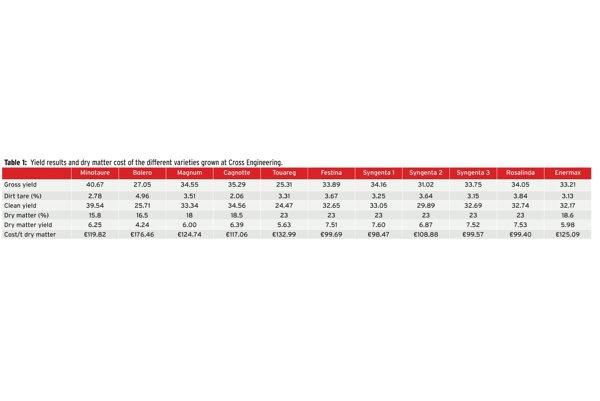
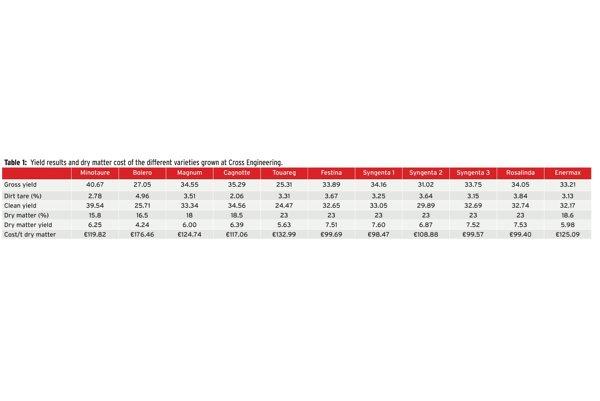
Feeders have recognised this with Magnum for years, relative to the other fodder varieties. Based on the figures in Table 1, its 34.55t/ac field yield converted to a 6t/ac dry matter yield of roots.
The newer Minotaure produced a whopping 40.67t/ac of roots but this converts to 6.25t/ac of dry matter yield.
Varieties like Rosalinda, Festina and two of the Syngenta varieties all produced dry matter yield in excess of 7.5t/ac from lower root yields.
The calculated production cost of the beet in this field was €748/ac excluding VAT. This also excludes most fixed costs.
If the grower was the user, the cost of the fodder beet dry matter would range from €98.50/t to €176/t. This is the type of difference that the choice of variety can make.
In general, higher dry matter means less handling, less transport and less washing per unit of animal performance and this is all time or money.
Still more potential
It must be pointed out that the yields shown in Table 1 were those achieved in the second week of October.
Another month of growth could significantly change these yield figures, especially in some of the later maturing varieties which still have very good healthy green leaves.
Fodder beet varieties are currently trading for around €45-€48/t of washed beet.



SHARING OPTIONS