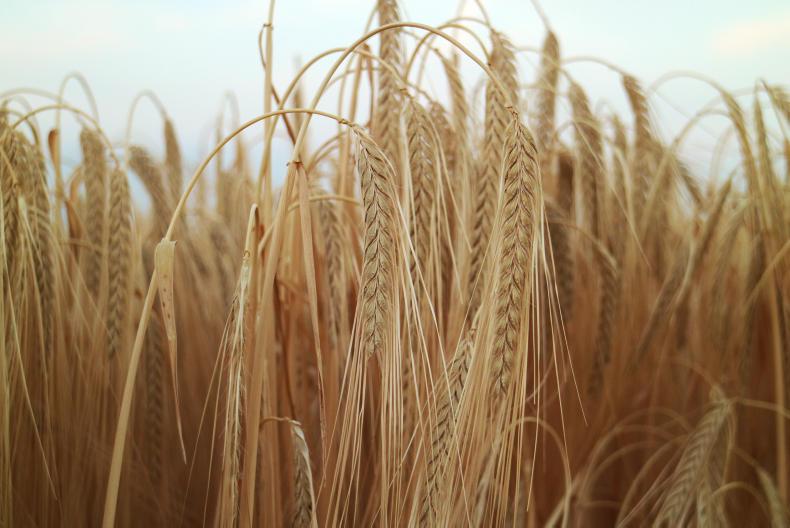
More frequent droughts forming part of climate change will hit barley-producing countries, especially Ireland, according to a study published in the journal Nature Plants.
Scientists from China, the UK and the US applied climate change models developed by the Intergovernmental Panel on Climate Change to the conditions required to grow the crop. More specifically, they examined the frequency of extreme heat and drought years under four possible scenarios.
20% yield drop
They found that the business-as-usual scenario leading to around 4°C global warming during the 21st century would result in an average worldwide fall in barley yields of 17% in increasingly frequent drought years. Ireland would be the third-worst affected producer, with the midpoint of yield estimates, depending on the severity of drought, showing a drop of over 20% during those hot years.
The scenario where global warming is kept under 2°C above pre-industrial levels, in accordance with the Paris climate agreement, would still cut barley yields by an average of 3% around the world in more frequent drought years. Ireland would again be severely affected, with the range of yield estimates ranging between stagnation and over 20% falls in those cases.
Beer price hikes
The findings were part of a study on the impact of climate change on the beer market. Competition between feed and malting uses would affect the brewing industry. Using economic modelling, the authors found that limited barley availability would push consumption down or prices up depending on the affluence and traditions in different countries.
While Argentinians would reduce their beer consumption by 32% during drought years under the most severe climate change scenario, Ireland is singled out as one of the countries where price hikes would be sharpest, with the cost of a pint most likely tripling.
'Add insult to injury'
“It may be argued that consuming less beer isn’t itself disastrous, and may even have health benefits," said Dabo Guan, professor of climate change economics at the University of East Anglia in the UK and co-ordinator of the research. "Nevertheless, there is little doubt that for millions of people around the world, the climate impacts on beer availability and price will add insult to injury.”
Read more
Chlorothalonil renewal hinges on expert group
Limiting global warming to 1.5°C: what does it mean for agriculture?
More frequent droughts forming part of climate change will hit barley-producing countries, especially Ireland, according to a study published in the journal Nature Plants.
Scientists from China, the UK and the US applied climate change models developed by the Intergovernmental Panel on Climate Change to the conditions required to grow the crop. More specifically, they examined the frequency of extreme heat and drought years under four possible scenarios.
20% yield drop
They found that the business-as-usual scenario leading to around 4°C global warming during the 21st century would result in an average worldwide fall in barley yields of 17% in increasingly frequent drought years. Ireland would be the third-worst affected producer, with the midpoint of yield estimates, depending on the severity of drought, showing a drop of over 20% during those hot years.
The scenario where global warming is kept under 2°C above pre-industrial levels, in accordance with the Paris climate agreement, would still cut barley yields by an average of 3% around the world in more frequent drought years. Ireland would again be severely affected, with the range of yield estimates ranging between stagnation and over 20% falls in those cases.
Beer price hikes
The findings were part of a study on the impact of climate change on the beer market. Competition between feed and malting uses would affect the brewing industry. Using economic modelling, the authors found that limited barley availability would push consumption down or prices up depending on the affluence and traditions in different countries.
While Argentinians would reduce their beer consumption by 32% during drought years under the most severe climate change scenario, Ireland is singled out as one of the countries where price hikes would be sharpest, with the cost of a pint most likely tripling.
'Add insult to injury'
“It may be argued that consuming less beer isn’t itself disastrous, and may even have health benefits," said Dabo Guan, professor of climate change economics at the University of East Anglia in the UK and co-ordinator of the research. "Nevertheless, there is little doubt that for millions of people around the world, the climate impacts on beer availability and price will add insult to injury.”
Read more
Chlorothalonil renewal hinges on expert group
Limiting global warming to 1.5°C: what does it mean for agriculture?
SHARING OPTIONS