


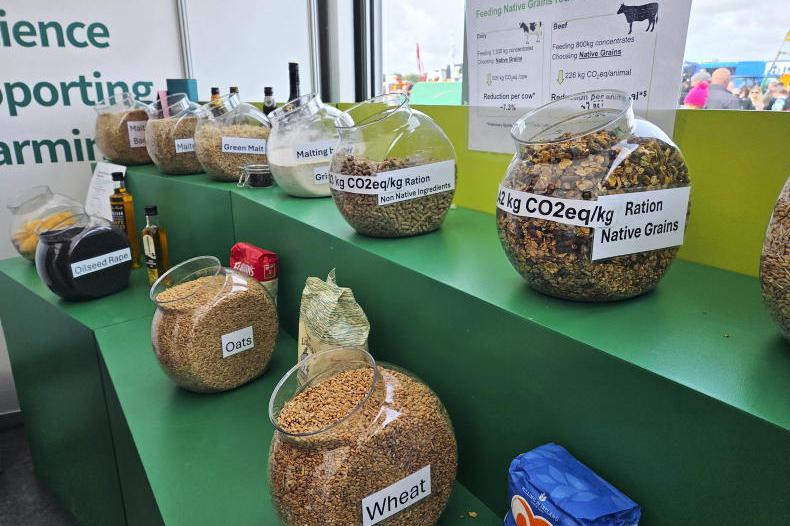
Feeding a ration with a high inclusion of Irish ingredients can significantly reduce the carbon footprint of dairy and beef animals, according to modelling from the Teagasc tillage team.
A display on the Teagasc stand at this year’s National Ploughing Championships showed that a dairy cow being fed 1,300kg in concentrates can drop carbon emissions by approximately 7.3% when fed a ration with 65% Irish ingredients compared to cows fed a ration produced using only imported ingredients.
The use of Irish grain and protein to feed animals according to the study results in a drop in emissions of 526kg CO2eq/cow.
On a beef farm, feeding 800kg of concentrates, using a ration with 62.5% Irish ingredients can result in a 3-5% decline in carbon footprint depending on the beef system.
The change from imported grain to native grain would result in a reduction in carbon footprint of 226kg CO2eq/animal. These figures are preliminary and depend on the beef system in place.
Carbon footprint of the ration
The ration made from imported grain, protein and other feed ingredients was given a carbon footprint of 0.83kg CO2eq/kg of ration. The ration produced from Irish grain and protein was estimated to have a carbon footprint of 0.42kg CO2eq/kg of ration.
Michael Hennessy, head of tillage knowledge transfer at Teagasc who carried out the study, told the Irish Farmers Journal that both rations are mixed to be the same nutritionally. The figures are based on Life Cycle Assessment (LCA) figures produced by Teagasc for Irish grain and LCA figures for imported grain using averages from different countries.
Hennessy also commented that as the cereal content of an animal feed ration declines the quality of the ration declines which can happen with imported feed.





SHARING OPTIONS