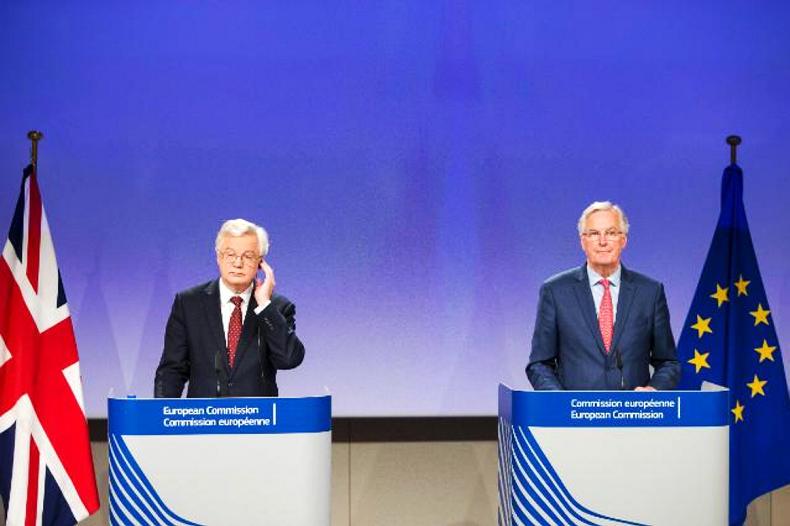
Michel Barnier, the EU lead negotiator on Brexit, provided an update on the EU negotiating position for the second phase of Brexit negotiations in Brussels this afternoon.
He indicated that the phase one agreement, announced in December, had to be put into legally binding language for the talks to move on to discussing the future UK relationship with the EU.
This was also a requirement to have a transition arrangement.
Blunt on terms
The lead negotiator was also blunt on what terms would be available for the UK during a transition phase.
Put simply, if the UK is to be part of a transition arrangement, they will be bound by EU rules on the single market and customs union for that period.
They will be able to have discussions with other countries in relation to trade agreements, but no agreement can take effect during the transition period.
Michel Barnier also said that he couldn’t guarantee UK access to agreements currently in place between the EU and other trading blocs and countries once they leave.
Significantly, he also said that the European Court of Justice (ECJ) would be the arbiter in disputes during any transition phase.
Comment
This position as stated by Michel Barnier will not sit easy with the UK government and in particular with the members the Conservative party who are advocating a clean break from the EU from March 2019.
The issue of the ECJ having jurisdiction on disputes will also create difficulties in Westminster, where the ambition is that the ECJ will cease to be applicable to the UK on 30 March 2019.
Also, with many in the Conservative party questioning the Prime Minister’s future, it is clear that while the UK debates what type of Brexit it wants, the EU has clear thinking on what it will allow. Whether or not the unity to date between the EU 27 remains will also be watched with interest in the UK.
Read more
Brexit uncertainty resumes as Mercosur deal also looms
Environmentalist sceptical of 'Green Brexit' plans
Michel Barnier, the EU lead negotiator on Brexit, provided an update on the EU negotiating position for the second phase of Brexit negotiations in Brussels this afternoon.
He indicated that the phase one agreement, announced in December, had to be put into legally binding language for the talks to move on to discussing the future UK relationship with the EU.
This was also a requirement to have a transition arrangement.
Blunt on terms
The lead negotiator was also blunt on what terms would be available for the UK during a transition phase.
Put simply, if the UK is to be part of a transition arrangement, they will be bound by EU rules on the single market and customs union for that period.
They will be able to have discussions with other countries in relation to trade agreements, but no agreement can take effect during the transition period.
Michel Barnier also said that he couldn’t guarantee UK access to agreements currently in place between the EU and other trading blocs and countries once they leave.
Significantly, he also said that the European Court of Justice (ECJ) would be the arbiter in disputes during any transition phase.
Comment
This position as stated by Michel Barnier will not sit easy with the UK government and in particular with the members the Conservative party who are advocating a clean break from the EU from March 2019.
The issue of the ECJ having jurisdiction on disputes will also create difficulties in Westminster, where the ambition is that the ECJ will cease to be applicable to the UK on 30 March 2019.
Also, with many in the Conservative party questioning the Prime Minister’s future, it is clear that while the UK debates what type of Brexit it wants, the EU has clear thinking on what it will allow. Whether or not the unity to date between the EU 27 remains will also be watched with interest in the UK.
Read more
Brexit uncertainty resumes as Mercosur deal also looms
Environmentalist sceptical of 'Green Brexit' plans









SHARING OPTIONS