


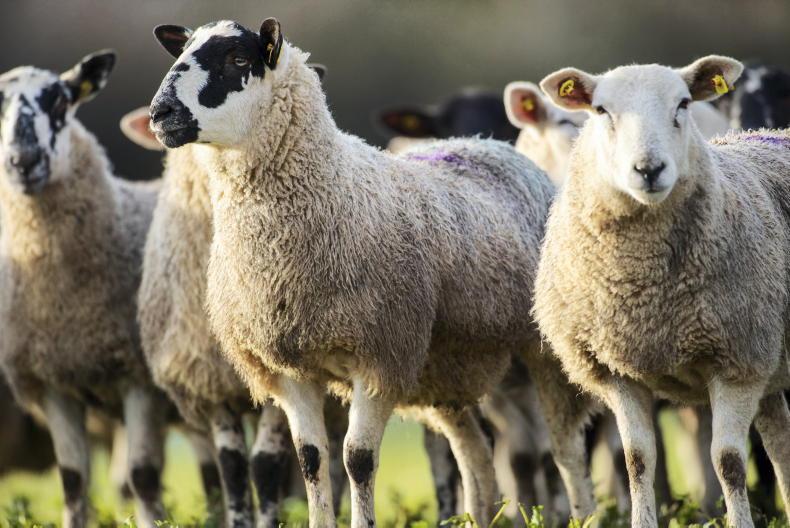
Breeding is coming to a close in the sheep flock this week on Tullamore Farm, with rams being removed over the weekend.
The breeding season ran over a six-week period with low activity recorded in the final two weeks. Ewes were introduced to rams on 16 October and mated in a number of groups using single-sire mating.
A total of 205 ewes were joined with eight different rams, leaving an average of 26 ewes per ram.
Some fitter or more active rams were put with larger groups and older rams expected to mate with small numbers in the first service and reserve energy should they be needed to be subbed in for a lame or sick ram in another bunch later in the season.
Of the eight rams used, there were four Texels, one Suffolk, two Charollais and one Easycare.
The farm has practiced single-sire mating for a number of years now to good success, but it requires careful management to ensure all rams are working and a number of grazing groups, which may make it unfeasible on some farms.
Data recording
The farm does a lot of data recording around lambing and during the rearing period of lambs in spring and summer, by using single-sire mating it gives us invaluable data around sire performance, since the start of the project we have been committed to buying four- and five-star rams and by single-sire mating and recording breeding activity we have a clear picture on how rams are performing when we record, lambing difficulty, birthweight, six-week weights, weaning performance and slaughter data.
Allowing us to make more informed breeding decisions in future based on ram performance.
Managing single sires
Management of single-sire mating requires a little extra attention and care when it comes to getting ewes in-lamb, but is something the farm has become accustomed to over the years. Managing the condition of rams pre-breeding is essential on any farm, but particularly important in a single-sire mating system, where each individual ram will be expected to breed with the entire number of sheep assigned to him within the first three weeks of the breeding season.
Essentially, the management of rams for this season would have started at the end of last season, with rams typically coming away from ewes in poorer condition than when breeding began.
Rams that had lost condition during the season last year would have been pulled aside for concentrate feeding to replenish BCS before being rejoined with the rest of the rams and put on a maintenance diet thereafter.
The six weeks in the run-up to breeding is extremely important. Rams should be in good BCS at that stage and free from lameness.
We generally introduce concentrates to rams one month pre-breeding to try to turn rams out in a BCS of 3.5 to 4 to ensure adequate fat reserves for the busy breeding season. All rams would be turned upside down to check their feet for any issues and some routine hoof paring done, but only if necessary.
Selection of ewes for rams is based on ewe breed and the size of the group is determined by age and fitness of the ram.
All mule ewes were run with Texel rams for the first cycle, with the two busiest rams being a strong hogget ram purchased this year and a four-year-old Texel ram, with 32 ewes selected to breed with each ram for the first cycle.
The oldest Texel ram on the farm was joined with 15 Suffolk/mule ewes and one more Texel ram running with a mixture of Suffolk/mule and mule ewes.
The busiest ram on the farm for the first cycle was our Easycare ram
All Texel/mule ewes on the farm were run with Charolais rams, with 10 Texel ewes selected to run with the Suffolk. The Suffolk sire was joined with 15 Easycare ewes not selected for purebred breeding and 10 Texel/mule ewes.
The busiest ram on the farm for the first cycle was our Easycare ram which was run with 50 Easycare ewes, with the view to keeping replacements from this bunch.
As with many maternal breeds, Easycare rams are seen to be quite active and able for larger numbers. This seems to be the case, with little repeat activity observed in this bunch, despite being asked to work harder than the more terminal breeds on the farm.
Raddling and swapping rams
We took a different approach to raddling this year, with no raddle used for the first 17 days of the breeding season.
In previous breeding seasons, rams were either fitted with raddle harnesses or had their chest painted with a mixture of oil and raddle powder.
However, due to the high activity of rams in the first week of breeding, we found ourselves having to gather breeding bunches to readjust raddle harnesses or top up raddle colours.
We try to avoid stressing or gathering ewes during the breeding season - hence our decision to use no raddle for the first 17 days.
On day 17, all bunches were gathered, each ewe recorded as being mated with the assigned sire, raddle harness or paint applied and rams swapped between bunches. Swapping of rams will protect us from any ram that could be infertile or sub-fertile.
Texel rams were swapped between mule and Suffolk mule bunches. Both Charollais rams swapped directly between their bunches and the Easycare ram removed and joined with 10 ewe lambs.
All Easycare ewes were then joined with a Suffolk and Texel ram which picked up repeats in this bunch.
Low activity has been recorded in the second cycle, with 12% of ewes bred in this window.
Raddle colours were changed again and rams joined together for the final two weeks of breeding with little or no activity observed.
Ewe lamb management
The farm has practiced breeding ewe lambs and lambing as yearling hoggets for a number of years. Ewe lambs are joined with rams at around days 17 or the beginning of the second cycle and are bred across a three-and-a-half-week breeding season.
Ewe lambs are joined at a minimum weight of 60% of mature weight. Sixty ewe lambs were joined this year and are a mixture of homebred Texel, Suffolk and Easycare lambs, with 15 bought-in Easycare ewe lambs joined also.
Ewe lambs were vaccinated against enzootic and toxoplasmosis abortion pre-breeding.
The breeding season is short in this group (3.5 weeks) and with this, we would expect a higher barren rate. However, this is not considered an issue, with the farm keen to keep the lambing season compact and empty ewe lambs being kept on to run as dry yearling hoggets and bred next season.
Concentrates will be introduced to this group about two weeks pre-scanning and fed through to lambing.
These lambs have been grass fed up until this point and introducing concentrates early will train lambs to eat meal before the critical points pre-lambing and will help to bolster thrive as they are still growing animals.
All ewe lambs are being bred by Charollais rams for ease of lambing, with 10 Easycare ewe lambs being bred pure.


SHARING OPTIONS