



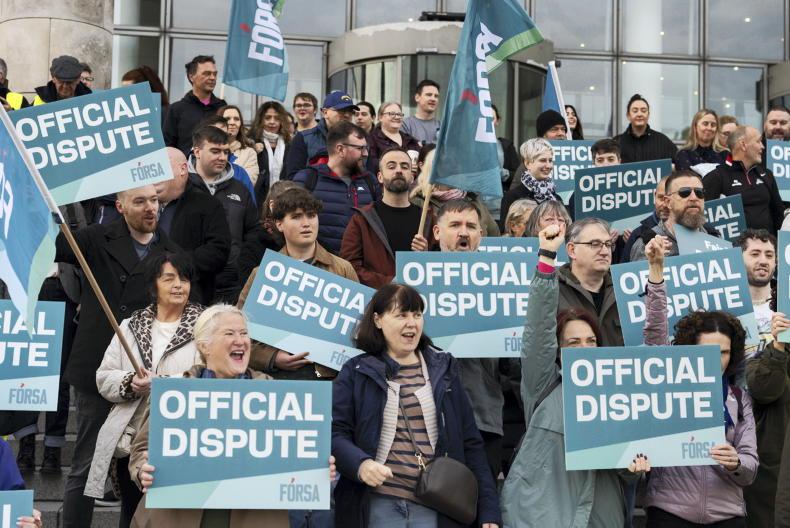
On Wednesday of last week, the public servants on picket duty outside the schools, hospitals and government offices displayed a range of pre-printed placards, one of which caught the eye: ‘We all deserve a better deal’.
The use of ‘We’, the first-person plural, is designed to engage the sympathy of the passer-by in the trade unions’ struggle and create the perception that all are equally deserving of the ‘better deal’.
All interests happily coincide by implication, in their disappointment with the government’s budget and the failure to scatter sufficient money around the country through greater spending increases and tax giveaways.
Sympathetic general public
If the vox pops aired by RTÉ and other broadcasters are representative, the general public is amenable to the view that all have, indeed, been let down by the failure of the Government to spend more freely and to cut taxes more aggressively.
The public-service unions have, thus far, secured at least a grudging free pass from the public at large, with only a few grumbles from the usual suspects, economists from the Fiscal Council and the Economic and Social Research Institute (ESRI).
Both organisations have warned about the medium-term pressures for extra spending on the elderly, unavoidable at some stage given the demographic profile. Over the shorter horizon of the next few years, their principal worry is the fragility of the current boom in corporation tax revenues.
Treating a portion of this bonanza as transient means that the budget is already in deficit.
Threats up ahead
But there are additional threats to the sustainability of a further spell of relaxed budget policy. Government has rarely stuck close to budget targets in recent years, and public expenditure minister Jack Chambers has already described the €1.2 billion 2027 budget provision for a public-service pay deal as a ‘starting point’ for discussions.
There have been persistent overshoots on current spending, and officials at the Department of Finance will not welcome the minister’s willingness to contemplate slippage from a figure which does not include the knock-on costs for pensions.
These are automatically linked to current pay rates, and the true figure could be closer to €1.7 billion when the full bill is totted up.
Moreover, the economists remember the last outbreak of unjustified optimism about the public finances, leading up to the bust of 2008.
So does Stephen Collins, writing in The Irish Times on 16 October. He recalled the brisk growth in the public-service pay bill in the complacent years from 2000 until the collapse. Public pay rates in Ireland had risen sharply – including at the recruitment grades – and had begun to out-run what was on offer in the private economy.
The later years of the Bertie Ahern era had seen a succession of economy-wide pay deals negotiated by the social partners, consisting of trade unions, employers and, unfortunately, the Exchequer.
A national misunderstanding
The deals were each called the National Understanding by participants and another National Misunderstanding by those who were conscious that the property bubble would pop, as bubbles do.
There is currently no economy-wide pay-determination system in place which compares to the social-partnership model of the pre-bust period, devoutly though the trade unions – especially in the public sector – would wish its return.
It helped to camouflage what was really going on in public-pay costs pre-2008, all dressed up as part of a ‘national’ agreement.
Union membership remains strong in public employment here, above 80% on most estimates, but has collapsed in the private sector, where the figure seems to be no more than about 15%.
Even if no longer likely to propagate beyond the State sector, the settlement which Chambers and his colleagues eventually concede will matter in budget terms – there are over 400,000 potential beneficiaries, not counting pensioners.
Threats
The corporation-tax bonanza is continuing for now and could last another couple of years, maybe even longer. But there are long-term threats in other areas not yet flagged by the Fiscal Council or the ESRI.
They could come directly from the European Union or indirectly through the pressure to abandon neutrality and embrace a far more costly annual bill for the military. If Ireland were in NATO, the bill would rise from the €1.6 billion pencilled in for 2027 to, ultimately, €25 billion or even more. And for ever more.
That is the implication of the current push by EU countries to increase defence spending, currently only one-fifth of 1% of national income in Ireland, to 3% or higher.
Some countries in eastern Europe are already at 5% and rising.
Without joining NATO, there will be EU pressure to spend more on defence anyway, not easy to resist while the budget surplus, however transient, continues.
Do not be surprised to see the fiscal worriers embrace neutrality, even out-and-out pacifism, over the next few years.






SHARING OPTIONS