


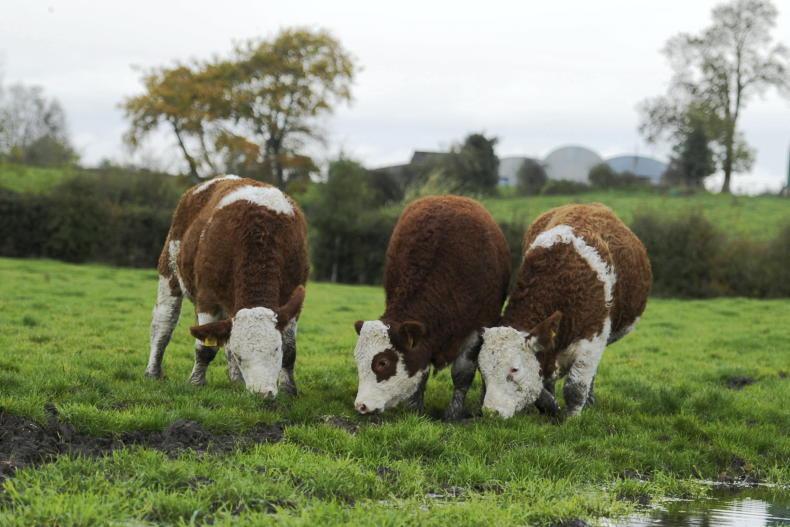
Just as quickly as things dried up, heavy rain over the early part of the week has led to saturated soils and difficult grazing conditions for the majority of farms on heavy or mixed soils.
The only solace that farmers can take is that warmer and more settled conditions are set to return towards the weekend, so hopefully normal grazing habits can resume then.
As we saw last week, ground can dry very quickly at this time of the year if given half a chance. If you haven’t gotten up to speed yet with fertiliser applications, try to get some nitrogen out whenever conditions allow.
Speaking to farmers over the past week, fertiliser has yet to go out on a lot of silage ground. There is just shy of seven weeks until the end of May, so the likelihood of getting any silage ground yet to be grazed cleaned up is poor.
To avoid pushing cutting dates out into June (for farms targeting high DMD silage) the option for these is to not graze these swards and to take an early cut of silage in the first half of May.
Growth won’t have reached its midsummer slump, so recovery should be good.
Farmers can then decide to fertilise for a second cut if it will be required. For farmers looking for bulky dry cow silage, a later cutting date can work, although every farm has a requirement for a certain amount of high quality silage.
Trevor Boland – Dromard, Co Sligo
Autumn calved cows are still housed, but all other stock are out at grass at the minute. Ground conditions are not too bad after a slow spring.
Weanling bulls have been grazing around the home block, with this being earmarked for silage, and the weanling heifers and in-calf heifers are on the out-farm.
I’m hoping to get cows turned out in the next week. They will be forced to graze out ground well, but will still gain condition throughout the summer.
Grazing ground has received 30 units of N, with 75 units spread on silage ground, along with 2,000 gallons slurry/acre. This will be closed up this week and baled at the end of May.
System Suckler to finishing
Soil type Mainly dry
Farm cover (kg/DM/ha) 628
Growth (kg/DM/ha/day) 41
Demand (kg/DM/ha/day) 25
Shaun Diver – Tullamore Farm, Co Offaly
We had to rehouse some cows and calves that were close to the yard yesterday (Tuesday) because of the heavy rain.
We have 32 cows and calf pairs and 40 heifers remaining at grass, as well as the lambed ewes. We spread half bag/acre of urea on 30 acres last week when the weather was fine.
Ewes at grass are either being fed concentrates or have received a magnesium bolus to help prevent any grass tetany issues, with the idea being we will wean ewes off concentrates when the weather improves.
We have begun breeding the suckler cows, although the current weather is less than ideal for cows holding in calf.
System Suckler to finishing
Soil type Variable
Farm cover (kg/DM/ha) 933
Growth (kg/DM/ha/day) 29
Demand (kg/DM/ha/day) 29
Billy Gilmore – Cortoon, Co Galway
We got some lighter heifers out in February and rehoused when weather broke.
All stock were out at grass last week, but had to be rehoused Tuesday morning. We have been hammered with rain over the past few weeks. Grazing conditions are very difficult at the moment.
Some 2,000 gallons slurry/acre was spread in late January on one third of the farm with a dribble bar. In mid-February, 20 units of urea 38% + S were spread on reseeded paddocks and those with the strongest growth, with half a bag potash/ acre given to paddocks low in the beginning of March.
One bag/acre of 18:6:12 was spread on paddocks last week that had not received slurry, with those which had being topped up with urea at 20 units/acre.
System Contract rearing
Soil type Variable
Farm cover (kg/DM/ha) 912
Growth (kg/DM/ha/day) 21
Demand (kg/DM/ha/day) 22



SHARING OPTIONS