How has 2017 been for your farmer customers?
There’s a sharp contrast between Ireland and the UK at the moment, as well as the contrast between dairy and arable farming in Ireland.
Sterling has devalued significantly in the last year allowing UK farmers to get higher prices for their wheat, milk and beef.
But in turn, sterling has put pressure on Irish farmers. Tillage farming in Ireland is under pressure, while in the UK, tillage farming is in recovery after five years of decline.
In dairy farming, prices have improved this year in both the UK and Ireland.
How has this affected machinery sales?
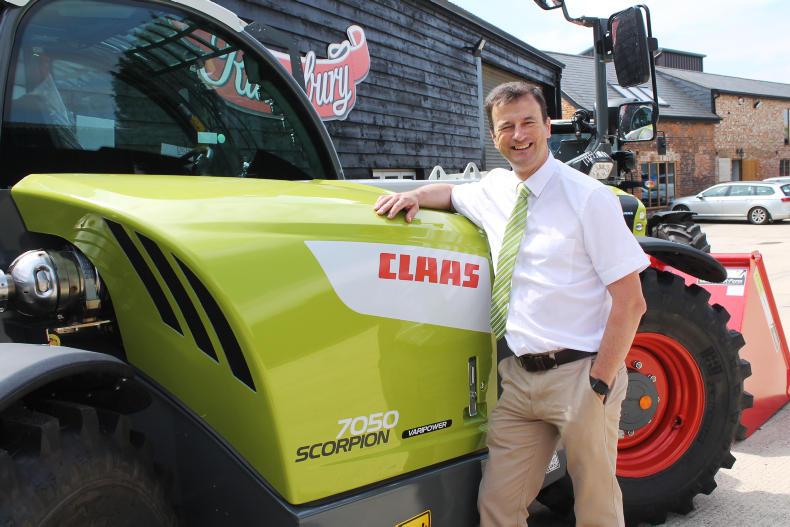
Overall, our business has improved this year after three years of declining sales. Our Irish business had five years of continuous growth up to 2014, having started Claas Ireland in 2009.
Up to the end of July, we are 22% ahead of last year and on track for a record year.
Will farm subsidies continue in
the UK post-Brexit?
We hope farm subsidies in the UK will survive in some form in a post-Brexit environment. The UK government has stated that subsidies will continue at the current level up to 2022.
My view is that subsidies will change to more environmental payments around animal welfare and food quality. If subsidies disappeared, it would certainly be a real commercial challenge for UK farmers.
Farming can survive without subsidies but it’s a different way of farming, typically much larger-scale.
How has sterling weakness affected your business?
Our sales prices in euro have not changed since the Brexit vote except for inflation, but our sterling prices have had to increase dramatically.
They’re up more than 20% in the last 18 months. And that’s a significant cost increase for the British farmer to absorb.
Has this impacted the cost of steel?
Steel prices have been a big issue.
We buy forward all of our steel needs but we’ve seen steep rises in steel costs for our 2018 range of machines.
We won’t be able to pass all of that cost rise on to the customer. It’s the smaller machines that get hit the worst as they have proportionally more steel content compared with larger ones.
How will Brexit affect your business?
Claas will remain flexible. We import Claas machines from France, Germany and Hungary to the UK. And we then export these machines from the UK to Ireland. No matter what happens with Brexit, it won’t change the fact that we manage UK and Ireland as one market.
There may be changes with customs arrangements or VAT but Claas has the systems already in place across our global business to handle that.
We’re now bringing these systems to our UK and Ireland business to work around any new customs arrangements.
Is investing in R&D and technology a big cost?
Claas invests over 5% of annual turnover in R&D, which is over €200m per annum. In recent years, we’ve had to spend a lot of time and effort investing in R&D around emissions.
But we’ve completed a lot of that work so we can start to focus more on developing new technology for our customers’ needs.
Read more
Claas given approval for building of new headquarters
Claas tractor range gets a new lease of life
How has 2017 been for your farmer customers?
There’s a sharp contrast between Ireland and the UK at the moment, as well as the contrast between dairy and arable farming in Ireland.
Sterling has devalued significantly in the last year allowing UK farmers to get higher prices for their wheat, milk and beef.
But in turn, sterling has put pressure on Irish farmers. Tillage farming in Ireland is under pressure, while in the UK, tillage farming is in recovery after five years of decline.
In dairy farming, prices have improved this year in both the UK and Ireland.
How has this affected machinery sales?
Overall, our business has improved this year after three years of declining sales. Our Irish business had five years of continuous growth up to 2014, having started Claas Ireland in 2009.
Up to the end of July, we are 22% ahead of last year and on track for a record year.
Will farm subsidies continue in
the UK post-Brexit?
We hope farm subsidies in the UK will survive in some form in a post-Brexit environment. The UK government has stated that subsidies will continue at the current level up to 2022.
My view is that subsidies will change to more environmental payments around animal welfare and food quality. If subsidies disappeared, it would certainly be a real commercial challenge for UK farmers.
Farming can survive without subsidies but it’s a different way of farming, typically much larger-scale.
How has sterling weakness affected your business?
Our sales prices in euro have not changed since the Brexit vote except for inflation, but our sterling prices have had to increase dramatically.
They’re up more than 20% in the last 18 months. And that’s a significant cost increase for the British farmer to absorb.
Has this impacted the cost of steel?
Steel prices have been a big issue.
We buy forward all of our steel needs but we’ve seen steep rises in steel costs for our 2018 range of machines.
We won’t be able to pass all of that cost rise on to the customer. It’s the smaller machines that get hit the worst as they have proportionally more steel content compared with larger ones.
How will Brexit affect your business?
Claas will remain flexible. We import Claas machines from France, Germany and Hungary to the UK. And we then export these machines from the UK to Ireland. No matter what happens with Brexit, it won’t change the fact that we manage UK and Ireland as one market.
There may be changes with customs arrangements or VAT but Claas has the systems already in place across our global business to handle that.
We’re now bringing these systems to our UK and Ireland business to work around any new customs arrangements.
Is investing in R&D and technology a big cost?
Claas invests over 5% of annual turnover in R&D, which is over €200m per annum. In recent years, we’ve had to spend a lot of time and effort investing in R&D around emissions.
But we’ve completed a lot of that work so we can start to focus more on developing new technology for our customers’ needs.
Read more
Claas given approval for building of new headquarters
Claas tractor range gets a new lease of life






SHARING OPTIONS