Coolmore is a name we associate with extremely successful horses and trainers. Rock of Gibraltar, Galileo, and Yeats, are just some of the world-famous names. Breeding and training are of course highly important, but at this level you need to dot the Is and cross the Ts.
You can’t bed these thoroughbreds with any old straw and they don’t eat any old oats. So, from the outside, when you look at the tillage operation of Coolmore Stud, it looks like a big farm and it is, it has increased in size significantly over the last decade, but it is a key part of the stud’s success.
Unbelievably, even though a lot of barley straw is produced, the farm still needs to purchase some straw from neighbours. By being somewhat self-sufficient, along with purchasing straw from neighbouring farms, the stud had enough supplies during the drought year of 2018. It’s a business that appreciates the value of a local source of grain and straw. Something refreshing at a time when little value is being placed by many on Irish grain.

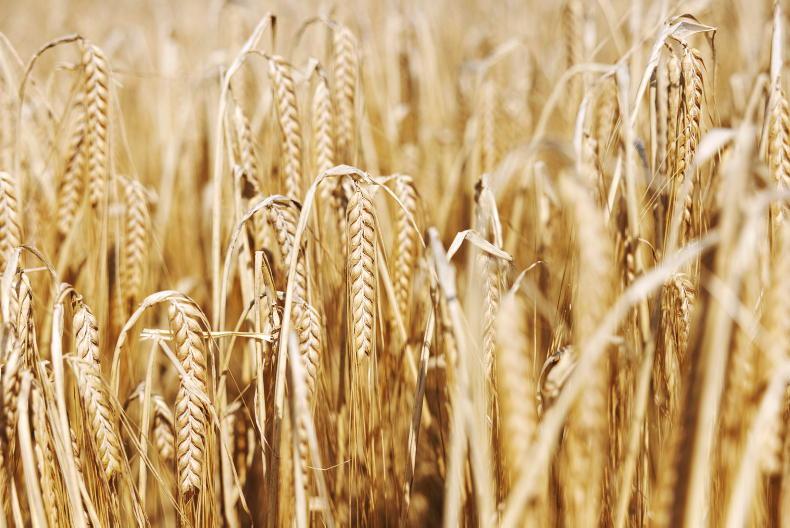
Winter barley on Coolmore's tillage farm, near Clonmel, Co Tipperary. \ Odhran Ducie
The tillage farm’s main base is Grange Farm, near Clonmel, and it is managed by local man Tony Nugent. Tony explains that he manages the farm in different blocks. At this scale, logistics management is paramount.
Winter barley is by far the biggest crop on the farm, and on a recent tour with the Fertilizer Association of Ireland that is where we started, in the winter barley fields. As straw is an important product for the farm, it makes sense that winter barley dominates. It has an early harvest date and long cutting days.
Recent advances in genetics have also helped with management. Tony, an agronomist, told us that 60-70% of the winter barley varieties planted on the farm are now barley yellow dwarf virus (BYDV) tolerant varieties. This allows for early sowing, and a pre-emergence herbicide is applied after the roller or the drill to keep grass weeds under control. There is no wait to apply an aphicide. In a year like this, it also gave some security, because after the pre-emergence herbicide was applied, sprayers didn’t get out to winter crops until February.
KWS Joyau, Sensation and Integral are the BYDV-tolerant varieties, while Tardis and Pixel make up a good proportion of the remainder.
A growth regulator is generally applied at GS30/31 and a fungicide, such as Proline, along with it. It could take three to four days to spray the winter barley, so it makes sense to keep ahead of the crop when travelling and to keep disease under control.
Decoy and Priaxor were also applied, while Revystar went on as the final spray this season on 5 May. Tony believes that Revystar is good on ramularia. He adds that the straw needs to be clean, so while his spend might be on the high side, a little extra on fungicide helps to ensure this.
Back in Coolmore and Ballydoyle, they want golden straw and they were fans of the pink straw that came in some of the hotter years, but it has to be clean, disease free and show no signs of brackling.

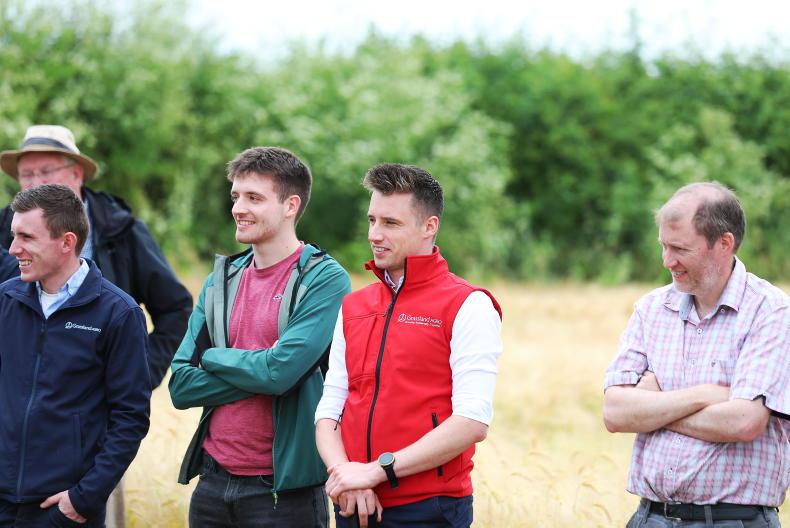
The Fertilizer Association of Ireland Summer Tour event at Lisronagh, Clonmel, Co Tipperary. \ Odhran Ducie
Grass weeds
Every year some straw is bought in and some contractors come on to the farm. Like most farms, grass weeds are a problem and while brome is the particular culprit, where we looked at the winter barley it was clean for what was a fourth winter barley, with small bits of soft brome on the edge of the roadway.
On purchasing straw, Tony said: “I can manage my own weeds. I can’t manage everyone else’s.”
Due to this, and the increasing threat of blackgrass, straw purchases are now very strict. Straw that is being purchased is segregated. Crops are inspected for grass weeds regularly prior to harvest.
Minimum tillage
Minimum tillage is used to establish crops on the farm, where possible. It’s efficient and helps to improve soil health, but Tony acknowledged that while he wants to get away from the plough, he simply can’t, and 2022-23 was one of the years where minimum-tillage drills were left in the shed once rain hit.
However, having short-term cover crops between successive winter crops allowed easier drilling of winter crops without ploughing last autumn. The land with the cover crops received one run of a 9m carrier and was drilled with a pair of Horsch power harrow drills and the Mzuri drill.
“We wouldn’t have got our autumn crops in otherwise.”
Listening to Tony, he’s a big fan of the Vaderstad Top Down (7m), but he commented that while land is often cultivated to 6”, it could be cultivated to 8/9” at times. This machine plants all of the cover crops, as well as carrying out the main deep cultivating.
Soil
The focus for the past few years on soil has been to fix the basics – pH, phosphorus (P) and potassium (K). Soils are sampled to 1ha every four years. Variable rate P and K application was used, and indices are now up in the 3s across most of the farm. Having indices up allowed the farm to take a risk and cut Ps and Ks completely this season, when prices were at some record highs. Tony commented that this went down well with the farm’s financial manager, Tim Gleeson. He puts it bluntly, that if he didn’t cut those Ps and Ks from the input sheet then at current grain prices the farm would not make any money this year.
Soil health is something Tony talked a lot about during the visit. Compost has been applied to the land from the stables. For the last two years the spreading of compost had stopped. This was to get a handle on grass weeds.
A policy of segregating straw at harvest time and after its use in the stables has been worked out. The holy grail is to add compost to the land and not weed seeds, increasing soil organic matter and reducing P and K fertiliser applications.
Tony, along with Joe Holohan the overall farm manager, and John Corbett, the farm’s grassland and sustainability manager, have worked out a plan where all straw is traced from the moment it arrives; to which stables it goes to and afterwards at composting sites. This will ensure only clean compost (free of grass weeds) goes back onto the tillage farms.
Rotation is also important. Oilseed rape and bean straw are both chopped and incorporated back into the soil, and Tony commented on the ability of a bean root to break through the soil and spread its roots so well.
Also in the rotation are wheat, oats and spring barley. The spring beans and spring barley help to spread the workload on the farm. Some Planet is grown for malting, along with some Tungsten for whiskey production.
There is some black soil with a known manganese deficiency and manganese is applied two to three times to crops in the season on these fields. Leaf testing is something that Tony says is in the plan now that the basics are right.
When asked about bio-stimulants, Tony says he sees them playing a role as chemistry moves off the market, but he said he will use them as a replacement for something else and they will not be used as an extra addition to inputs. This year, they have replaced folpet and he is excited in how this has helped disease control.

Lisronagh, Clonmel, Co Tipperary. \ Odhran Ducie
Cover crops
Now that the basics are fairly right across soils, Tony is moving on to cover crops and increasing organic matter in the soil.
With oilseed rape and beans in the rotation, he is conscious of things like club root breaking through and so keeps away from brassicas and vetch, and tries to stick to crops that will not cause problems in the cash crops.
Buckwheat was planted to try and release some phosphorus from the soil and phacelia is in the mix with this. The buckwheat dies off in the frost and the phacelia is sprayed off with glyphosate.
Some catch crops go in straight after winter barley and are taken out in the middle of September, before the next batch of winter barley. This is done to reduce take-all in land that grows second, third and fourth barley crops and he feels that they have had a positive effect on brome reduction.
Tony thinks December is the ideal time to spray glyphosate on these crops, to be ready for planting in early spring. Last season, sheep from a local farmer grazed a cover crop of berseem clover, phacelia and forage rape. Some back-fencing was needed and it sounds like something that will continue in some form or another in the future on the farm.
This year the beans were planted in February, but the majority of spring barley was drilled at the beginning of April. When we visited on 16 June it was raining, which was welcome. The winter barley was coming in quick and harvest was expected to start in early July. The horses and trainers will no doubt be examining the produce of that carefully.
Coolmore is a name we associate with extremely successful horses and trainers. Rock of Gibraltar, Galileo, and Yeats, are just some of the world-famous names. Breeding and training are of course highly important, but at this level you need to dot the Is and cross the Ts.
You can’t bed these thoroughbreds with any old straw and they don’t eat any old oats. So, from the outside, when you look at the tillage operation of Coolmore Stud, it looks like a big farm and it is, it has increased in size significantly over the last decade, but it is a key part of the stud’s success.
Unbelievably, even though a lot of barley straw is produced, the farm still needs to purchase some straw from neighbours. By being somewhat self-sufficient, along with purchasing straw from neighbouring farms, the stud had enough supplies during the drought year of 2018. It’s a business that appreciates the value of a local source of grain and straw. Something refreshing at a time when little value is being placed by many on Irish grain.

Winter barley on Coolmore's tillage farm, near Clonmel, Co Tipperary. \ Odhran Ducie
The tillage farm’s main base is Grange Farm, near Clonmel, and it is managed by local man Tony Nugent. Tony explains that he manages the farm in different blocks. At this scale, logistics management is paramount.
Winter barley is by far the biggest crop on the farm, and on a recent tour with the Fertilizer Association of Ireland that is where we started, in the winter barley fields. As straw is an important product for the farm, it makes sense that winter barley dominates. It has an early harvest date and long cutting days.
Recent advances in genetics have also helped with management. Tony, an agronomist, told us that 60-70% of the winter barley varieties planted on the farm are now barley yellow dwarf virus (BYDV) tolerant varieties. This allows for early sowing, and a pre-emergence herbicide is applied after the roller or the drill to keep grass weeds under control. There is no wait to apply an aphicide. In a year like this, it also gave some security, because after the pre-emergence herbicide was applied, sprayers didn’t get out to winter crops until February.
KWS Joyau, Sensation and Integral are the BYDV-tolerant varieties, while Tardis and Pixel make up a good proportion of the remainder.
A growth regulator is generally applied at GS30/31 and a fungicide, such as Proline, along with it. It could take three to four days to spray the winter barley, so it makes sense to keep ahead of the crop when travelling and to keep disease under control.
Decoy and Priaxor were also applied, while Revystar went on as the final spray this season on 5 May. Tony believes that Revystar is good on ramularia. He adds that the straw needs to be clean, so while his spend might be on the high side, a little extra on fungicide helps to ensure this.
Back in Coolmore and Ballydoyle, they want golden straw and they were fans of the pink straw that came in some of the hotter years, but it has to be clean, disease free and show no signs of brackling.

The Fertilizer Association of Ireland Summer Tour event at Lisronagh, Clonmel, Co Tipperary. \ Odhran Ducie
Grass weeds
Every year some straw is bought in and some contractors come on to the farm. Like most farms, grass weeds are a problem and while brome is the particular culprit, where we looked at the winter barley it was clean for what was a fourth winter barley, with small bits of soft brome on the edge of the roadway.
On purchasing straw, Tony said: “I can manage my own weeds. I can’t manage everyone else’s.”
Due to this, and the increasing threat of blackgrass, straw purchases are now very strict. Straw that is being purchased is segregated. Crops are inspected for grass weeds regularly prior to harvest.
Minimum tillage
Minimum tillage is used to establish crops on the farm, where possible. It’s efficient and helps to improve soil health, but Tony acknowledged that while he wants to get away from the plough, he simply can’t, and 2022-23 was one of the years where minimum-tillage drills were left in the shed once rain hit.
However, having short-term cover crops between successive winter crops allowed easier drilling of winter crops without ploughing last autumn. The land with the cover crops received one run of a 9m carrier and was drilled with a pair of Horsch power harrow drills and the Mzuri drill.
“We wouldn’t have got our autumn crops in otherwise.”
Listening to Tony, he’s a big fan of the Vaderstad Top Down (7m), but he commented that while land is often cultivated to 6”, it could be cultivated to 8/9” at times. This machine plants all of the cover crops, as well as carrying out the main deep cultivating.
Soil
The focus for the past few years on soil has been to fix the basics – pH, phosphorus (P) and potassium (K). Soils are sampled to 1ha every four years. Variable rate P and K application was used, and indices are now up in the 3s across most of the farm. Having indices up allowed the farm to take a risk and cut Ps and Ks completely this season, when prices were at some record highs. Tony commented that this went down well with the farm’s financial manager, Tim Gleeson. He puts it bluntly, that if he didn’t cut those Ps and Ks from the input sheet then at current grain prices the farm would not make any money this year.
Soil health is something Tony talked a lot about during the visit. Compost has been applied to the land from the stables. For the last two years the spreading of compost had stopped. This was to get a handle on grass weeds.
A policy of segregating straw at harvest time and after its use in the stables has been worked out. The holy grail is to add compost to the land and not weed seeds, increasing soil organic matter and reducing P and K fertiliser applications.
Tony, along with Joe Holohan the overall farm manager, and John Corbett, the farm’s grassland and sustainability manager, have worked out a plan where all straw is traced from the moment it arrives; to which stables it goes to and afterwards at composting sites. This will ensure only clean compost (free of grass weeds) goes back onto the tillage farms.
Rotation is also important. Oilseed rape and bean straw are both chopped and incorporated back into the soil, and Tony commented on the ability of a bean root to break through the soil and spread its roots so well.
Also in the rotation are wheat, oats and spring barley. The spring beans and spring barley help to spread the workload on the farm. Some Planet is grown for malting, along with some Tungsten for whiskey production.
There is some black soil with a known manganese deficiency and manganese is applied two to three times to crops in the season on these fields. Leaf testing is something that Tony says is in the plan now that the basics are right.
When asked about bio-stimulants, Tony says he sees them playing a role as chemistry moves off the market, but he said he will use them as a replacement for something else and they will not be used as an extra addition to inputs. This year, they have replaced folpet and he is excited in how this has helped disease control.

Lisronagh, Clonmel, Co Tipperary. \ Odhran Ducie
Cover crops
Now that the basics are fairly right across soils, Tony is moving on to cover crops and increasing organic matter in the soil.
With oilseed rape and beans in the rotation, he is conscious of things like club root breaking through and so keeps away from brassicas and vetch, and tries to stick to crops that will not cause problems in the cash crops.
Buckwheat was planted to try and release some phosphorus from the soil and phacelia is in the mix with this. The buckwheat dies off in the frost and the phacelia is sprayed off with glyphosate.
Some catch crops go in straight after winter barley and are taken out in the middle of September, before the next batch of winter barley. This is done to reduce take-all in land that grows second, third and fourth barley crops and he feels that they have had a positive effect on brome reduction.
Tony thinks December is the ideal time to spray glyphosate on these crops, to be ready for planting in early spring. Last season, sheep from a local farmer grazed a cover crop of berseem clover, phacelia and forage rape. Some back-fencing was needed and it sounds like something that will continue in some form or another in the future on the farm.
This year the beans were planted in February, but the majority of spring barley was drilled at the beginning of April. When we visited on 16 June it was raining, which was welcome. The winter barley was coming in quick and harvest was expected to start in early July. The horses and trainers will no doubt be examining the produce of that carefully.
SHARING OPTIONS