


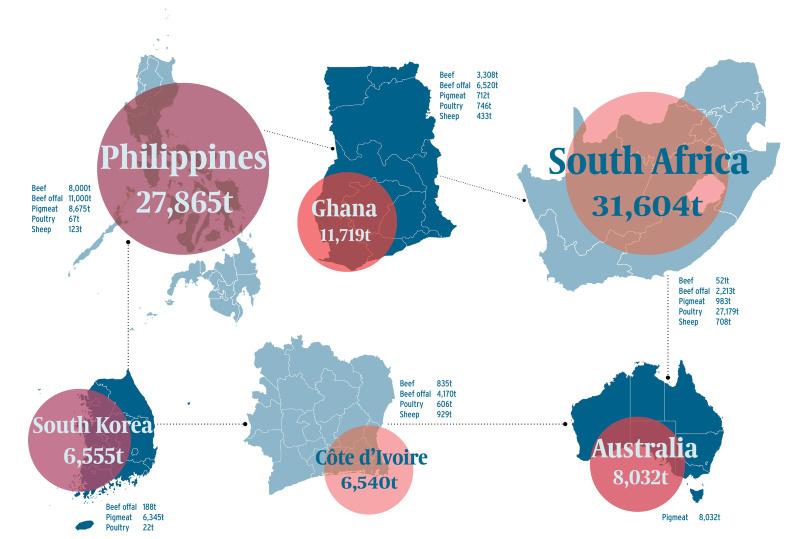
In the 10 years since the start of the financial crisis in 2008, when the euro traded at 95p sterling, Irish meat exports globally have increased by 69%, or just under 500,000t, up to 2018. Volumes to the United Kingdom, still by far our main export market for meat, have increased by just under 200,000t. European markets also grew significantly, taking 90,000t more than they did in 2008, with France, Germany, Netherlands and Denmark delivering a combined 75,000t of this growth.
In the last ten years, Ireland has invested significant resource in market access and either gained initial market access or expanded existing access to China, Philippines, Australia, South Africa, United States, Canada, Saudi Arabia and many other markets.
The biggest difference, however, is the increased volume of Irish meat shipped to markets outside of Europe. These exports combined have increased from 26,000t in 2008 to just under 208,000t last year, or approximately 20% of all output. A total 57,000t of those exports was offal, which helped market expansion in Ghana and the Ivory Coast.
It goes without saying that unlocking opportunities in markets outside the UK is significantly more difficult. Complications around communication, shipping times, consumption habits, business culture and international tariffs and regulations mean that growth gets more difficult. Membership of the European Union negates many of the latter logistical challenges, but for those markets outside of Europe, this challenge can be complex.
Demand
The world’s population is estimated at 7.7bn people today, compared to an estimated 6.7bn in 2008. Wealth is increasing and urbanization is just one factor leading to lower agricultural output and more demand for imported food and ingredients. A country’s self-sufficiency, or ability to feed its population, is a political consideration many in Europe wouldn’t even think about. Outside of Europe, this is often a fundamental challenge many global governments have near the top of their agendas.
The global population is predicted to reach 10bn in 2056, and regions that currently have a low self-sufficiency in production of key proteins will drive a demand for which Ireland, as an exporter, is in a position to supply.
Market access – the procedure
Securing market access approval is agreed between governments and is usually a slow bureaucratic process. Only when access is secured can a market be commercially developed by exporting companies.
Although some market access applications can be approved in less than a year, most take from three to five years or even longer to conclude. This time is required in order for inspectors to visit Ireland, usually at least twice, and for reports and questionnaires to be completed on both sides before negotiations around the conditions of supply are agreed.
In the last ten years, Ireland has invested significant resource in market access and either gained initial market access or expanded existing access to China, Philippines, Australia, South Africa, United States, Canada, Saudi Arabia and many other markets.
Last month, two teams of inspectors from the GACC, the customs inspection agency of the Chinese government were hosted by the Department of Agriculture for a 10 day factory inspection itinerary. It is these inspectors that approve factories outside China as suppliers to the Chinese market. While the schedule was disrupted by the factory protests, arrangements were made locally that enabled the completion of 14 more Irish factory inspections. Additionally, for the first time, Ireland’s sheepmeat production system was audited to assess suitability for supplying China.
Building awareness
Recent research undertaken by Bord Bia found that awareness of Ireland, among a survey of 1,000 people in China, was less than 1%. In Japan and South Korea the equivalent figures were even lower. Bord Bia has been working hard to change this, by targeting those B2B buyers and media influencers to raise Ireland’s profile. Once more, trade missions play a key role. Japan, a country that imports around 1.5mt of pigmeat and a further 700,000t of beef, is a good example.
In June of 2019, as part of a Ministerial trade mission to Japan, over 80 Japanese importers, buyers and industry leaders attended a Bord Bia conference highlighting the positive implications of the EU Japan Economic Partnership Agreement on tariffs for imported Irish pigmeat and beef. One-to-one meetings were scheduled between Irish exporters and their Japanese counterparts to drive business opportunities. This has been followed up with a further technical seminar, delivered by the Bord Bia Tokyo office on the evening before the Ireland Japan rugby match, to further establish Ireland’s credentials as a suitable supplier to a market with the highest standards.
Promotional campaigns
Bord Bia undertakes a variety of activities, depending on the market, to assist exporters in turning demand and access into sales. These include direct engagement with buyers, trade show participation, bringing buyers to Ireland and leveraging promotional activities highlighting Ireland’s uniquely sustainable proposition to buyers and consumers. One highlight of these activities has been Ireland’s successful application to be the EU member state given the responsibility and budget to promote beef and lamb over the past three years in China and for the next three years for beef and pigmeat in the Philippines, Vietnam and South Korea. These initiatives deliver promotional events in each country’s market, including participation in trade shows such as Sial Shanghai, Foodex Tokyo, Wofex Philippines and Seoul Food Korea. Two separate groups of buyers from the Philippines visited Irish meat plants this autumn, as a result of this partnership.
Having access to the best markets for each of these cuts positions Ireland’s exporters to mix their sales, maximise the best return from their production and deliver increased value back to farmers.



SHARING OPTIONS