




THe United States department of agriculture (USDA) is forecasting that record volumes of beef will be imported by the United States this year, but the amount coming from Ireland is negligible and continues to decline.
The US national cattle herd is at a 75-year low and industry analysts suggest that any rebuild will be slow, with little impact for the remainder of this decade.
With a current farmgate beef price at the equivalent of €7.48/kg for steers similar to our R3 grade, it is a particularly high-value market that wants to import a huge quantity of beef.
In April, USDA revised its forecast for US beef imports in 2026 up from 2.472m tonnes carcase weight equivalent (CWE) to 2.626m tonnes CWE, a significant increase on last year’s record 2.481m tonnes CWE.
Slice
All of the world’s major beef-exporting countries have had an increased slice of the US beef import market this year, with the exception of Ireland.
USDA import data up to end of the first week of June shows that the US imported 831,674t of beef (product weight), an 11% increase on the 749,662t imported in the same period last year.
Australia is the biggest supplier of US beef imports, accounting for 206,510t during this period, a 12% increase year on year.
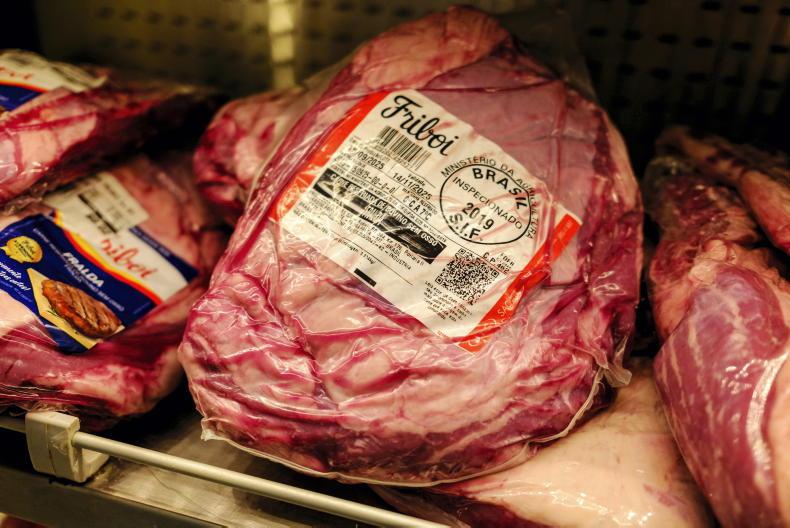
It is followed by Brazil, which has supplied 159,949t, 13% more than in the same period in 2025.
Canada and Mexico both provided over 100,000t and increased their volumes, with New Zealand the only major supplier to do less business this year compared with last year. It dipped below 100,000t to 96,727t, a 4% drop.
Irish beef in the US
When Irish beef relaunched in the US at the beginning of 2015, there were great expectations that the market would grow quickly.
However, that failed to materialise, as there was little demand for prime beef cuts and further work had to be done to secure certification for manufacturing-type beef.
When that was eventually secured, business did grow and the US was a market for 9,593t of Irish beef in 2020, according to Bord Bia export data.
Since then, the market has been in freefall, with just 1,000t exported last year. In the first quarter of 2026, just 219t was exported, a decline of 52% compared with the first quarter last year.
Reasons why US market hasn’t developed
One of the main barriers to growth in exports to the US has been the fact that the UK and EU markets were more lucrative for Irish beef exporters over the past decade.
However, that may be changing, given that competition is increasing, particularly in the UK due to its trade deals with Australia and New Zealand.
Another impediment is that many Irish beef exporting factories are not approved to export to the US. Securing USDA approval is difficult and not something that would be pursued without a realistic business opportunity.
That means that the US isn’t an opportunity for speculative trade for many factories, but, again, if the demand is there, it can be secured.
There is also an issue with tariffs. Irish beef has to pay a 26.4% import tariff on most of the beef we might export to the US and this makes us uncompetitive, particularly against Australia, which has a huge tariff-free quota.
For all these reasons, the US market has failed to happen for Irish beef exports.
Given its record demand for imported beef and increased competition in the UK and EU markets, it could mean that Irish beef exporters might take another look at the US as a potential market for more Irish beef.





SHARING OPTIONS