



They milk 60 dairy-bred MRI cows in a spring calving system. Since 2010, William has been an active participant in the dairy calf to beef programme.
Before joining the programme the Carrolls slaughtered dairy bulls at 20 to 24 months with a carcaseweight of 350kg to 370kg. William uses his own bulls from the dairy cows in his herd along with some bought in dairy bull calves. He finds that the MRI cross delivers a better quality calf compared with pure Holsteins.
The MRI bred calves from his dairy herd normally grade O+ or R-, on average at slaughter.
2012 Born Bulls
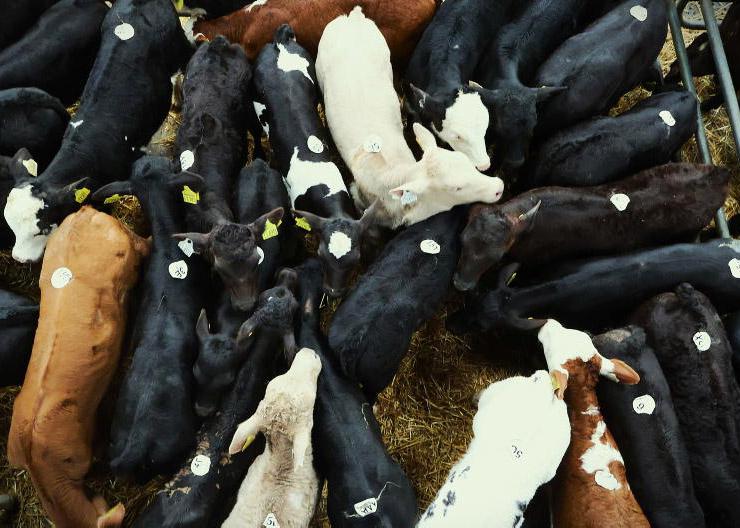
This year William has 77 spring born bulls with an average date of birth of 7 February. The target is to slaughter these bulls under 16 months of age next May and June.
After weaning, he supplemented the calves with 1kg of concentrates per head per day for a three-week period after turnout.
Supplementation then ceased until the week pre-housing. Given the year that has been, William faced grazing challenges like many of the other participants in the programme.
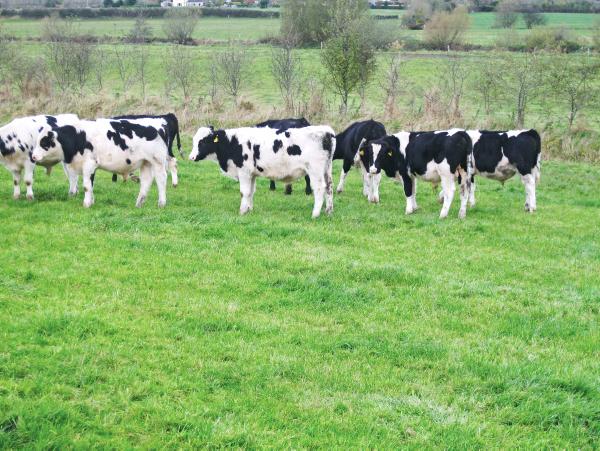
He overcame these difficulties by regularly moving the calves to fresh pasture every four to five days. This, he believes, is the secret to obtaining good performance from grass alone.
As William has operated a paddock grazing system for the dairy cows for many years, he has implemented a similar paddock grazing system with the bulls as he has knows the benefits.
This has allowed him to manage the quality and increase the utilisation of grazed grass. Last year William maintained his bulls at grass for 200 days. This year’s bulls were weighed on 11 October and averaged 248kg (range 211kg to 302kg), giving an average liveweight gain from grass of 0.83kg/day.
However, the lighter of the calves were 25kg to 30kg behind the target liveweight at weighing.
As a result, the lighter calves were housed on 2 November and divided into three groups.
It is hoped that the lighter of these calves will compensate when fed 73 DMD silage from last year along with 3kg of concentrate containing 16% protein.
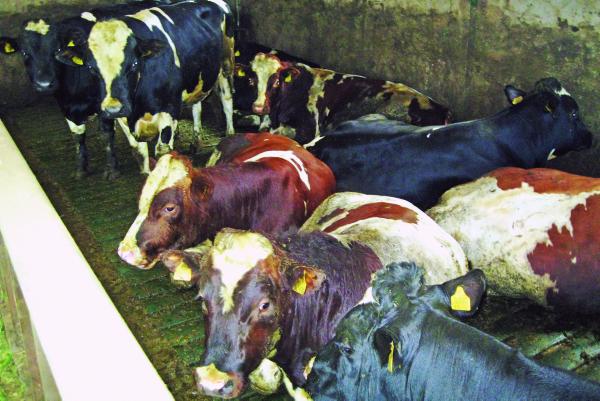
The remainder of these bulls, currently outside, will be housed in the coming days and will be fed a grower ration containing 16% protein along with ad-lib 73DMD silage.
The calves will be weighed again in mid-January following 80 to 90 days on the growing ration. At that stage they should be weighing approximately 350kg liveweight.
A decision will then be made as to whether they will be finished intensively in the 16-month system or go for the 19-month bull system. It is expected that 60% to 70% of this year’s bulls will be on target for the 16-month system.
Bulls slaughtered
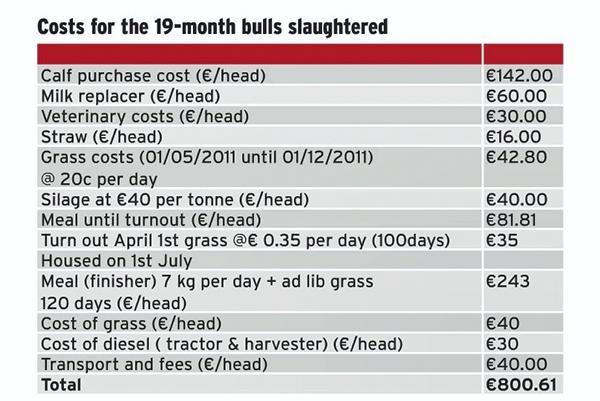
William slaughtered 25 bulls under 16 months on 30 May. They averaged 525kg liveweight and produced a carcase of 273kg (52% kill-out). A further 43 bulls were slaughtered at an average age of 19 months with a final liveweight of 623kg liveweight and delivered a carcase of 324kg (52% kill-out).
The bulls that went into the 19-month system were weighed on 19 January last and averaged 314kg, some 30kg to 35kg below the target for the 16-month system of 350kg.
It was decided to feed the lighter group separately and turn them out to grass for 100 days prior to housing and finishing at 19 months of age.
Tackling meal prices
During the finishing period, in an effort to reduce concentrates and utilise additional grass that was available on the farm, William cut grass using an old single chop harvester (typical harvesting covers of 1,800 to 2,200kg/DM/ha/12cm to 13cm) and fed it to the bulls indoors. This reduced the finishing costs for the bulls.
In addition to the high quality grass, the diet was also supplemented with a low protein grass nut at a rate of 6kg to 7kg/head per day.
On this finishing diet the bulls had a liveweight gain of 1.3kg to 1.4kg/liveweight/day.
On this farm the overall proportion of grass in the feed budget of the bulls has the ability to keep input costs low and William intends to capitalise and exploit this as much as possible.



SHARING OPTIONS