



Will 2022 be worth the effort at all?
This is now a common question among farmers out here in the US Midwest and Irish farmers have the same concerns.
Fertiliser prices took off last fall and have now gone to record levels.
While there have been some small reductions, fertiliser prices are still close to an all-time high for most products.
Fertiliser
As I write this, nitrogen prices remain at close to record highs and the Russian/Ukrainian issue is forcing additional price volatility.
My suppliers recently quoted me $830/t for 46% urea (€815/t), monoammonium phosphate (MAP) is $930/t (€913/t) and potash is up at $840/t (€824/t).
Anhydrous ammonia (82% N) is between $1,360/t and $1,470/t, up from $480/t last year. But it was always available and I wonder if there may yet be surplus supply looking for a home ahead of spring planting.
There is a lot of talk in the rural Midwest about curtailing crop spend to $1,000/ac (€877/ac).
With farm corn (maize) yield averages of 170 to 220 bushels per acre (4.5t/ac to 6t/ac) we could farm all year, invest big dollars and possibly lose money. So, the risk is seen as high for corn.
Another big worry is the apparent shortage of crop care or crop protection products.
Last year, we purchased all the Roundup we needed for $10 a gallon (€47/20 litres). This year, they are asking $55 to $75 per gallon (up to €306/20 litres) – that is some hike.
Our costs still jumped up 34% compared to last year on the same products
Most other chemical products have a similar story. We are not sure if this is corporate greed or an actual shortage, but whatever is going on it will hurt farmers. We were lucky in that we locked in and took delivery of this year’s needs early.
Our costs still jumped up 34% compared to last year on the same products.
There is some talk of growers switching totally to soya beans this year as the inputs will be a lot lower.
We were recently offered $16.25 a bushel (€526/t) for beans and I have not had that price offered to me before in my lifetime.
A year ago, diesel cost me $1.98/US gallon (€0.461/l) for farm diesel and $2.40 (€0.559/l) for road fuel. Today’s prices for a tanker load are $2.56 (€0.596/l) and $3.25 (€0.756/l)
It is certainly very tempting to run all beans and have cost savings that will help profit, but we will stick to our 50-50 rotations. Much of our corn is grown on premium contracts and they are helping the returns from that crop.
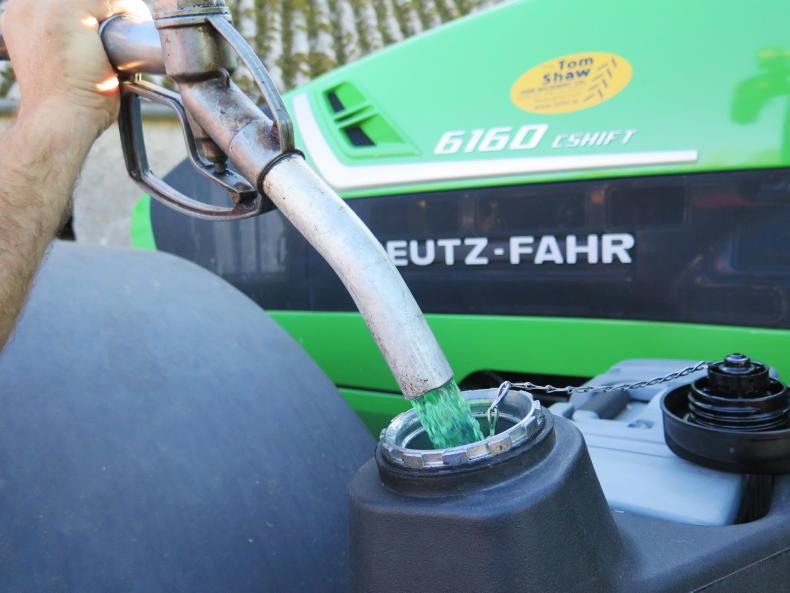
I see diesel as a wild card issue. A year ago, diesel cost me $1.98/US gallon (€0.461/l) for farm diesel and $2.40 (€0.559/l) for road fuel. Today’s prices for a tanker load are $2.56 (€0.596/l) and $3.25 (€0.756/l), respectively.
We will continue to buy and take delivery of these fuels as the tanks draw down as I want to keep our tanks full, given all the issues in the world today.
Never in my lifetime have I seen land prices here at current levels. Ordinary corn/soya bean farms are making $10,000/ac (€8,900), with good ground bringing $14,000/ac to $15,000/ac (€12,466 to €13,356/ac).
We are usually buyers if land is local or a value deal, but I have chosen to sit these prices out for a while. I am not comfortable taking on these prices at my age. I have an agent who wants to show me a farm 50 miles away – 535 acres asking $9,000/ac (€8,000/ac) for good bottom ground, but this still seems high.
People are spooked by things such as the stock market, our current political situation and world geo-political issues. So they buy farmland as a safe investment – time will be the judge of that.
I am sure you are experiencing the same machinery price escalations that we are and I do not see an end to these increases for some time. My sons and bother traded their combines last year and Michele and I traded our combine last December for a year-old machine with 300 hours.
It still cost a lot to replace my 10-year-old machine with 2,000 hours on the clock, but we do not see them being any cheaper next year. In the meantime, my old one will drop more in value.
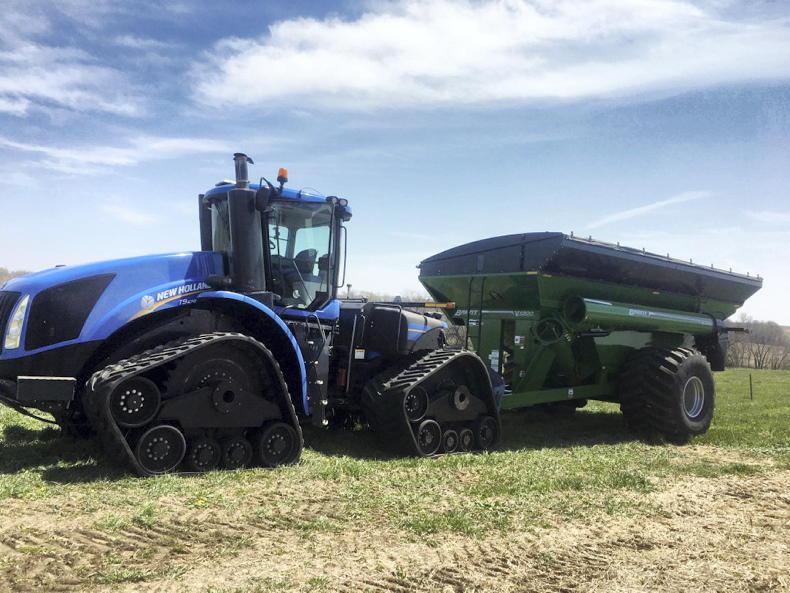
So, next fall, we will have all newish combines. We try to keep combines for 10 years, if possible, and the big four-wheel drive tractors for 20 or more years. I added a New Holland T9.670 hi-track tractor to the farm this spring.
New planters are impossible to find, so we will rebuild the soya bean planter one more time. We had hoped to upgrade it to a 60ft (18m) unit like the corn planter, but we have not been able to find a new one for the past two years.
As far as grain marketing goes, I do not have any idea anymore. The older I get, the less confidence I have in my ability to get it right. As for the best marketing strategy – in the last two years, the best thing was to do nothing and wait until the market hits a price you are comfortable with. Then sell it for cash and don’t look back.
I have used many fancy hedging products and all I did was lose hard-earned dollars and potential profits. My wife, Michele, will confirm that. It seems that our spouses can remember marketing mistakes a whole lot better than we can. But better prices currently help a little with the cost increases.
We had wonderful weather last autumn and got harvest wrapped up in record time.
The fall stayed nice until late December, so we got a lot of field work done.
All the fertiliser was applied in November.
Lime was applied to the corn stubbles until supplies dried up – we use three different suppliers and they all ran out.
We have had very little snow so far this winter, but land is dry and it needs some moisture for the next crop.


SHARING OPTIONS