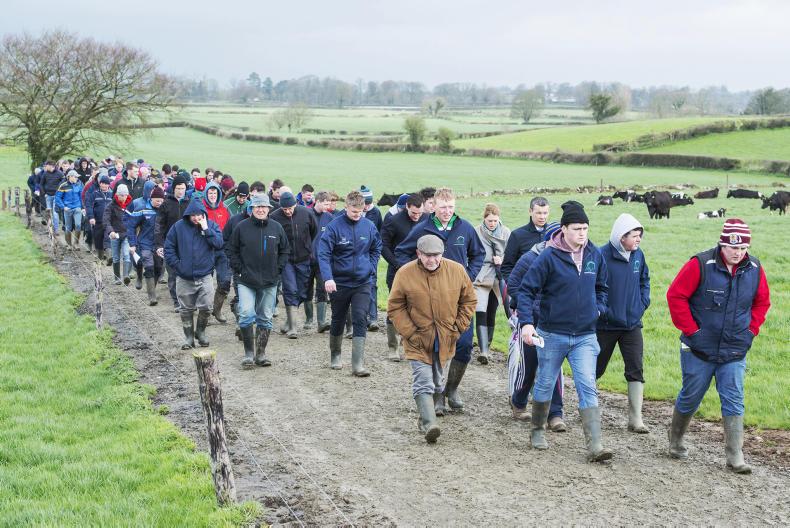
Eddie and Denis O’Donnell are the winners of the Grassland Farmer of the Year award for 2017. The open day took place on a miserable morning, but nevertheless the farm looked splendid – a testament to the O’Donnell’s status as grassland farmers.
Eddie and Denis are milking 355 cows this year, with 250 milked on the home farm at Golden and 105 being milked on a leased outfarm near Dundrum. The stocking rate on the milking block is 3.1 cows/ha. There are 44ha of outside land supporting the replacement heifers and for silage.
Last year, the farm sold 466kg of milk solids per cow. Eddie is responsible for the grassland management on the farm. That’s his passion, but there’s more than just grass to learn about from this farm.
Eddie and Denis are helped out by farm employees, Jeremy Furlong and Philip Roche. Jeremy does most of the milking and grass measuring on the outfarm and works about 30 hours a week on average. He is also a dairy AI technician. Philip is working on the home farm along with running a beef farm of his own. He works an average of 46 hours a week.
Only milkings are done on Saturdays and Sundays. Philip only milks on Tuesdays and Thursdays but is on the farm all day Monday, Wednesday and Friday and milks every second weekend. Both Philip and Jeremy are planning to become dairy farmers in their own right in the future.
Over the last five years, the farm has grown an average of 17.5t/ha. Fifty grass walks were completed in 2017. Ten percent of the grass is grown in spring, 57% in summer and 33% in autumn. On average, between 10 and 11 grazings or silage cuts per paddock were taken on the farm since 2013, surpassing the Grass 10 target of 10 grazings/cuttings per paddock.
Attention to detail is evident throughout. The focus is on removing the constraints to growth. So that is to make sure that soil fertility is good, that there are good grass varieties present and that the field can be grazed, even when conditions are bad. While grazing in wet weather is a challenge for all farms, it is fair to say that the home farm in Golden has some of the best land in Ireland.
Challenges
But this spring wasn’t without its challenges. Over the previous three years, the farm has grown an average of 1.85t DM/ha in spring. This year, it has grown 1.3t DM/ha so this deficit had to be plugged with extra silage and meal.
Eddie had medium-quality pit silage for dry cows, but had to buy in about 120 bales of higher-quality silage to feed to the milkers. In total, about 130kg DM of silage was fed to the milkers this spring. He has 260kg of meal fed to the milkers so far, about 100kg more per cow compared with normal. He normally feeds around 500kg of meal per cow.
Like everywhere else, growth had picked up a lot by last week. On the day of the walk, the average farm cover was 727kg/ha or 181kg/cow. Growth was measured at 52kg/day and demand was 62 with a stocking rate of four cows/ha as the maiden heifers were brought back on to the home farm for the summer. Last week, the cows were milking 25.6 litres at 4.54% fat and 3.52% protein or 2.13kg milk solids per cow, while on 2kg of meal and grass full time.
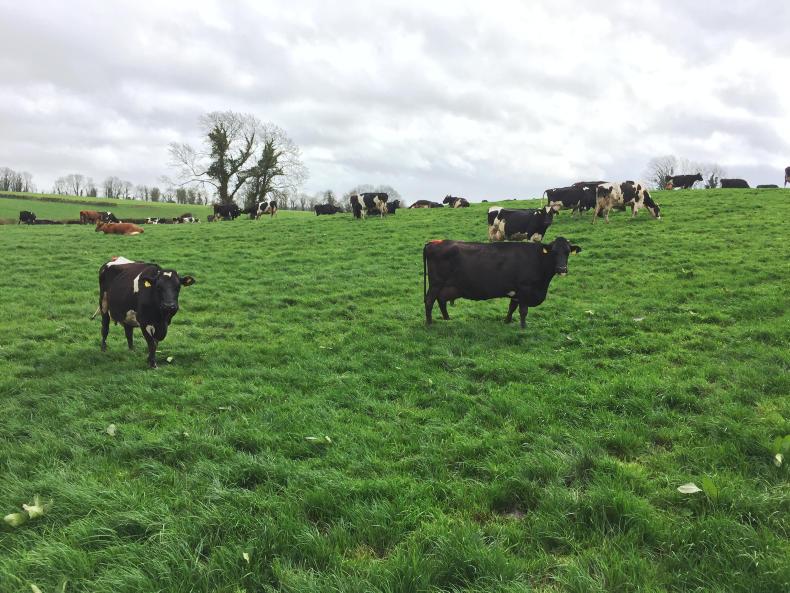
The O’Donnells started crossbreeding with Jerseys in 2009 and a high proportion of the herd is crossbred now. AI straws from 14 different bulls have been purchased for this season. About one-third of the straws are high EBI Holstein Friesian to be used on smaller crossbred cows.
One-third of the straws are purebred Jersey to be used on larger Holstein Friesian cows and the remainder are Kiwi cross bulls to be used on medium-sized crossbred cows.
“My goal is to breed a cow that weighs 500kg and produces 500kg of milk solids and stock her at three cows/ha to produce 1,500kg MS/ha with no more than 500kg of meal fed per cow. I’m not sure if the breeding strategy is the right one in the future, but it has delivered for us so far,” Eddie said.
Only 7% of the cows were empty after 12 weeks of breeding in 2017 and 2% of the heifers were empty after 10 weeks. Eddie’s breeding policy is to get someone in to condition-score the herd in early April. Anything less than a BCS of 2.8 is put on once-a-day milking until she is bred.
In 2017, the O’Donnells had a 93% submission rate, a 75% six-week in-calf rate and they calved down 86% of the herd in six weeks this year, with a 17% replacement rate.
In 2005, Eddie went on a study trip to New Zealand. He says the trip opened his eyes to the opportunities that exist.
When he came back, himself and his parents Denis and Nora began doing five-year plans and updating them annually. Back then, the O’Donnells were milking 70 cows and farming a total of 50ha. Today, they are milking 350 cows and farming a total of 160ha. Over this time, they have leased land and bought land.
“Even though my father was doing a very good job when we had 70 cows, it was clear when we did the numbers that it wasn’t going to be enough for two family incomes so if I were to come home farming we had to grow. At first, I did most of the milkings on the leased farm and dad milked on the home farm but as we’ve grown we’ve taken on more people,” Eddie said.
For the future, Eddie said they are currently looking for a contract rearer to take the maiden heifers. This will reduce the workload and allow for more silage to be made from outside blocks, which means the stocking rate on the leased farm could increase.
It is currently stocked at 2.8 cows/ha.
As for expansion, he said that himself and his wife Fiona are always doing business plans and looking at opportunities. But he said they will only do something if it is part of their mission statement: “To run a highly efficient and therefore highly profitable and sustainable dairy business while also enjoying a good family life.”
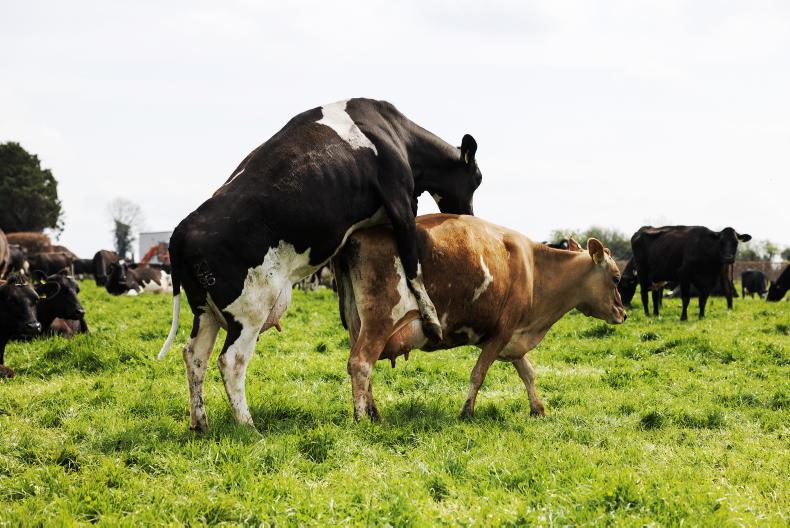
Cows are tail-painted red on 15 April.Top up tail paint on cows twice a week from 16 to 28 April.Record all cows that still have red paint on 28 April.On 29 April, paint all cows with no paint green and top up those with red paint.By 30 April, AI cows will be in heat once daily. Paint all cows that have been served blue and top up the three colour tail paints two or three times a week.Get the vet to check any cow with red paint still on by 7 May.Introduce vasectomised bulls on 25 May.Remove vasectomised bulls on 20 June and let in stock bulls, but continue to use AI.Finish breeding on 23 July.
Eddie and Denis O’Donnell are the winners of the Grassland Farmer of the Year award for 2017. The open day took place on a miserable morning, but nevertheless the farm looked splendid – a testament to the O’Donnell’s status as grassland farmers.
Eddie and Denis are milking 355 cows this year, with 250 milked on the home farm at Golden and 105 being milked on a leased outfarm near Dundrum. The stocking rate on the milking block is 3.1 cows/ha. There are 44ha of outside land supporting the replacement heifers and for silage.
Last year, the farm sold 466kg of milk solids per cow. Eddie is responsible for the grassland management on the farm. That’s his passion, but there’s more than just grass to learn about from this farm.
Eddie and Denis are helped out by farm employees, Jeremy Furlong and Philip Roche. Jeremy does most of the milking and grass measuring on the outfarm and works about 30 hours a week on average. He is also a dairy AI technician. Philip is working on the home farm along with running a beef farm of his own. He works an average of 46 hours a week.
Only milkings are done on Saturdays and Sundays. Philip only milks on Tuesdays and Thursdays but is on the farm all day Monday, Wednesday and Friday and milks every second weekend. Both Philip and Jeremy are planning to become dairy farmers in their own right in the future.
Over the last five years, the farm has grown an average of 17.5t/ha. Fifty grass walks were completed in 2017. Ten percent of the grass is grown in spring, 57% in summer and 33% in autumn. On average, between 10 and 11 grazings or silage cuts per paddock were taken on the farm since 2013, surpassing the Grass 10 target of 10 grazings/cuttings per paddock.
Attention to detail is evident throughout. The focus is on removing the constraints to growth. So that is to make sure that soil fertility is good, that there are good grass varieties present and that the field can be grazed, even when conditions are bad. While grazing in wet weather is a challenge for all farms, it is fair to say that the home farm in Golden has some of the best land in Ireland.
Challenges
But this spring wasn’t without its challenges. Over the previous three years, the farm has grown an average of 1.85t DM/ha in spring. This year, it has grown 1.3t DM/ha so this deficit had to be plugged with extra silage and meal.
Eddie had medium-quality pit silage for dry cows, but had to buy in about 120 bales of higher-quality silage to feed to the milkers. In total, about 130kg DM of silage was fed to the milkers this spring. He has 260kg of meal fed to the milkers so far, about 100kg more per cow compared with normal. He normally feeds around 500kg of meal per cow.
Like everywhere else, growth had picked up a lot by last week. On the day of the walk, the average farm cover was 727kg/ha or 181kg/cow. Growth was measured at 52kg/day and demand was 62 with a stocking rate of four cows/ha as the maiden heifers were brought back on to the home farm for the summer. Last week, the cows were milking 25.6 litres at 4.54% fat and 3.52% protein or 2.13kg milk solids per cow, while on 2kg of meal and grass full time.
The O’Donnells started crossbreeding with Jerseys in 2009 and a high proportion of the herd is crossbred now. AI straws from 14 different bulls have been purchased for this season. About one-third of the straws are high EBI Holstein Friesian to be used on smaller crossbred cows.
One-third of the straws are purebred Jersey to be used on larger Holstein Friesian cows and the remainder are Kiwi cross bulls to be used on medium-sized crossbred cows.
“My goal is to breed a cow that weighs 500kg and produces 500kg of milk solids and stock her at three cows/ha to produce 1,500kg MS/ha with no more than 500kg of meal fed per cow. I’m not sure if the breeding strategy is the right one in the future, but it has delivered for us so far,” Eddie said.
Only 7% of the cows were empty after 12 weeks of breeding in 2017 and 2% of the heifers were empty after 10 weeks. Eddie’s breeding policy is to get someone in to condition-score the herd in early April. Anything less than a BCS of 2.8 is put on once-a-day milking until she is bred.
In 2017, the O’Donnells had a 93% submission rate, a 75% six-week in-calf rate and they calved down 86% of the herd in six weeks this year, with a 17% replacement rate.
In 2005, Eddie went on a study trip to New Zealand. He says the trip opened his eyes to the opportunities that exist.
When he came back, himself and his parents Denis and Nora began doing five-year plans and updating them annually. Back then, the O’Donnells were milking 70 cows and farming a total of 50ha. Today, they are milking 350 cows and farming a total of 160ha. Over this time, they have leased land and bought land.
“Even though my father was doing a very good job when we had 70 cows, it was clear when we did the numbers that it wasn’t going to be enough for two family incomes so if I were to come home farming we had to grow. At first, I did most of the milkings on the leased farm and dad milked on the home farm but as we’ve grown we’ve taken on more people,” Eddie said.
For the future, Eddie said they are currently looking for a contract rearer to take the maiden heifers. This will reduce the workload and allow for more silage to be made from outside blocks, which means the stocking rate on the leased farm could increase.
It is currently stocked at 2.8 cows/ha.
As for expansion, he said that himself and his wife Fiona are always doing business plans and looking at opportunities. But he said they will only do something if it is part of their mission statement: “To run a highly efficient and therefore highly profitable and sustainable dairy business while also enjoying a good family life.”
Cows are tail-painted red on 15 April.Top up tail paint on cows twice a week from 16 to 28 April.Record all cows that still have red paint on 28 April.On 29 April, paint all cows with no paint green and top up those with red paint.By 30 April, AI cows will be in heat once daily. Paint all cows that have been served blue and top up the three colour tail paints two or three times a week.Get the vet to check any cow with red paint still on by 7 May.Introduce vasectomised bulls on 25 May.Remove vasectomised bulls on 20 June and let in stock bulls, but continue to use AI.Finish breeding on 23 July. 





SHARING OPTIONS