With February now behind us and St Patrick’s Day fast approaching, disease burden in spring-calving herds is starting to build.
By now, close to half the cows on a lot of farms around the country will have calved. Calving pens have seen a lot of traffic over the last number of weeks and the calf sheds on farm are filling up rapidly.
The damp and wet weather over the last month has been the perfect storm for bacteria and infection to fester in sheds.
When all of these factors are taken into consideration, it’s easy to see why disease risk is close to its peak in terms of young calves – the most at-risk animal on the farm.
Here are some of the key areas of focus to keep calf health right over the coming months.
The underlying factor of most calf health issues can be traced back to colostrum management. As the calving season starts to reach the mid-point, it’s important farmers continue to maintain high standards around colostrum management.
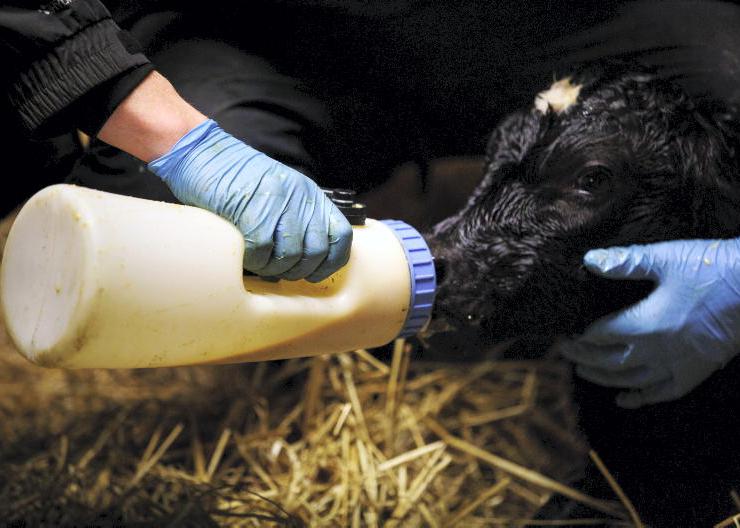
The 3-2-1 rule for colostrum management of at least three litres of colostrum, within two hours of calving and from the cows first milking and while it’s old news at this stage, it still remains best practice.
According to Catherine McAloon, vet and researcher at UCD’s school of veterinary medicine, one of the most important but overlooked practices in colostrum quality management is how soon the first milk is collected and how well it’s stored.
“Colostrum quality is much higher in a cow just after calving than in a cow that’s hours on from calving. The sooner that first milking is taken, the better.
“The next step is clean storage. A bucket or churn that’s not spotless will inevitably mean a greater bacteria risk,” Catherine says.
“Once the first milking is taken and stored cleanly, it should go into a fridge or freezer as soon as possible. This slows down the rate of bacteria multiplication and will help to maintain the quality,” she continues.
Three litres is the minimum feed and bigger calves should be getting closer to four litres.
Similar to collecting the colostrum, the sooner the calf is fed that colostrum the better.
Continuing to test colostrum quality throughout the calving season will prevent standards slipping and will ensure all calves are getting the best start.
Research is showing that the level of feeding in calves pre-weaning has a significant impact on how that animal will perform in later life.
“The first three months of a calf’s life are crucial in the development of the metabolic pathways for gene expression.
“Calves that are well fed and develop these strong pathways have been shown time and again to have improved feed conversion efficiency, greater disease resistance, higher milk production and improved fertility,” Catherine says.
Calves will voluntarily drink about 20% of their birth weight in milk each day. In a 30kg calf that’s six litres per day and in a 40kg calf, eight litres per day.
According to Catherine, calves should be fed this level of milk to see real gains and 15% of birth weight should be the absolute minimum standard.
Calves should be fed twice a day up to at least six weeks of age and once-a-day feeding should only be used as a weaning tool to encourage calves to eat more concentrates the closer they get to weaning.
The calves weaning date should be determined by the level of concentrate the calf is consuming. The age or weight should not be the deciding factor. Calves can get to a certain weight but if the rumen is not correctly developed, the development of that animal will be stunted for a period after weaning.
To begin the weaning process of tapering down the quantity of milk offered, a calf should be eating at least 1kg to 1.5kg of meal per day.
To achieve proper rumen development, calves will need water and fibre to ferment the concentrate they are eating. Both should be offered from a few days old, regardless of whether or not they are eating or drinking it.
Milk can be removed from the diet at such time that on the group average, each calf is eating between 1.5kg and 2kg of meal per day.
The biggest cause in calf mortality rates is calf scours and the main causes of all calf scours is rotavirus and Cryptosporidium. These affect calves in the first month of life and are mainly passed through faecal-oral contact in dirty pens, according to Catherine.
For that reason, hygiene in sheds is important. Bedding should be kept fresh and dry and sheds well drained.
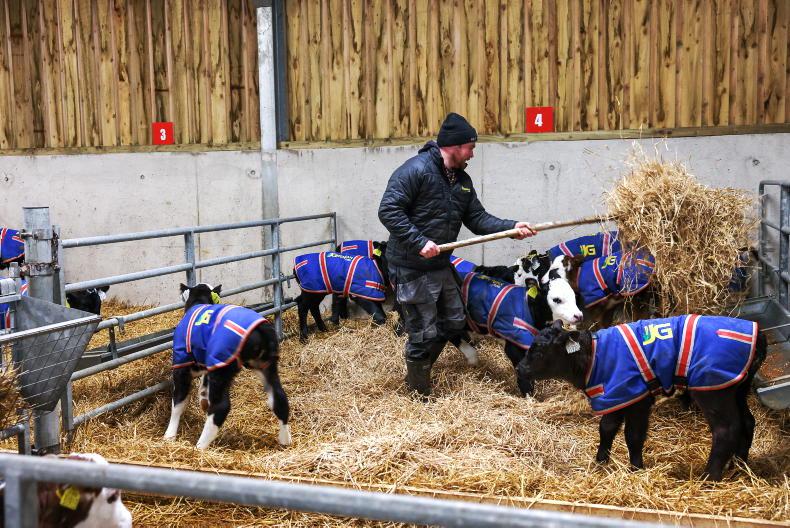
Make sure calf pens are regularly cleaned and bedded well, particularly over the coming weeks as disease risk is high \ Odhran Ducie
Calving pens should be also cleaned regularly and topped up with fresh bedding to prevent bacterial scours like E coli and Salmonella in newly born calves.
Scouring calves should be isolated, if possible, in a sick pen.
These calves should receive electrolytes twice a day on top of normal milk feeding.
Electrolytes cannot replace milk as there is no energy in these products and therefore a calf will be unable to fight the infection and continue to gain weight.
Where calves are still struggling to recover after a couple of days or the infection is spreading through the shed, vets should be consulted in plenty of time.
Click here to listen to the podcast.
With February now behind us and St Patrick’s Day fast approaching, disease burden in spring-calving herds is starting to build.
By now, close to half the cows on a lot of farms around the country will have calved. Calving pens have seen a lot of traffic over the last number of weeks and the calf sheds on farm are filling up rapidly.
The damp and wet weather over the last month has been the perfect storm for bacteria and infection to fester in sheds.
When all of these factors are taken into consideration, it’s easy to see why disease risk is close to its peak in terms of young calves – the most at-risk animal on the farm.
Here are some of the key areas of focus to keep calf health right over the coming months.
The underlying factor of most calf health issues can be traced back to colostrum management. As the calving season starts to reach the mid-point, it’s important farmers continue to maintain high standards around colostrum management.
The 3-2-1 rule for colostrum management of at least three litres of colostrum, within two hours of calving and from the cows first milking and while it’s old news at this stage, it still remains best practice.
According to Catherine McAloon, vet and researcher at UCD’s school of veterinary medicine, one of the most important but overlooked practices in colostrum quality management is how soon the first milk is collected and how well it’s stored.
“Colostrum quality is much higher in a cow just after calving than in a cow that’s hours on from calving. The sooner that first milking is taken, the better.
“The next step is clean storage. A bucket or churn that’s not spotless will inevitably mean a greater bacteria risk,” Catherine says.
“Once the first milking is taken and stored cleanly, it should go into a fridge or freezer as soon as possible. This slows down the rate of bacteria multiplication and will help to maintain the quality,” she continues.
Three litres is the minimum feed and bigger calves should be getting closer to four litres.
Similar to collecting the colostrum, the sooner the calf is fed that colostrum the better.
Continuing to test colostrum quality throughout the calving season will prevent standards slipping and will ensure all calves are getting the best start.
Research is showing that the level of feeding in calves pre-weaning has a significant impact on how that animal will perform in later life.
“The first three months of a calf’s life are crucial in the development of the metabolic pathways for gene expression.
“Calves that are well fed and develop these strong pathways have been shown time and again to have improved feed conversion efficiency, greater disease resistance, higher milk production and improved fertility,” Catherine says.
Calves will voluntarily drink about 20% of their birth weight in milk each day. In a 30kg calf that’s six litres per day and in a 40kg calf, eight litres per day.
According to Catherine, calves should be fed this level of milk to see real gains and 15% of birth weight should be the absolute minimum standard.
Calves should be fed twice a day up to at least six weeks of age and once-a-day feeding should only be used as a weaning tool to encourage calves to eat more concentrates the closer they get to weaning.
The calves weaning date should be determined by the level of concentrate the calf is consuming. The age or weight should not be the deciding factor. Calves can get to a certain weight but if the rumen is not correctly developed, the development of that animal will be stunted for a period after weaning.
To begin the weaning process of tapering down the quantity of milk offered, a calf should be eating at least 1kg to 1.5kg of meal per day.
To achieve proper rumen development, calves will need water and fibre to ferment the concentrate they are eating. Both should be offered from a few days old, regardless of whether or not they are eating or drinking it.
Milk can be removed from the diet at such time that on the group average, each calf is eating between 1.5kg and 2kg of meal per day.
The biggest cause in calf mortality rates is calf scours and the main causes of all calf scours is rotavirus and Cryptosporidium. These affect calves in the first month of life and are mainly passed through faecal-oral contact in dirty pens, according to Catherine.
For that reason, hygiene in sheds is important. Bedding should be kept fresh and dry and sheds well drained.

Make sure calf pens are regularly cleaned and bedded well, particularly over the coming weeks as disease risk is high \ Odhran Ducie
Calving pens should be also cleaned regularly and topped up with fresh bedding to prevent bacterial scours like E coli and Salmonella in newly born calves.
Scouring calves should be isolated, if possible, in a sick pen.
These calves should receive electrolytes twice a day on top of normal milk feeding.
Electrolytes cannot replace milk as there is no energy in these products and therefore a calf will be unable to fight the infection and continue to gain weight.
Where calves are still struggling to recover after a couple of days or the infection is spreading through the shed, vets should be consulted in plenty of time.
Click here to listen to the podcast.
SHARING OPTIONS