



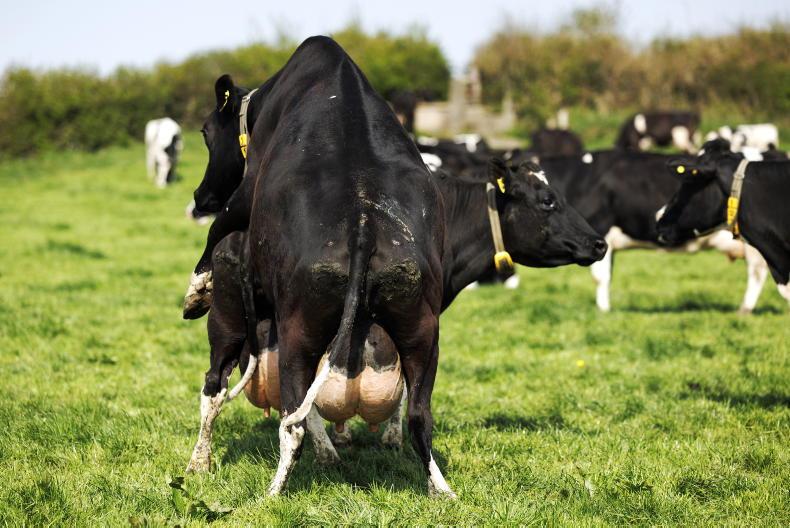
We’re now exactly two months on from the beginning of May; the typical start date for the breeding season on spring-calving dairy farms.
If breeding started on 1 May, there’s now 61 days of mating done, or just under nine weeks.
Any cow that’s served today will be calving around 10 April, provided she holds.
That cow will then need another 30 days at the minimum before she will resume her normal heat cycle.
Therefore, at the very earliest, that cow will come bulling in the middle of May of next year.
A cow that’s served in two weeks’ time will calve at the end of April and won’t come bulling until early June next year.
Cut-off point
Late April should really be the cut-off point for calving on dairy farms. Cows dragging on into May are a problem for a number of reasons.
They’re taking up time a farmer could be dedicating to other jobs like breeding, grassland management or fertiliser for one, secondly that cow is only going to be in milk for about seven months making her far less profitable than a February or March calver. Thirdly, the calf is going to be more susceptible to disease.
Calving pens and calf-rearing facilities are dirtier at that stage, energy levels of the farmers are lower and the calf price is probably going to be smaller as well.
To ensure all cows are calved before the start of May, breeding needs to finish by around mid-July. That’s just over 11 weeks from the start of May.
Some farmers in recent years have bred for just 10 weeks to try and make the system more compact.
In this scenario, empty rates are likely to be slightly higher but farmers are willing to accept this.
Any bulls used from now on should be short-gestation bulls at the very least, to try and get cows calved and back cycling as early as possible next year.
Non-return rates
As most farms won’t be scanning for another while, it can be useful to run a quick analysis on non-return rates at this stage of the year in order to see if things are going according to plan.
Using ICBF data of serve dates or physical records, farmers can work out the percentage of animals that have not come bulling again.
Ideally, non-return rates will be well above 60% at this stage.
If they are a lot lower than 60% and the farm is normally calving compactly with good genetics, it means there’s a problem somewhere.
For example, it may be an issue with the heat detection protocol, the AI flask could be an issue or the person doing the AI might be a problem.
By running this quick analysis now, it gives the farmer some chance to fix the problem before it’s too late.


SHARING OPTIONS