



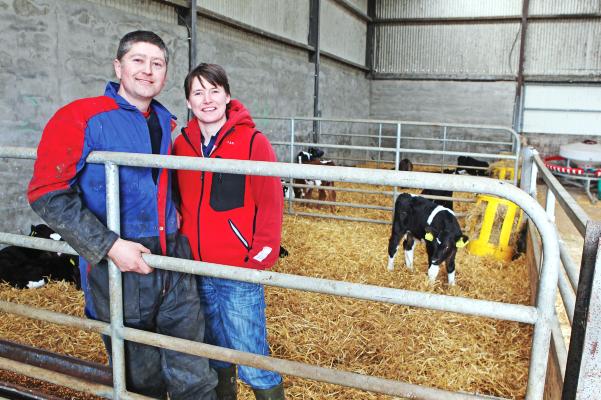
The couple bought the 100 acre farm in 2002 and have developed it from a dry stock farm to a top class dairy farm. Last year, 70 acres came up for long term lease adjoining the grazing block so the Powells now have the opportunity to develop further.
The 250 cow herd (Friesian Jersey crossbred) will calve in 12 weeks this year with approximately 80% (200 cows) due in the first eight weeks. Calving start date was 7 February as some of the farm is quite wet.
When I talked to the Powells this week, they were two weeks into the calving season with 90 out of 250 cows (36%) already calved. Calved cows are at grass day and night this week as the paddocks have dried out. Average farm cover is 633kgDM/ha and grass will be rationed out over the spring using the spring rotation planner.
The plan is to milk 210 cows in 2013 and so 40 cows will be sold. Even though the milking herd is expanding, good cow fertility and using AI both on cows and heifers is already delivering more replacements than needed every year.
The first three weeks of calving will be extremely busy as all heifers were synchronised at the start of the breeding season last year.
In the first two weeks alone, over 50% of heifers have calved. With so many animals calving together, how do the Powells keep on top of everything and ensure calves are reared successfully?
The first step is adequate labour. Local man John Cashan has been employed full time on the farm for the last two years, and a student, Nigel Browne, from Gurteen Agricultural College, is also now working on the farm on a three month college placement.
Having worked incredibly hard to grow the business to where it is today, the Powells recommend having enough labour as essential to making sure everything is done properly. They suggest extra labour can quickly pay for itself with improved performance.
Cow condition
The best possible start to a calf’s life is crucial and John feels a fit cow is critical to this.
When I visited last week, cows were in excellent body condition of 3-3.25. The herd was dried off since 22 November as John and Sylvia had reservations about silage quality and wanted to ensure cows were set up for good production in 2013. All cows have been receiving dry cow minerals since Christmas.
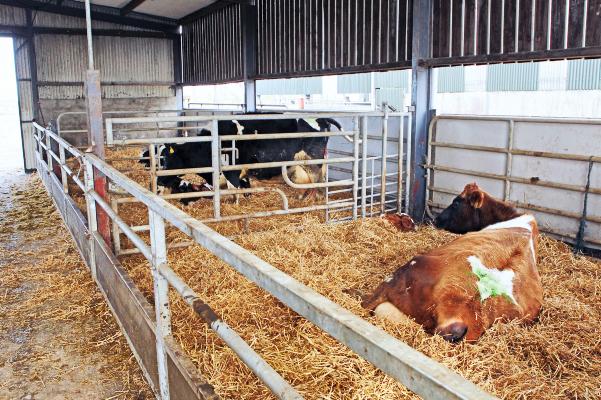
Cows are wintered on a wood chip pad. Every morning, when silage is fed, John or Sylvia walk along behind the cows and spray paint the tail head of anything close to calving. These are drafted out into calving pens two hours later.
Calving ease is critical on this farm. John said: “We use easy calving breeds (Jersey and KiwiCross) and within that, easy calving sires to avoid the need for intervention due to calving difficulty.
“The benefits of this can’t be over-stated; cows are up straight after calving, clean no problem and calves are eager to get their first feed. It takes a huge hassle out of the system.”
As there are no difficult calvings, cows are no longer checked during the night on the Powell farm. Cows are checked at 11pm, allowing the other person to get an early night.
The herd is then checked again at 6am and the first job of the morning is to get three litres of colostrum into any new born calf.
A dump line in the parlour is used to divert first milking colostrum only into a drum which is kept as a reserve and fed to new born calves.
Any milk collected after the first milking, but before the milk is clear to go into the bulk tank, is held separately and fed to calves in their first week of life.
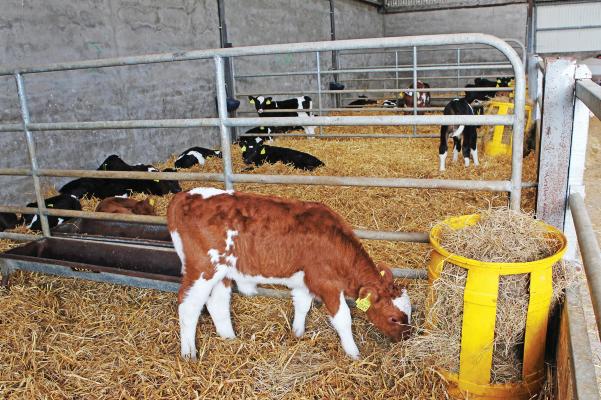
Calves get a maximum of 12 hours with their mother. Once removed from their mother, calves are moved into bunches of 10 where they are reared on teat feeders for the first three weeks.
All bull calves (Friesian, Jersey etc) are sold to the one client who will collect calves once called which eliminates a lot of hassle for the Powells. The first 15 bull calves will be collected this weekend.
Meal
Meal is available from three days of age and Sylvia remarked how the two-week-old calves are already eating meal.
The Powells finds that calves prefer a course ration and usually feed an 18% crude protein mix. Hay or straw is fed in plastic containers with strips cut out to allow calves pull hay out. Every two weeks, the calving pens are cleaned out, limed and a completely fresh straw bed put in.
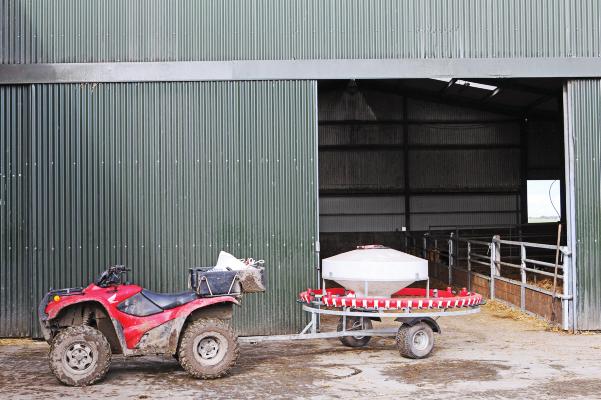
After three weeks in bunches of 10, calves go into groups of 40 in a large straw bedded area and are fed four litres, once a day, using a 50 teat mobile feeder.
Feeding this number of calves together really cuts down on labour requirements.
After three weeks in this set-up, calves get moved into another shed where they also have access to a paddock completely surrounded by Leylandii trees, which offers calves excellent shelter.
John feels this is an important part of the system: “We bought this farm in 2002 and straight away planted the Leylandii hedging which now provides excellent shelter. Calves outside are far healthier and it also makes weaning and the transition onto a grass and meal diet much easier.”
Weaning takes place at roughly 12 weeks of age and target weight for black and white calves is 90kg with Jersey cross calves weaned lighter than this.
Later born calves last year suffered with coccidiosis so calves will be watched vigilantly this year and will be dosed with Vecoxan should an infection occur.
Having worked together on farms in New Zealand, once the couple purchased their own dairy farm in 2002 they went straight down the crossbred route using New Zealand genetics and Jersey sires.
Current herd EBI is €144 with €38 for milk and €82 for fertility. Last year’s production was 375kgMS/cow (4,440l at 4.72% fat and 3.73% protein) on 800kg meal per cow; however 35% of the herd were first lactation heifers so they expect to improve on this as the herd matures.
Sylvia looks after breeding decisions on the farm and the current policy is that small Jersey-like animals get a New Zealand Friesian, Friesian animals get a Kiwi cross bull and big Friesian animals get a Jersey bull. Six AI bulls are used every year, two of each breed.
Sylvia was keen to point out that crossbreeding alone does not deliver high milk solids.
“The bull you select, regardless of breed, needs to have excellent figures himself. There are definite benefits from cross breeding but if you’re not using excellent bulls, this is only a compensation effect,” she said.
“In truth, the crossbreds we started with weren’t near the standard we have now, milk solids per cow has improved from 305kgMS/cow back then to 375kgMS/cow today, and with a mature herd we will easily break 400kgMS/cow in the future.”
Grassland management is the other key factor for achieving good milk solids and so either John or Sylvia will make sure to walk the farm weekly. The Powells tried some Montbelliarde genetics in the past but found lameness was an issue and they have also used some Norwegian Red genetics.
2013 bulls have already been picked on the farm. A team of six will be used and all are from LIC. On average the team has an EBI €253 (€110 milk, €104 fertility), is +37kgs for milk solids and has a calving difficulty of 1.7%.
Crossbreeding and good management delivering a fertile herd allowing stock numbers increase, facilitating herd expansion when opportunity arose.
Focusing on calving ease minimises stress on man and animal, and leads to better cow and calf health.
Group rearing of calves and getting them outdoors drastically reduces labour demand on this Offaly farm.



SHARING OPTIONS