



Danny is a monitor farmer in the heavy soils project which is a research trial comparing different drainage methods on different soils.
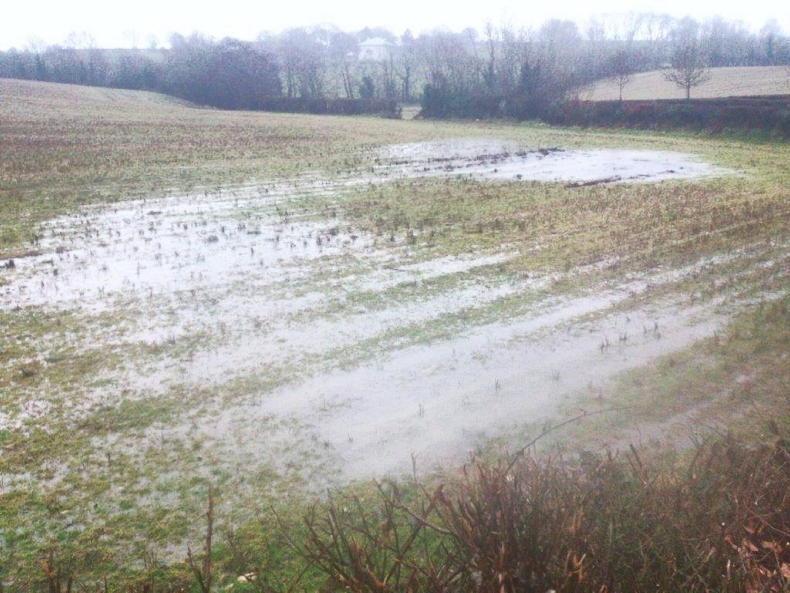
A lot of Danny’s farm borders a peat bog and some of the cow grazing paddocks are typically a very deep peat. At the other end of his farm, Danny has about 40 acres which has a six inch peaty top soil, but underneath this top six inches, there is a very sticky, yellow-blue mud soil which allows no water up or down.
Last year, I was present when the experts were digging the test holes to establish what drainage method would be suitable for this soil type, and this year I was present when the drainage work started last week.
The first step before any drainage takes place is to establish the soil type and what drainage might be suitable. This usually involves digging one or two deep holes with an excavator. From this you can see the different layers of soil type.
Last year, Tim Gleeson and Pat Tuohy from Teagasc explained we could clearly see a peaty permeable topsoil followed underneath with a sticky, muddy blue clay.
Underneath that again was a slightly looser sandstone and fissured shale stone layer which was letting in lots of water into the deep hole.
With this in mind, the researchers involved decided to install collector drains at 15 metre spacings which lead to a deep open drain along a ditch (see Diagram 1).
In between the collector drains they plan to have naked mole drains and it is these mole drains that will do most of the water draining from this field.
You can see that a third of the field will be left undisturbed as a control to show what the field would be like if you didn’t do any drainage.
A five acre plot of land has been assigned to the trial and last week the collector drains were installed. When the yellow-blue subsoil dries out later in the summer, the mole drains will be installed.
Danny sprayed off the five acre field before cutting silage last week and the field will be reseeded once the collector drains are installed and covered up. It took Joe Kelly about three days to dig the 13 (80m) collector drains and fill them in with stone. A stone cart was used to fill in the stone.
The net cost of the drainage job on this five acre field is expected will be in the region of €1,800 to €2,000 per acre when all costs have been accounted for, so €10,000 in total.
It will probably be necessary to mole plough every two or three years because the naked mole plough drains tend to break down over time. Gravel stone can be installed in the mole drains, but this would add another €500 per acre cost to the drainage job.




SHARING OPTIONS