


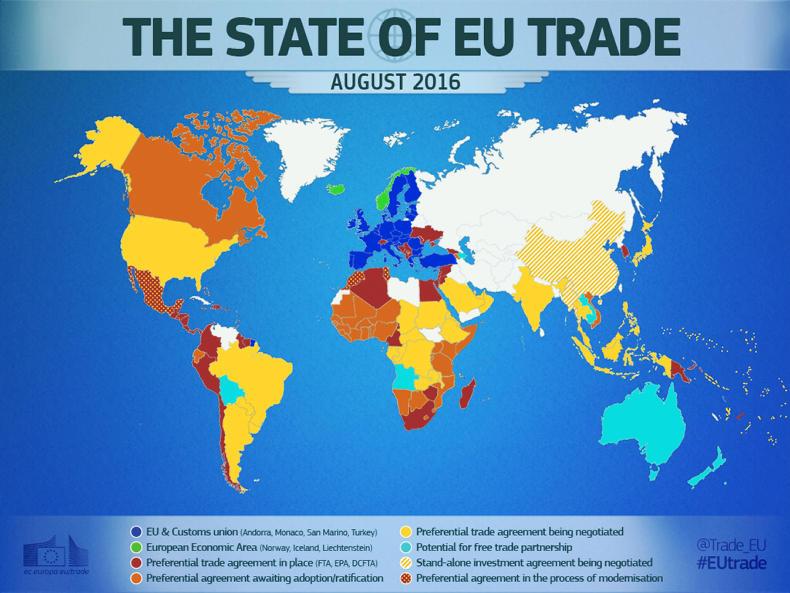
While Irish farmers have been focused on the threat of a Mercosur trade deal since a 78,000t beef quota was raised a year ago, several other trade deals are either under discussion or about to commence. In some cases, they will present opportunities for farmers; while others have the potential to add further supply to the EU market.
Canada
In the past year, the free trad agreement (FTA) with Canada (CETA) has completed its approval process in Europe and now awaits formalities being completed in Canada before it comes into effect. It gives access for 50,000t of beef to the EU, but in turn it gives EU access to Canada.
As Canadian prices have been either on par or ahead of Irish prices in recent times, the Irish beef industry sees some potential in that market for Irish beef sales, and 450t were exported there in 2016 ahead of the FTA. CETA was widely opposed by Irish farming organisations, but if current farmgate prices remain it may be less of a threat than feared.
USA
After Mercosur, the most feared deal by farmers was between the EU and USA under TTIP. This is considered to be in “cold storage” with the election of president Trump in the US and his hostility to trade deals that further weaken the USA’s trade balance with other countries or trade blocks.
In this context, TTIP was thought to be less of an issue, but with the recent deal between the USA on China granting the US access to the Chinese market for beef, it could be that the US president is reviewing his approach to trade deals, and TTIP could come back on to the agenda again.
Asia
In Asia, deals are at various stages of negotiation, ranging from close to conclusion with Japan, to just beginning with Indonesia. A deal has been agreed between the EU and Vietnam and is currently progressing through the EU approval process.
Parliament is expected to be asked to approve it some time in the second half of this year, to take effect in early 2018.
This would represent an opportunity for Ireland to sell lower parts of the animal tariff free and build on the 1,741t of exports to Vietnam in 2016.
Assuming the deal with Japan is concluded later this year, it will give a boost to Irish exports, which were 1,322t in 2016, as well as being a large market for Irish dairy products and pigmeat.
Discussions on a FTA with the Philippines commenced in May last year with the first round of negotiations, and a second taking place in February this year.
This is one market that is of huge interest to Irish exporters, having taken 14,158t of lower-value beef cuts in 2016. If tariff free, Irish and EU exports would be much more price competitive in this market.
Other markets
Mexico is also a market for Irish dairy and pigmeat and already has a trade agreement with the EU, which is in the process of being renegotiated, a third round of negotiations having taken place last week.
Trade deals in general are either positive or neutral for Irish dairy and pig meat exports, with lamb more exposed and beef most exposed of all. All of the potential deals with Asian countries are therefore positive from the perspective of Irish agriculture as a whole.
So far Mercosur is the one that stands out as a particular threat, with TTIP and CETA also a cause of concern to beef if not the others.
A further country that the EU has just concluded a scoping exercise with is Australia. This is a preliminary to trade negotiations, which sets out the broad targets and objectives of a negotiation. It is reported that these emphasised that expectations for agricultural produce have to be realistic, but they will concern beef and sheep farmers, as Australia is a huge exporter of both.
A similar scoping exercise was concluded with New Zealand last month, also with a “realistic” clause on agriculture. New Zealand is second only to Australia for exports of sheep meat and the world’s No 1 dairy exporter.
Negotiations with both are expected to commence within the next year if the EU Council gives approval.



SHARING OPTIONS