



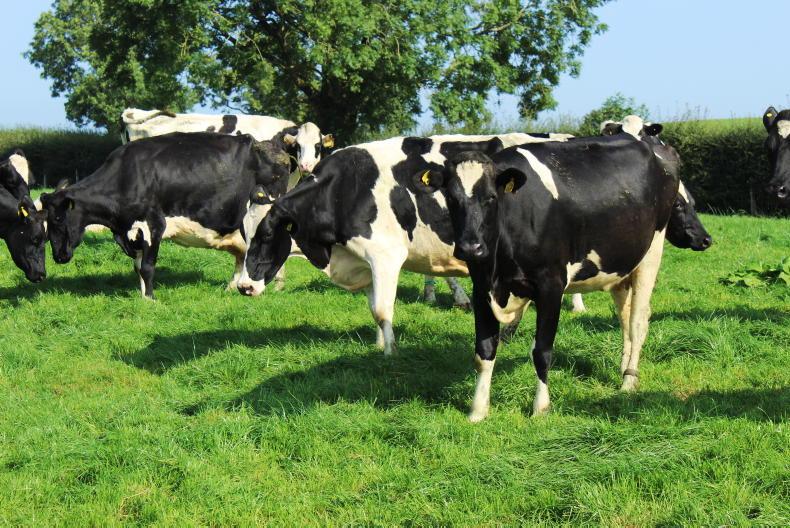
Rain has been falling steadily over the past week, albeit with some areas receiving more than others.
For the most part, it has halted the slippage in growth rates, with a lot of farmers reporting that the combination of the rain and nutrients getting back on to fields again is seeing paddocks green up and growth to rise slowly.
This recovery won’t be overnight, with good drying conditions often removing the moisture that has just fallen back out of the soil.
Recovery will be slow, and farmers should act slowly to remove any supplementation.
A lot of farmers I have been talking to have been grazing swards below 1,200kg DM/ha and reporting grazed paddocks or those mown out in the last few weeks to be slowest to recover.
This points to two things; firstly, that the average farm cover is low, and secondly that the wedge is likely not as much a wedge as normal and is likely flat in places.
Continuing supplementation for a number of days after rainfall, even past the point where growth is exceeding demand, would be recommended to allow the farm cover to build a little.
Remember, it is still very early in the summer and we are likely to see a pinch in growth again at some point.
It could happen that you are feeding silage one week and mowing surplus the next, but there are worse things that could happen.
Regarding a flat wedge, some farmers will employ a splitting of nutrient application instead of blanket spreading the whole farm to stagger when paddocks become fit for grazing. Paddocks can also begin to be grazed at 1,000-1,100kg DM/ha to ensure that some paddocks do not become over heavy.
Aidan Kenny – Cloghan, Co Offaly
Grass isn’t looking too pretty at the moment, with swards having been under moisture and nutrient stress. We stopped applying fertiliser during the dry period, but have gotten back out to paddocks again with the recent rainfall.
Half of the farm has received 20 units of protected urea, with the other half to receive it 10 days later to prevent paddocks becoming fit for grazing all at once.
We stopped pre-mowing during the drought, but may have to return to that again now to control quality. In ten days or two weeks’ time we might have a surplus of grass again, and some of the stemmier paddocks will be mowed and baled.
Stocking Rate (cows/ha) 3.33
Growth Rate (kg/day) 46
Average Farm Cover (kg/cow) 175
Yield (l/cow) 24.2
Fat % 4.11
Protein% 3.44
Milk Solids (kg/cow) 1.88
Concentrates 2
Donald Bateman – Ballylooby, Co Tipperary
We received 20mm of rain in the last week, and while the place is still green it is drying out as quick as the rain is falling. We are now on to grazing after grass covers of 800-900kg DM/ha, with the rotation at 19 days.
Ideally, we would leave these another few days and extend the rotation by three to four days.
I’m considering purchasing some grass for zero grazing to help build covers, as I would expect that we will see another dry spell during the summer.
Approximately 33% of the farm has received watery slurry in the past week, with a good percentage of the remainder receiving 15-16 units of chemical N.
Stocking Rate (cows/ha) 2.8
Growth Rate (kg/day) 38
Average Farm Cover (kg/cow) 165
Yield (l/cow) 23.7
Fat % 4.4
Protein% 3.77
Milk Solids (kg/cow) 1.9
Concentrates 3
David Brady – Stradone, Co Cavan
Growth has been improving, but the rainfall has been very localised. Our wedge is a bit misleading, as we have a lot of paddocks that were cut 26 days ago with covers of 1,100-1,200kg DM/ha to be grazed soon, and I know cows will fly through these.
Quality has been a big challenge, and we have been trying to control it through topping or mowing and baling paddocks, with two paddocks baled out this week.
Paddocks that have been cut or topped are receiving slurry, with grazed paddocks being spread with 16-17 units of protected urea. We didn’t really stop spreading fertiliser, bar maybe for one week, with all paddocks up-to-date now.
Stocking Rate (cows/ha) 3.07
Growth Rate (kg/day) 63
Average Farm Cover (kg/cow) 190
Yield (l/cow) 25
Fat % 4.13
Protein% 3.45
Milk Solids (kg/cow) 1.95
Concentrates 3.5




SHARING OPTIONS